
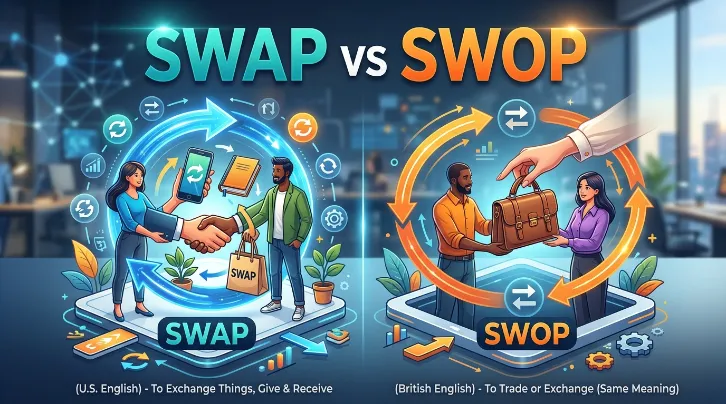
Choosing between swap vs swop seems simple until you notice both words appearing in books, websites, games, and everyday conversations. While they often refer to the same basic action, their usage is not identical. The difference mainly comes down to regional spelling, modern preference, and context.
Here’s the key point.
If you write for an international audience, especially in American English, swap is almost always the correct choice. If you’re reading older British texts or certain regional publications, you may occasionally see swop, but it has become much less common in modern writing.
Understanding this distinction helps you write more naturally, avoid unnecessary corrections, and match your audience’s expectations. Let’s break everything down in a simple way.
The Core Rule Explained Simply
The easiest rule is this:
- Swap is the standard spelling used almost everywhere today.
- Swop is an older alternative spelling, mainly associated with British English, but it is now uncommon.
Both words mean to exchange one thing for another.
The meaning stays the same.
Only the spelling changes.
Swap: The Modern Standard
Today, swap is accepted in both American English and modern British English.
It works as both a verb and a noun.
Examples:
- We decided to swap seats.
- Can we swap shifts tomorrow?
- They organized a book swap.
- Let’s swap phone numbers.
- She wants to swap her old bike for a new one.
You’ll find swap in newspapers, business writing, academic materials, software documentation, and everyday conversation.
Swop: The Older Alternative
Swop has exactly the same meaning as swap.
However, it appears mostly in:
- Older British publications
- Historical writing
- Some regional British speech
- Occasional literary works
Examples:
- They agreed to swap horses.
- The children swapped toys after school.
Although these sentences are correct in some contexts, modern editors usually replace swop with swap.
Side-by-Side Comparison Table
| Situation | Example | Meaning | Correct Usage |
| American English | We will swap cars. | Exchange | Swap |
| Modern British English | Let’s swap places. | Exchange | Swap |
| Older British Writing | They swapped books. | Exchange | Swop acceptable historically |
| Business Writing | We need to swap suppliers. | Exchange | Swap |
| Technology | Swap memory | Exchange or substitute | Swap |
| Gaming | Swap characters | Change positions | Swap |
| Academic Writing | Swap variables | Exchange | Swap |
| Historical Novel | They swapped hats. | Exchange | Context-dependent |
Deep Dive into Swap
When Should You Use Swap?
Use swap whenever you’re writing modern English.
This includes:
- Emails
- Essays
- Articles
- Websites
- Books
- Reports
- Marketing
- Social media
Readers immediately recognize swap because it is the dominant spelling worldwide.
Examples:
- Let’s swap offices.
- We should swap ideas.
- They swapped recipes.
- Can I swap my ticket?
- The teams swapped players.
Notice something.
Every sentence sounds perfectly natural.
Swap as a Verb
As a verb, swap means exchange.
Examples:
- We swapped gifts.
- She swapped shoes with her sister.
- I swapped my afternoon meeting.
Swap as a Noun
It also functions as a noun.
Examples:
- A clothing swap
- A seed swap
- A toy swap
- A cookie swap
Many community events use swap this way.
Quick Test
Ask yourself these questions:
- Am I writing modern English?
- Is my audience international?
- Is this professional writing?
- Would Microsoft Word expect this spelling?
If you answered yes, choose swap.
Common Patterns Using Swap
Some expressions appear constantly.
Examples include:
- Swap places
- Swap roles
- Swap seats
- Swap ideas
- Swap numbers
- Swap stories
- Swap files
- Swap passwords
- Swap images
- Swap accounts
These combinations are standard English.
Deep Dive into Swop
When Might You See Swop?
Although uncommon today, swap still appears in certain situations.
These include:
- Older British novels
- Historical newspapers
- Archived magazines
- Traditional dialect writing
- Vintage advertisements
If you encounter it while reading, don’t assume it’s incorrect.
Instead, recognize it as an older spelling.
Examples:
- They swopped cattle.
- We swapped addresses.
- She swapped hats with her cousin.
The meaning remains identical.
Why Has Swop Become Rare?
Language naturally changes.
Over time, one spelling usually becomes dominant.
For this word, swap gradually replaced swop in dictionaries, publishing, education, journalism, and digital communication.
Today, even many British writers choose swap.
Patterns Where Swop Still Appears
You may still notice swop in:
- Historical fiction
- Reprinted British texts
- Older educational books
- Vintage advertisements
- Personal writing by some British speakers
These uses reflect tradition rather than current standard practice.
Swap vs Swop; The Meaning Shift (or Nuance)
Here’s an important point.
There is no real meaning difference between swap and swop.
Both mean:
- Exchange
- Trade
- Switch
- Substitute one item for another
The only practical difference is spelling preference.
Compare these:
- We swapped bicycles.
- We swapped bicycles.
Both communicate the exact same idea.
The first simply sounds more modern.
Swap vs Swop; Why the Confusion Persists
Several reasons keep this question alive.
First, people encounter older British books.
Second, search engines still index pages using swop.
Third, family members may use different spellings based on age.
Fourth, some dictionaries still include both forms.
Finally, regional language habits survive for decades even after official standards shift.
As a result, learners wonder whether the words have different meanings.
They do not.
Formal vs Casual Contexts
Your audience matters.
Formal Writing
Choose swap.
Examples:
- Academic papers
- Business reports
- Research
- Government documents
- Technical manuals
Editors overwhelmingly expect swap.
Casual Writing
You should still use swap.
Examples:
- Text messages
- Emails
- Social media
- Blogs
- Group chats
Only if you’re intentionally writing in an older British style might swop fit naturally.
Case Studies / Pop Culture Examples
Look at everyday language.
Technology companies regularly use swap.
Examples include:
- Swap memory
- Swap files
- Swap screens
- Swap devices
- Swap accounts
Television shows frequently feature:
- Wife swap
- House swap
- Character swap
- Body swap
Community events advertise:
- Book swaps
- Plant swaps
- Toy swaps
- Recipe swaps
Financial experts discuss:
- Interest rate swaps
- Currency swaps
- Credit default swaps
Modern journalism consistently favors swap because it aligns with current language standards.
Even publishers in the UK overwhelmingly prefer this spelling today.
Swap vs Swop; Advanced Scenarios & Flowchart
Sometimes the decision feels uncertain.
Use this flowchart.
Is the word describing an exchange?
Yes
Are you writing modern English?
Yes
Use swap
No
Are you deliberately copying historical British style?
Yes
You may use swop
No
Use swap
Not describing an exchange?
Choose another word entirely.
Swap vs Swop; Quick Reference Table
| Use This | When |
| Swap | American English |
| Swap | Modern British English |
| Swap | Academic writing |
| Swap | Business writing |
| Swap | Websites |
| Swap | Technology |
| Swap | Journalism |
| Swop | Older British texts |
| Swop | Historical style only |
Swap vs Swop; Common Mistakes That Lower Quality
Even experienced writers sometimes make these errors.
Assuming They Have Different Meanings
They do not.
The meanings are identical.
Using Swop in Professional Writing
Modern readers expect swap.
Choosing swap may appear outdated.
Mixing Spellings
Don’t write:
- swap
- swopped
- swapping
- swop
Stay consistent.
Use one spelling system.
Believing British English Requires Swop
That was once more common.
Modern British English overwhelmingly uses swap.
Ignoring Audience Expectations
Always think about who will read your work.
International readers expect swap.
Memory Hacks That Actually Work
These tricks make the difference easy to remember.
Think About Modern English
Modern English equals swap.
That’s the easiest rule.
Remember Popular Phrases
Have you heard of these?
- Swap seats
- Swap ideas
- Swap cards
- Swap files
You rarely hear swop in today’s media.
Associate Technology with Swap
Computers use:
- Swap memory
- Swap space
- Swap file
Technology reinforces the modern spelling.
Think of Publishing Trends
Publishers choose consistency.
That consistency is almost always swapped.
Why Precision Matters (SEO/Authority)
Correct spelling affects credibility.
Readers quickly notice outdated or unusual word choices.
Using swap demonstrates awareness of current English conventions and aligns with what most dictionaries, style guides, and publishers recommend.
Search engines also tend to recognize the spelling that users search most frequently. While swop is still indexed, swap appears in far more articles, educational resources, and authoritative publications. Matching common usage improves readability and helps content meet reader expectations.
Professional communication benefits as well.
Whether you’re writing blog posts, emails, product descriptions, academic papers, or business reports, using swap reduces distractions. Readers stay focused on your message instead of questioning an uncommon spelling.
Precision also creates trust.
When every word follows modern standards, your writing appears polished, reliable, and suitable for a wider audience.
A Quick Quiz
Fill in the blanks with swap or swap.
- Let’s ______ phone numbers before we leave.
- Modern business writing almost always prefers ______.
- The old British novel used the spelling ______.
- We decided to ______ seats during the meeting.
- A community book ______ lets people exchange books.
- Most technology manuals use the word ______.
- Historical British texts may contain the spelling ______.
Conclusion
Understanding swap vs swop ultimately comes down to recognizing the difference between modern standard usage and historical or regional spelling. While both words carry the same meaning, which is to exchange one thing for another, modern English overwhelmingly favors swap. Whether you’re writing an email, creating website content, publishing an academic paper, or communicating in a professional setting, swap is the spelling your readers expect to see. Although swop remains a legitimate historical variant and may still appear in older British literature or archival materials, it is no longer the preferred choice in contemporary writing. Using the correct spelling helps your content appear polished, current, and trustworthy while reducing the chance of distracting or confusing your audience.
Precision matters more than many writers realize. Choosing swap instead of swop reflects an understanding of current language conventions and demonstrates attention to detail, qualities that strengthen your credibility as a writer. This is especially important in business communication, SEO content, educational resources, and technical documentation, where consistency builds reader confidence. If you’re reading historical texts, don’t be surprised when you encounter swop, because it represents an earlier stage of English rather than a different meaning. For nearly every modern writing situation, the decision is simple: choose swap, stay consistent throughout your document, and focus on delivering clear, natural, and professional English that meets today’s expectations.
Frequently Asked Questions
Is swop actually a real English word?
Yes, swop is a genuine English word. It is an older alternative spelling of swap, particularly associated with British English. However, it has become much less common over time. Modern dictionaries usually list it as a variant, but contemporary publications, schools, and style guides overwhelmingly recommend swap for almost every type of writing.
Which spelling is correct in American English, swap or swop?
In American English, swap is the only standard spelling. You will rarely, if ever, see swop in newspapers, academic writing, business documents, or everyday communication in the United States. If you’re writing for an American audience, always choose swap to match modern language expectations and avoid appearing outdated.
Do swap and swop have different meanings?
No, they have exactly the same meaning. Both words describe the act of exchanging one item, person, or idea for another. The distinction is based entirely on spelling preference rather than definition. In modern usage, swap has become the accepted standard, while swop survives mainly in historical or regional contexts.
Why do older British books use swop?
Many older British publications were written before swap became the dominant spelling. Language naturally evolves, and spelling preferences often change over time. As dictionaries, publishers, and educational institutions standardized modern English, swap gradually replaced swop. Reading older novels or newspapers may still expose you to the earlier spelling.
Should I ever use swop in modern writing?
In most cases, no. Unless you’re intentionally writing historical fiction, quoting an original source, or preserving an older British style, swap is the better choice. Modern readers are far more familiar with swap, making your writing clearer, more natural, and more aligned with current English conventions.
Is swap acceptable in British English today?
Absolutely. Modern British English strongly favors swap in newspapers, books, websites, educational materials, and professional communication. Although swop has historical roots in Britain, it is no longer the preferred spelling for everyday writing. Most British publishers and editors now use swap consistently.
How does using swap instead of swap help SEO?
Using swap aligns your content with the spelling that most people search for online. Search engines generally prioritize matching user intent, and swap is significantly more common in modern searches. While swap can still appear in search results, using swap improves readability, meets audience expectations, and supports stronger SEO performance.
Can swap be both a noun and a verb?
Yes. Swap functions naturally as both a verb and a noun. As a verb, it means to exchange something, such as “Let’s swap seats.” As a noun, it refers to an exchange itself, such as “The neighborhood hosted a clothing swap.” This flexibility contributes to its widespread use in modern English.
How can I easily remember the difference between swap and swap?
A simple memory trick is to associate swap with standard. Both words begin with the letter S, making it easy to remember that swap is the standard spelling used today. Think of technology terms like swap file or common expressions such as swap places, and you’ll naturally reinforce the modern form every time you encounter it.

Elliot Mason is a passionate English writer dedicated to making language learning clear, practical, and enjoyable. As an author at Grammar Alpha, he creates helpful content covering grammar, vocabulary, word meanings, sentence structure, common mistakes, and everyday English usage. His straightforward articles are designed for students, professionals, and English learners who want to communicate with greater confidence. Elliot believes that better English begins with understanding the basics, and his goal is to turn challenging language concepts into simple, useful lessons readers can apply every day.