
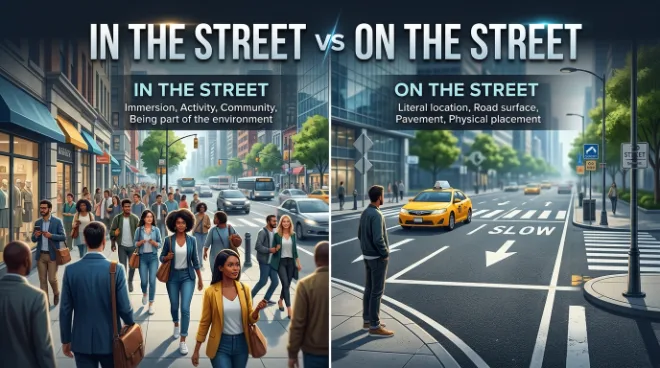
Understanding the difference between in the street vs on the street is essential if you want your English to sound natural and accurate. These two expressions look almost identical, but they do not always mean the same thing. The correct choice depends on where someone is, what they are doing, and whether you’re following British or American English conventions.
Many English learners mix these phrases because both involve a street. However, native speakers use them differently depending on context, location, and regional grammar. Choosing the wrong one can make a sentence sound awkward, even if people still understand your meaning.
Here’s the good news.
The rules are much simpler than they first appear. Once you understand the core distinction between in the street and on the street, you’ll rarely hesitate again.
The Core Rule Explained Simply
The easiest way to remember in the street vs on the street is this:
- In the street usually emphasizes being inside the roadway itself, especially in British English.
- On the street usually refers to being outdoors on a street, including sidewalks, and is the preferred form in American English for most situations.
Think of it like this.
If you’re talking about location within the road, “in” often fits better. If you’re simply describing someone’s general location along a street, “on” is usually the natural choice.
When to Use “In the Street”
In the street commonly describes someone or something physically within the roadway.
Examples:
- The children were playing in the street.
- There was broken glass in the street.
- A parade stopped traffic because hundreds of people stood in the street.
- Workers repaired a water pipe in the street.
British English uses this expression more frequently than American English.
When to Use “On the Street”
On the street generally refers to someone being outside along a street, whether on the sidewalk or in the general street area.
Examples:
- I saw her on the street yesterday.
- There are several restaurants on the street.
- We met on the street after work.
- Street musicians performed on the street.
American English strongly favors this expression for everyday conversation.
Side-by-Side Comparison Table
| Situation | Example | Meaning | Correct Usage |
| Children playing in the roadway | Kids are playing ___ the street. | Inside the road | In the street |
| Walking downtown | I saw him ___ the street. | Along a public street | On the street |
| Buildings facing a road | Many shops are ___ this street. | Located along the road | On the street |
| Debris lying in traffic | Glass is scattered ___ the street. | Within the roadway | In the street |
| Meeting someone outdoors | We met ___ the street. | Public outdoor location | On the street |
| Cars blocking traffic | Protesters stood ___ the street. | Occupying the road | In the street |
Deep Dive into Category 1
When to Use In the Street
Use in the street when the focus is on the roadway itself rather than the surrounding area.
Imagine looking from above.
The person or object is actually occupying the space where vehicles normally travel.
Examples include:
- A dog ran in the street.
- Snow covered the entire street, leaving piles in the street.
- Children shouldn’t play in the street.
- Floodwater filled the street, leaving cars stranded in the street.
Notice something.
Every example highlights something physically inside the roadway.
Common Patterns
You’ll often see in the street with:
- Playing
- Standing
- Running
- Lying
- Falling
- Dancing
- Blocking traffic
- Flooding
Examples:
- People danced in the street after the victory.
- Leaves gathered in the street.
- Protesters remained in the street for hours.
- Construction equipment stayed in the street overnight.
Quick Test
Ask yourself these questions:
- Is the object actually inside the roadway?
- Would vehicles normally travel where it is?
- Is the emphasis on occupying the road itself?
If you answered yes, in the street is likely correct.
Deep Dive into Category 2
When to Use On the Street
The street is much broader.
It usually means somewhere along a street, not necessarily standing in the traffic lane.
Examples:
- We met on the street.
- I found a wallet on the street.
- They sell artwork on the street.
- She lives on the street behind the library.
American English especially prefers this wording.
Common Patterns
You’ll frequently hear:
- Walking on the street
- Living on the street
- Shopping on the street
- Performing on the street
- Meeting on the street
- Working on the street
Examples:
- Street vendors worked on the street all day.
- Tourists gathered on the street.
- We bumped into each other on the street.
- The parade attracted thousands on the street.
Quick Checklist
Choose on the street if:
- You’re describing a general outdoor location.
- You’re talking about sidewalks or nearby public spaces.
- You’re using American English.
- The exact position within the roadway isn’t important.
The Meaning Shift
The difference between in the street vs on the street is often subtle.
Compare these examples:
The children are in the street.
This suggests they’re in the roadway, possibly creating a safety concern.
The children are on the street.
This simply indicates they’re outside on the street. They may be walking, standing on the sidewalk, or somewhere nearby.
Another comparison:
- There is water in the street.
- There is a festival on the street.
The first emphasizes physical placement within the roadway.
The second refers to the overall location of the event.
Small prepositions can create surprisingly different mental images.
Why the Confusion Persists
Several factors cause confusion.
First, many languages use a single preposition for both ideas. Learners naturally transfer those patterns into English.
Second, British English and American English prefer different expressions. Someone learning from both varieties may encounter conflicting examples.
Third, English prepositions rarely translate directly. Instead, they reflect historical usage, idiomatic patterns, and regional habits.
Finally, native speakers sometimes use both expressions depending on emphasis, making the distinction seem inconsistent.
Fortunately, the underlying logic remains fairly stable.
Formal vs Casual Contexts
Both expressions appear in formal and informal English.
However, their frequency changes depending on the audience.
Formal Writing
Formal writing often prefers precision.
Examples:
- Flooding occurred in the street.
- Demonstrators gathered in the street.
- Businesses located on the street reported increased traffic.
Academic writing usually selects whichever expression matches the physical situation.
Casual Conversation
Daily conversation is more flexible.
American speakers commonly say:
- I saw him on the street.
- We met on the street.
- There were musicians on the street.
British speakers may naturally say:
- Children were playing in the street.
- There was snow in the street.
Regional preference matters.
Case Studies / Pop Culture Examples
Street celebrations provide excellent examples.
After major sporting victories, newspapers often report:
“Thousands danced in the street.”
The emphasis is that crowds filled the roadway.
Movies frequently include dialogue like:
“I saw her on the street yesterday.”
The focus isn’t traffic lanes. It’s simply an outdoor encounter.
Travel guides often write:
- Restaurants on the street
- Cafes on the street
- Markets on the street
Again, the emphasis is location along the street rather than inside the road.
Emergency reports frequently say:
- Oil spilled in the street.
- Water collected in the street.
- A tree fell in the street.
These examples highlight the roadway itself.
Advanced Scenarios & Flowchart
Sometimes the correct choice depends on what you’re emphasizing.
Follow this guide:
Is someone or something physically occupying the roadway?
Yes
Use in the street
Example: Protesters stood in the street.
No
Are you describing someone’s general outdoor location?
Yes
Use on the street
Example: I met him on the street.
No
Are you talking about businesses or buildings facing the road?
Yes
Use on the street
No
Is your emphasis specifically on objects inside the roadway?
Yes
Use in the street
Quick Reference Table
| Use This | Best Situation |
| In the street | Inside the roadway |
| On the street | General outdoor location |
| In the street | Traffic lane emphasis |
| On the street | Sidewalks or along the road |
| In the street | British descriptions of road activity |
| On the street | Everyday American English |
Common Mistakes That Lower Quality
Many advanced learners still make these mistakes.
Using “on the street” for objects inside the roadway.
Incorrect:
The broken pipe is on the street.
Better:
The broken pipe is in the street.
Using “in the street” for every outdoor encounter.
Incorrect:
I met my teacher in the street.
Better:
I met my teacher on the street.
Ignoring regional English.
American English is usually favoured on the street.
British English more frequently accepts in the street, especially when discussing activities happening within the roadway.
Thinking the two phrases are always interchangeable.
Sometimes they overlap, but many situations clearly favor one expression.
Memory Hacks That Actually Work
Here’s an easy trick.
Think about traffic.
If a car could drive through the exact spot you’re describing, choose in the street.
Think about location.
If you’re simply saying someone is outside along a street, choose on the street.
Another memory aid:
In = Inside the roadway.
On = On the street as a place.
Visualizing the scene makes the decision much easier.
Practice with everyday examples until the pattern becomes automatic.
Why Precision Matters (SEO/Authority)
Using the correct preposition improves more than grammar.
It makes your writing sound polished, professional, and trustworthy.
Readers subconsciously notice awkward prepositions. Even when they cannot explain why something sounds strange, incorrect usage can reduce confidence in your writing.
This matters for:
- Business communication
- Academic writing
- SEO content
- Journalism
- Marketing
- Professional emails
- Books and articles
Search engines increasingly reward content that demonstrates clarity, authority, and natural language usage. Correct grammar contributes to a better reading experience, longer engagement, and stronger credibility.
For English learners, mastering small distinctions like in the street vs on the street helps your writing resemble that of fluent native speakers. Small improvements accumulate into significantly stronger communication.
A Quick Quiz
Fill in the blanks using the street or on the street.
- The children shouldn’t play ________.
- I met an old friend ________ yesterday.
- Broken glass lay ________ after the accident.
- Several cafés are located ________ near the station.
- Protesters gathered ________ for hours.
- We saw musicians performing ________ downtown.
- Water collected ________ after the heavy rain.
Answers
- in the street
- on the street
- in the street
- on the street
- in the street
- on the street
- in the street
Conclusion
Understanding the difference between in the street vs on the street is much easier once you focus on the image each phrase creates. The street usually places a person or object within the roadway itself, making it the natural choice when discussing traffic, hazards, celebrations, or anything occupying the road. On the street, on the other hand, generally describes a broader outdoor location and is especially common in American English when referring to meeting someone, walking, shopping, or simply being outside along a street. Although both expressions relate to the same place, they emphasize different perspectives, and recognizing that distinction will instantly improve the clarity and naturalness of your writing.
Small grammatical choices often have a surprisingly large impact on how professional your English sounds. Whether you’re writing blog posts, academic papers, business emails, travel guides, or everyday messages, choosing the correct preposition helps readers understand your meaning without hesitation. It also demonstrates a stronger command of English usage, which builds credibility and authority. The best way to master the street vs on the street is through regular exposure and practice. Read authentic English, pay attention to how native speakers use these expressions, and test yourself with real-life examples. Over time, selecting the correct phrase will become automatic, allowing you to communicate more confidently and accurately in any context.
Frequently Asked Questions
Is in the street grammatically correct?
Yes, in the street is completely grammatically correct. It is commonly used when referring to something physically located within the roadway or when emphasizing that a person or object occupies the part of the street where vehicles normally travel. It is also more common in British English than in American English, particularly when describing children playing, people protesting, or objects blocking traffic.
Is on the street more common in American English?
Yes, on the street is generally the preferred expression in American English for describing someone or something located along a street. Americans often use it whether the person is walking on the sidewalk, standing outside, or simply present in the general street area. It sounds more natural in everyday conversation and appears frequently in journalism, fiction, and spoken English.
Can in the street and on the street ever mean the same thing?
Sometimes they can overlap, especially when the exact physical position is not important. For example, both phrases might be understood if someone says they saw a performer outside. However, each expression creates a slightly different mental image. In the street focuses on the roadway itself, while on the street refers more generally to being outdoors along the street.
Which phrase should English learners use most often?
If you are learning American English, on the street is usually the safer everyday choice because it fits many common situations. If you are learning British English, you should also become comfortable in the street, particularly when discussing activities or objects located within the roadway. Learning both expressions will help you understand native speakers from different regions.
Why do native speakers sometimes use different prepositions?
English prepositions are influenced by history, regional preferences, and idiomatic usage rather than strict logical rules. British and American English have developed slightly different habits over time, which explains why both in the street and on the street remain correct in different contexts. Paying attention to context is more important than trying to memorize one universal rule.
Should I use in the street when talking about buildings?
Generally, no. When referring to houses, stores, restaurants, or offices located along a road, on the street is the natural expression. For example, “There are several cafés on the street” sounds correct because the buildings are situated along the street rather than inside the roadway itself.
Does choosing the wrong phrase change the meaning?
In many situations, people will still understand what you mean. However, using the less appropriate expression can create an unintended image or make your English sound slightly unnatural. For instance, saying children are in the street suggests they are actually in the roadway, while on the street simply indicates they are outside somewhere along the street.
How can I remember the difference quickly?
A simple memory trick is to think about traffic. If a vehicle could drive through the exact location you are describing, in the street is often the better choice. If you are simply describing someone’s location outdoors or along the road, on the street is usually correct. This visualization helps make the distinction easier to remember.
Are these expressions used in formal writing?
Yes, both expressions appear in formal writing, journalism, academic texts, and professional communication. The key is choosing the phrase that accurately reflects the intended meaning. Writers should focus on precision rather than assuming the expressions are interchangeable, since accurate preposition choice improves readability and strengthens credibility.
How can I master in the street vs on the street permanently?
The best approach is consistent exposure and practice. Read newspapers, novels, blogs, and professional articles while paying attention to how native writers use each phrase. Create your own example sentences, complete grammar exercises, and notice the context whenever you hear these expressions in movies or conversations. Over time, repeated exposure will make the correct choice feel natural instead of something you have to consciously remember.

Ethan Walker is a passionate English writer dedicated to making English grammar, vocabulary, and writing skills simple, practical, and engaging. At Grammar Alpha, he creates clear content covering grammar rules, word meanings, sentence structure, common English mistakes, punctuation, and everyday English usage. His articles help students, professionals, and English learners improve their communication skills and write with confidence. Ethan believes learning starts with clarity, and his goal is to turn complex language topics into lessons readers can understand and apply.