
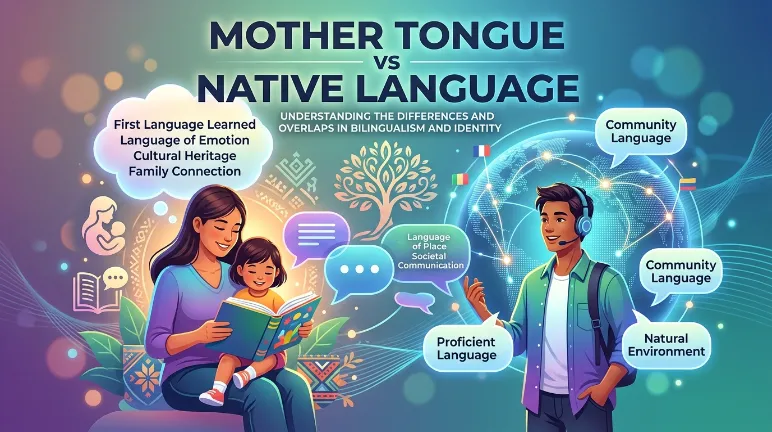
People often use their mother tongue and native language as if they mean exactly the same thing. In many everyday conversations, that works just fine. However, in linguistics, education, immigration, and cultural discussions, the two terms can carry slightly different meanings.
Understanding the difference between mother tongue vs native language helps you communicate more accurately. It also prevents confusion when filling out official forms, writing academic papers, or discussing language learning. While the overlap is significant, the context often determines which expression fits better.
Here’s the key idea.
A mother tongue usually refers to the first language learned from parents or caregivers during childhood, especially in a cultural or family setting. A native language often refers to the language a person naturally acquired from birth and speaks with native proficiency. In many cases, they are the same language, but not always.
Let’s explore why.
The Core Rule Explained Simply
The easiest way to remember the difference is this:
- Mother tongue focuses more on family origin, childhood, and cultural identity.
- Native language focuses more on natural language acquisition and proficiency.
For many people, both expressions point to the exact same language.
For others, especially multilingual individuals, adopted children, immigrants, or people raised in bilingual homes, the distinction becomes much more meaningful.
Mother Tongue
A mother tongue is traditionally the first language learned from one’s parents or immediate family. The phrase emphasizes heritage, upbringing, and cultural roots rather than current ability.
Examples:
- My mother tongue is Punjabi.
- She teaches children in their mother tongue.
- They celebrate literature written in their mother tongue.
Notice that the emphasis stays on identity and early childhood.
Native Language
A native language refers to the language someone acquired naturally during their earliest years and usually speaks intuitively.
Examples:
- English is his native language.
- She speaks French at a native language level.
- Native language speakers recognize subtle expressions instantly.
Here, the focus is more on natural fluency than cultural heritage.
Side-by-Side Comparison Table
| Situation | Mother Tongue | Native Language | Correct Usage |
| Family heritage | First language learned from family | Usually the same, but not always | Mother tongue |
| Natural acquisition | Possible | Primary meaning | Native language |
| Cultural identity | Strong emphasis | Less emphasis | Mother tongue |
| Linguistics research | Used sometimes | More common | Native language |
| School language policy | Frequently used | Also acceptable | Depends on region |
| Immigration forms | Sometimes requested | More commonly requested | Follow the form wording |
| Language proficiency | Not always current | Usually implied | Native language |
| Heritage discussions | Best choice | Possible | Mother tongue |
| Bilingual childhood | May refer to family language | May refer to both acquired languages | Context matters |
| Academic writing | Common internationally | Preferred in linguistics | Depends on audience |
Deep Dive into Mother Tongue
The phrase mother tongue has existed for centuries. It originally referred to the language children learned from their mothers or primary caregivers.
Today, the expression represents much more than vocabulary.
It often symbolizes family history, tradition, identity, and cultural belonging.
When to Use Mother Tongue
Use mother tongue when discussing:
- Family background
- Cultural traditions
- Heritage preservation
- Indigenous languages
- Primary childhood language
- Language education policies
Examples:
- Students learn best in their mother tongue during early education.
- She writes poetry in her mother tongue.
- Many families preserve their mother tongue across generations.
- His mother tongue connects him to his grandparents.
The phrase naturally emphasizes emotional and cultural connections.
Examples of Mother Tongue in Context
Example 1:
“My mother tongue is Urdu, but I mostly speak English at work.”
Example 2:
“The community wants schools to support education in children’s mother tongues.”
Example 3:
“Although she rarely speaks it today, Spanish remains her mother tongue.”
These examples show that a mother tongue may remain part of someone’s identity even if it is no longer their strongest language.
Quick Test
Ask yourself these questions:
- Is the discussion about family heritage?
- Is cultural identity the main focus?
- Are childhood language experiences being discussed?
- Is preserving traditional language important?
If most answers are yes, choose mother tongue.
Deep Dive into Native Language
The expression native language centers on how a language was acquired naturally during early childhood.
Unlike mother tongue, this term often appears in linguistics, psychology, language teaching, translation, and international communication.
Researchers frequently discuss:
- Native language acquisition
- Native language interference
- Native language speakers
- Native language competence
The emphasis is typically on language ability rather than family history.
When to Use Native Language
Choose native language when discussing:
- Language proficiency
- Linguistic research
- Translation
- Speech development
- Accent studies
- Language testing
Examples:
- She translates into her native language.
- Native language speakers detect subtle pronunciation differences.
- Children develop their native language naturally.
- He has native language fluency in Japanese.
These examples focus on linguistic competence.
Patterns You’ll Notice
Native language frequently appears alongside words like:
- Speaker
- Fluency
- Acquisition
- Competence
- Pronunciation
- Grammar
- Translation
- Linguistics
Examples:
- Native language speaker
- Native language acquisition
- Native language skills
- Native language proficiency
These combinations are especially common in academic writing.
Mother Tongue vs Native Language; The Meaning Shift
This is where things become interesting.
Most people have one language that is both their mother tongue and their native language.
However, modern life creates many exceptions.
Consider these situations.
A child is born in Germany to Korean parents.
The parents speak Korean at home.
The child attends German schools from age two.
As an adult, the child speaks German far more fluently than Korean.
Questions naturally arise.
Is Korean the mother tongue because it came from the family?
Is German the native language because it became the person’s naturally acquired dominant language?
Different institutions may answer differently.
Similarly, an adopted child may have one birth language but another language acquired during infancy.
Bilingual households also complicate the distinction because children may naturally acquire two native languages simultaneously.
That is why experts sometimes avoid rigid definitions.
Why the Confusion Persists
Several factors keep these expressions confusing.
First, dictionaries often define each term using the other.
Second, different countries prefer different terminology.
Third, educational systems sometimes treat them as perfect synonyms.
Fourth, globalization has increased multilingual childhoods.
Finally, identity and language do not always develop together.
Someone may emotionally identify with one language while using another every day.
Because language experiences vary widely, definitions continue evolving.
The important point is recognizing the context rather than memorizing one rigid rule.
Mother Tongue vs Native Language; Formal vs Casual Contexts
Context changes everything.
Casual Conversations
Friends usually understand either phrase.
Examples:
- My mother tongue is Arabic.
- My native language is Arabic.
Very little meaning changes.
Academic Writing
Researchers often prefer native language when discussing acquisition, cognition, and linguistics.
Examples:
- Native language acquisition influences pronunciation.
- Native language interference affects second-language learning.
Cultural Discussions
Here, mother tongue often sounds more appropriate.
Examples:
- Protecting children’s mother tongues.
- Literature written in one’s mother tongue.
- Celebrating mother tongue education.
Government Documents
Some forms ask for native language.
Others ask for their mother tongue.
Always answer according to the form’s intended meaning.
If unsure, check the provided definition instead of assuming both terms are interchangeable.
Case Studies / Pop Culture Examples
Case Study 1, International Students
An international student from India speaks Hindi at home and English throughout university.
Their mother tongue may be Hindi.
Their strongest academic language may be English.
Depending on the institution, both facts matter.
Case Study 2, Bilingual Families
Children growing up with Spanish and English from birth may have two native languages.
Many linguists accept simultaneous native language acquisition.
The family may also describe both as the children’s mother tongues.
Case Study 3, Heritage Speakers
Many heritage speakers understand a family language but rarely use it.
For example:
- Understands Vietnamese.
- Speaks English daily.
- Identifies culturally with Vietnamese.
Their mother tongue remains closely connected to family heritage, even if English becomes their dominant language.
Case Study 4, Translation Industry
Professional translators are frequently encouraged to translate into their native language because it usually produces the most natural writing.
Here, native proficiency is more important than family background.
Advanced Scenarios & Flowchart
Use this simple decision guide.
Start
Are you discussing family heritage or cultural identity?
Yes
Use mother tongue
No
Are you discussing language acquisition or fluency?
Yes
Use native language
No
Is this everyday conversation?
Yes
Either expression usually works.
No
Follow the terminology preferred by the organization or academic field.
Mother Tongue vs Native Language; Quick Reference Table
| If You Mean… | Best Choice |
| Family language | Mother tongue |
| Cultural heritage | Mother tongue |
| Childhood identity | Mother tongue |
| Natural acquisition | Native language |
| Language proficiency | Native language |
| Linguistics | Native language |
| Heritage preservation | Mother tongue |
| Everyday conversation | Either, depending on context |
| Immigration paperwork | Follow the document |
| Academic research | Usually native language |
Mother Tongue vs Native Language; Common Mistakes That Lower Quality
Even experienced writers make these errors.
Mistake 1: Assuming both expressions always mean exactly the same thing.
Sometimes they do.
Sometimes they do not.
Always consider context.
Mistake 2: Ignoring bilingual childhoods.
Many children naturally acquire multiple languages from birth.
Their language identity cannot always be reduced to one label.
Mistake 3: Equating heritage with proficiency.
Someone’s mother tongue may no longer be the language they speak best.
Mistake 4: Using whichever phrase sounds more familiar.
Professional writing benefits from selecting the expression that best matches the discussion.
Mistake 5: Treating official forms casually.
Some organizations define the terms differently.
Read the instructions carefully.
Memory Hacks That Actually Work
Try these practical tricks.
Think “Mother = Family.”
If the conversation centers on family, culture, or heritage, choose your mother tongue.
Think “Native = Natural.”
If the discussion centers on natural acquisition or fluency, choose native language.
Remember the audience.
Academic readers often expect native language.
Cultural discussions frequently favor mother tongues.
Visual association works.
Picture a family tree for your mother tongue.
Picture a child naturally learning speech for native language.
Simple images make the distinction easier to remember.
Why Precision Matters (SEO/Authority)
Using the correct terminology improves credibility.
Readers notice when writers understand subtle distinctions instead of treating every related term as identical.
For educators, translators, journalists, researchers, and content creators, choosing between mother tongue and native language demonstrates careful thinking and professional accuracy.
Search engines also reward content that clearly explains nuanced topics. Articles that distinguish closely related terms answer user intent more effectively, improve reader engagement, and reduce ambiguity. Whether you are writing educational content, preparing research, or optimizing a website, precise language builds authority, trust, and long-term value. A small wording choice can significantly improve clarity, making your content more useful for both human readers and search algorithms.
A Quick Quiz
Fill in the blanks with your mother tongue or native language.
- She writes novels in her __________ because it reflects her cultural heritage.
- Linguists study how children acquire their __________ during early childhood.
- The school encourages students to preserve their __________ through community programs.
- Professional translators usually translate into their __________ for the most natural results.
- Although he now speaks English every day, Punjabi remains his __________.
- Researchers examined how a child’s __________ influences pronunciation when learning a second language.
- Many bilingual children grow up with two __________ from birth.
- The museum organized an exhibition celebrating literature written in visitors’ __________.
Conclusion
Understanding mother tongue vs native language is less about memorizing strict definitions and more about recognizing the context in which each term is used. In everyday conversation, people often treat the two expressions as interchangeable because, for many individuals, their first language learned at home is also the language they naturally speak with native proficiency. However, modern multilingual societies have introduced many situations where the distinction matters. Children raised in bilingual homes, immigrants, adopted individuals, and heritage language speakers may have experiences that blur the traditional definitions. In these cases, mother tongue often highlights cultural identity and family heritage, while native language emphasizes natural language acquisition and linguistic competence. Choosing the right expression allows you to communicate with greater precision, whether you’re writing an academic paper, completing official documents, or discussing personal language history.
The best approach is to think about what you are trying to emphasize. If your focus is on roots, traditions, family, or cultural identity, mother tongue is usually the better choice. If you’re discussing language learning, fluency, pronunciation, translation, or linguistic research, native language is often more appropriate. Neither phrase is universally “more correct” than the other because each serves a slightly different purpose. By understanding these subtle differences, you can avoid common misunderstandings, improve the clarity of your writing, and demonstrate stronger command of English. Ultimately, mastering the distinction between mother tongue and native language is another step toward becoming a more confident, credible, and precise communicator in both personal and professional settings.
Frequently Asked Questions
Is there a real difference between mother tongue and native language?
Yes, although the difference is often subtle. Mother tongue generally emphasizes a person’s family background, cultural heritage, and first language learned at home, while native language focuses more on the language naturally acquired during early childhood and spoken with native-level competence. For many people, both expressions refer to the same language, but multilingual or multicultural experiences can create situations where the meanings differ slightly.
Can a person have more than one native language?
Absolutely. Many linguists recognize that children who are exposed to two or more languages from birth can develop multiple native languages simultaneously. These children naturally acquire each language without formal instruction, making all of them native languages. This is common in bilingual families where parents consistently use different languages during early childhood.
Can your mother tongue change over time?
Generally, your mother tongue does not change, because it refers to the language you first learned through your family or caregivers. However, your strongest or most frequently used language can change. Someone may eventually become more fluent in another language due to education, work, or immigration while still considering their original family language to be their mother tongue.
Why do official forms sometimes ask for your native language instead of your mother tongue?
Government agencies, universities, and employers often prefer native language because it can relate to communication ability, language support, or educational needs. Other organizations use mother tongue because they are collecting information about cultural or linguistic heritage. The intended meaning depends on the organization, so it’s always helpful to read any definitions or instructions provided on the form.
Which term is more appropriate in academic writing?
In most linguistics, psychology, language acquisition, and translation research, native language is generally the preferred term because it focuses on language development and proficiency. However, education, sociology, and cultural studies may use mother tongue, particularly when discussing heritage languages, identity, or language preservation. The preferred term often depends on the academic discipline.
Is mother tongue considered outdated?
No. Mother tongue remains a widely accepted and respected term around the world. It appears in educational policies, cultural discussions, and international organizations that promote multilingual education. While some researchers prefer native language for technical precision, mother tongue continues to be appropriate when referring to cultural identity, family language, and heritage.
How should bilingual people describe their language background?
The answer depends on their personal experience. Someone raised with two languages from birth may accurately describe both as their native languages. They may also consider both to be their mother tongues if each language played an important role in family life and cultural identity. There is no single universal rule, and individual experiences vary significantly.
Does speaking a language fluently make it your native language?
Not necessarily. A person can achieve near-native or even native-like fluency in a language learned later in life, but that does not automatically make it their native language. Native language usually refers to a language acquired naturally during early childhood rather than one mastered through later education or immersion, regardless of proficiency.
Which term is better for SEO content and educational articles?
For SEO and educational writing, using both terms naturally is often the most effective strategy because readers search for each phrase. Clearly explaining the relationship between mother tongue and native language, instead of treating them as exact synonyms, better satisfies search intent and improves topical authority. Just ensure each term is used accurately according to the context being discussed.

Daniel Carter is a passionate English writer dedicated to making language learning simple, practical, and engaging. At Grammar Alpha, he shares clear and reliable insights on grammar, vocabulary, word meanings, sentence structure, and everyday English usage. His easy-to-follow articles help students, professionals, and language learners strengthen their writing and communication skills. With a strong focus on clarity and accuracy, Daniel turns complex English concepts into useful lessons, empowering readers to write with confidence, speak naturally, and use English effectively every day.