
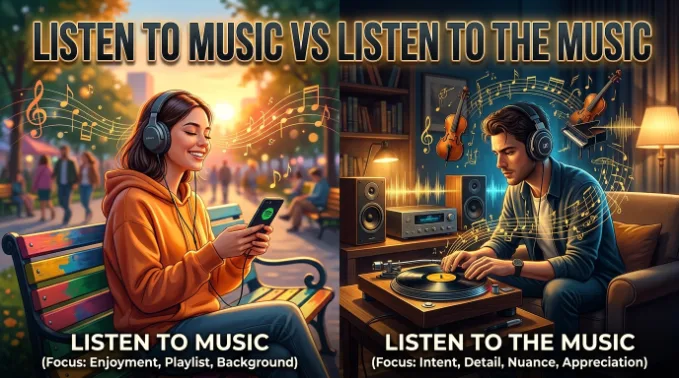
Have you ever wondered why English speakers sometimes say “listen to music” and other times say “listen to the music”? Both phrases sound correct, but using the wrong one can change what you mean.
Listen to Music vs Listen to the Music is all about one small word that makes a big difference. While one phrase describes enjoying music in general, the other refers to a particular song, track, or performance. By understanding this simple grammar rule, you’ll know exactly which phrase to use and feel more confident speaking and writing English naturally.
The Main Rule Behind Listen to Music vs Listen to the Music
The basic rule is straightforward:
Use “listen to music” when you mean music as a general hobby, activity, or concept.
Use “listen to the music” when you mean a specific piece of music that is already known, identified, or obvious from the situation.
Think of it this way:
No “the” = music as a general idea.
With “the” = a specific music selection.
For example:
- I love to listen to music while studying.
- Please listen to the music playing in the background.
In the first sentence, music is a general activity. The speaker does not mean one particular song.
In the second sentence, the speaker refers to a specific sound that the listener can identify.
The difference is not about the action of listening. The action stays the same. The difference comes from the scope and focus of the noun.
Listen to Music: Meaning and General Usage
“Listen to music” describes the habit or activity of enjoying musical sounds.
It does not focus on one song, album, artist, or performance. Instead, it talks about music as a broad category.
Examples:
- I usually listen to music after work.
- Many people listen to music to relax.
- She enjoys listening to music during exercise.
- They spend hours listening to music online.
In these examples, the speaker is discussing a regular behavior or personal preference.
The listener does not need to know which music is being played.
Listen to the Music: Meaning and Specific Usage
“Listen to the music” refers to a particular piece of music.
The listener can identify what music the speaker means because it has already been mentioned, is currently playing, or is clear from the context.
Examples:
- Listen to the music in this movie scene.
- Can you listen to the music coming from the next room?
- Everyone stopped talking to listen to the music.
- I want you to listen to the music I created.
Here, the music is not a general idea. It is a specific sound or composition.
Side-by-Side Comparison Table
| Situation | Example | Meaning | Correct Usage |
| General hobby | I like to listen to music. | Enjoying music as an activity | Listen to music |
| Daily routine | He listens to music while driving. | A regular habit involving music | Listen to music |
| Specific song | Listen to the music I sent you. | A particular track | Listen to the music |
| Background sound | Listen to the music coming from upstairs. | Identifiable music nearby | Listen to the music |
| Personal preference | She loves listening to music. | Music in general | Listen to music |
| Event or performance | We listened to the music at the concert. | Specific concert music | Listen to the music |
Understanding When to Use Listen to Music
The phrase “listen to music” is one of the most common expressions in English. It describes the general experience of hearing and enjoying music.
When you remove “the,” you make music an uncountable concept. You are not talking about individual songs. You are talking about music as a form of entertainment, art, or relaxation.
This pattern appears frequently with hobbies and routines.
Examples:
- I listen to music every morning.
- My brother listens to music while working.
- Students often listen to music when they study.
- People listen to music for emotional support.
In each sentence, music represents a broad category.
Let’s make this concrete.
Imagine someone asks:
“What do you do in your free time?”
A natural answer would be:
“I like to listen to music.”
You would not normally say:
“I like to listen to music.”
Why?
Because you are not referring to a specific song. You are describing an interest.
When to Use “Listen to Music”
Use “listen to music” in these situations:
1. Talking about habits
Examples:
- I usually listen to music before sleeping.
- She listens to music during her morning walk.
The phrase describes repeated actions.
2. Discussing preferences
Examples:
- Do you listen to music often?
- I do not listen to music very much.
The topic is your relationship with music generally.
3. Talking about purposes
Examples:
- I listen to music to reduce stress.
- He listens to music to improve his mood.
The focus is the reason for listening.
4. Discussing technology or trends
Examples:
- People now listen to music through streaming platforms.
- Teenagers often listen to music on their phones.
The subject is the overall activity.
Quick Test for “Listen to Music”
Ask yourself these questions:
Are you talking about music as a hobby?
If yes, use listening to music.
Are you talking about your general taste?
If yes, use listening to music.
Could you replace “music” with “songs in general”?
If yes, use listen to music.
Quick examples:
✅ I love to listen to music.
✅ She spends hours listening to music.
❌ I love to listen to the music. (unless a specific music piece is meant)
Understanding When to Use Listen to the Music
The phrase “listen to the music” has a narrower meaning. The article “the” tells the listener that the music is specific.
The listener should be able to answer:
“Which music?”
If the answer is clear, “the music” is appropriate.
Examples:
- Listen to the music from that restaurant.
- Did you hear the music in the opening scene?
- Please listen to the music I composed.
In these sentences, the speaker identifies a particular musical sound.
Here’s the pattern:
The + specific noun = a known or identifiable thing.
This rule applies beyond music.
Compare:
- I like reading books.
- I like reading the books you gave me.
The first example means books generally.
The second example means specific books.
The same logic applies:
- I enjoy listening to music.
- I enjoy listening to the music you recommended.
When to Use “Listen to the Music”
Use “listen to the music” when:
1. The music was already mentioned
Example:
- I downloaded a new album yesterday. Listen to the music.
The listener knows what music is being discussed.
2. The music is physically present
Example:
- Listen to the music coming from the street.
The sound can be identified.
3. You are pointing out a specific feature
Example:
- Listen to the music in this advertisement.
The speaker wants attention directed toward a specific musical element.
4. You are talking about a performance
Example:
- The audience listened to the music carefully.
The music refers to the performance being presented.
Quick Test for “Listen to the Music”
Ask:
Can the listener identify exactly which music you mean?
If yes, use the music.
Ask:
Is the music currently playing or previously mentioned?
If yes, use the music.
Ask:
Would pointing at the music make sense?
If yes, use the music.
Examples:
Listen to the music I made yesterday.
Listen to the music coming from the speaker.
Everyone listened to the music during the show.
The Meaning Shift Between the Two
The difference between “listen to music” and “listen to the music” is small in appearance but large in meaning.
The phrase without “the” creates a broad idea. It focuses on the activity itself.
The phrase with “the” creates a specific reference. It directs attention toward one identifiable musical source.
Compare these sentences:
I listen to music when I work.
This means music is part of the speaker’s routine.
I listen to the music when I work.
This suggests the speaker is referring to particular music, such as a previously mentioned playlist or a specific recording.
The addition of “the” changes the listener’s expectation.
Without the article, the listener thinks:
“What kind of activity?”
With the article, the listener thinks:
“Which music?”
That is the main difference.
Why People Confuse Listen to Music vs Listen to the Music
The confusion between “listen to music” and “listen to the music” exists because many languages do not use articles in the same way English does.
In some languages, speakers can mention a noun without deciding whether it is general or specific. English often requires this extra decision.
The challenge is not the verb “listen.” The challenge is understanding how articles change meaning.
Many learners memorize vocabulary but do not study the relationship between nouns and articles. As a result, they may know the words but still choose the wrong expression.
Here’s the core problem:
English speakers constantly decide whether something is a general concept or a specific item.
For example:
- I like listening to music.
- I like listening to the music from this movie.
The first sentence describes a broad interest.
The second sentence identifies a particular source.
Another reason confusion continues is that native speakers sometimes use both phrases in similar situations. Context decides the meaning.
Consider:
- I went outside to listen to music.
- I went outside to listen to the music.
The first sentence means the person wanted to enjoy music generally.
The second suggests there was specific music outside, perhaps from a concert, event, or nearby speaker.
Understanding this difference requires focusing on meaning, not just memorizing grammar rules.
Formal vs Casual Contexts
The choice between “listen to music” and “listen to the music” appears in both formal and casual English. However, the context determines which phrase sounds natural.
In casual conversations, “listen to music” is extremely common.
Examples:
- What do you do when you are bored?
- I usually listen to music.
- What helps you relax?
- Listening to music helps me.
These conversations focus on habits and preferences.
In formal writing, the same rule applies.
Examples:
- Many people listen to music while exercising.
- Researchers studied how people listen to music for relaxation.
Here, music represents a general activity.
Now consider formal situations involving specific works.
Examples:
- The participants were asked to listen to the music presented during the experiment.
- The students analyzed the music used in the documentary.
The article “the” appears because the music is clearly identified.
Using Listen to Music in Academic and Professional English
In academic writing, precision matters.
Compare:
Music influences human emotions.
This discusses music as a broad subject.
The music used in the study influenced participants’ reactions.
This discusses a specific selection.
The same principle applies in professional environments.
A marketing expert might write:
- Brands use music to create emotional connections.
But a film reviewer might write:
- The music in the final scene creates a powerful atmosphere.
The difference is not formality. It is specificity.
Case Studies and Pop Culture Examples
Real-world examples make the difference easier to understand.
Imagine discussing a favorite activity.
A person says:
“I love to listen to music while traveling.”
This means they enjoy music generally during trips.
They are not referring to a particular song or album.
Now imagine a movie discussion.
A reviewer says:
“Listen to the music in the final scene.”
The reviewer points attention toward a specific soundtrack.
The audience knows which music is being discussed because the scene identifies it.
Here’s another example:
A streaming service advertisement might say:
“Millions of people listen to music every day.”
The phrase works because it refers to a global activity.
A music teacher might say:
“Listen to the music carefully and identify the instruments.”
The phrase works because students are analyzing a specific piece.
Real-Life Examples of Listening to Music in Everyday Situations
Consider a concert.
Before the concert:
“I like to listen to music before performances.”
This describes a habit.
During the concert:
“Everyone stopped talking to listen to the music.”
This refers to the specific music being performed.
The same person can use both phrases in the same conversation.
Example:
“I listen to music every day. Yesterday, I listened to the music from a famous movie soundtrack.”
The first phrase describes a general habit.
The second describes a specific experience.
Advanced Scenarios and Flowchart
Use this decision process whenever you are unsure.
Start:
Are you talking about music generally as an activity, interest, or habit?
Yes → Use “listen to music.”
Example: I listen to music while cooking.
No → Continue.
Are you referring to a particular song, album, performance, or sound?
Yes → Use “listen to the music.”
Example: Listen to the music I recorded.
No → Continue.
Has the music already been mentioned or identified?
Yes → Use “listen to the music.”
Example: The movie started. We listened to the music.
No → Continue.
Are you describing a general love or dislike of music?
Yes → Use “listen to music.”
Example: She enjoys listening to music.
No → Look at the surrounding context.
The key question:
Can the listener answer “which music?”
If the answer is yes, use “the music.”
If the answer is no, use “music.”
Quick Reference Table
| Phrase | Meaning |
| Listen to music | Enjoy or experience music generally |
| Listen to the music | Pay attention to a specific piece of music |
| Listen to music daily | A repeated habit |
| Listen to the music from the movie | A particular soundtrack |
| Love listening to music | General preference |
| Listen to the music I sent | Specific musical item |
Common Mistakes When Using Listen to Music vs Listen to the Music
Even experienced English learners sometimes confuse these phrases.
Here are the most common mistakes.
Mistake 1: Adding “the” When Talking About Music Generally
Incorrect:
- I love to listen to the music.
Better:
- I love to listen to music.
Why?
Because the speaker is describing a general interest.
Mistake 2: Removing “the” From Specific References
Incorrect:
- Listen to music I created yesterday.
Better:
- Listen to the music I created yesterday.
Why?
The speaker refers to a specific creation.
Mistake 3: Thinking “The” Means Important
Some learners believe “the” is used because something is special or valuable.
That is incorrect.
“The” does not mean important.
It means specific or identifiable.
A simple song can be “the music” if everyone knows which song is meant.
Mistake 4: Translating Directly
Word-for-word translation often creates mistakes.
A phrase that works in one language may not follow English article rules.
English requires attention to meaning, not just vocabulary.
Mistake 5: Ignoring Context
The same word can require different grammar depending on the situation.
Compare:
- I listen to music in my car.
- I listen to the music in my car.
The first means music generally.
The second refers to a specific music source in the car.
Simple Memory Tricks to Remember the Difference
Remembering grammar rules becomes easier when you use simple tricks and everyday examples. These quick memory tips will help you understand when to use “listen to music” and “listen to the music” correctly.
Memory Hack 1: Think “Playlist vs Sound”
Listen to music = playlist idea
You are thinking about music generally.
Example:
“I listen to music when I exercise.”
Listen to the music = sound idea
You are focusing on a particular sound.
Example:
“Listen to the music from that room.”
Memory Hack 2: Ask “Which One?”
Use this question:
Which music?
If you can answer:
For example, the music from the concert.
Another example is the music you sent me.
Similarly, the music in the video.
Then use the music.
If you cannot answer:
Use music.
Memory Hack 3: Remove the Specific Detail
Try removing extra information.
Example:
“Listen to the music I recommended.”
Remove the detail:
“Listen to the music.”
The phrase still refers to something specific.
Now:
“I listen to music every evening.”
Remove the time:
“I listen to music.”
The meaning stays general.
Memory Hack 4: Use “The” as a Specificity Signal
The word “the” acts like a pointing finger.
It points toward something known.
No pointing:
listen to music
Pointing:
listen to the music
Why Precision Matters (SEO and Authority)
Using correct expressions like “listen to music” and “listen to the music” improves communication quality.
Small grammar choices affect how professional and natural your English sounds.
For writers, bloggers, educators, and content creators, accuracy builds trust.
Search engines also reward content that answers language questions clearly and naturally. Articles that explain subtle differences provide better value because readers are looking for exact solutions.
For English learners, mastering these differences improves speaking, writing, and comprehension.
A person who understands articles can express ideas with greater accuracy.
Compare:
“I heard music.”
“I heard the music.”
The first creates a general impression.
The second suggests a specific source.
That small difference creates a clearer message.
Strong language skills come from understanding these small details.
A Quick Quiz
Fill in the blanks with “listen to music” or “listen to the music.”
1. I usually ______ while I am exercising.
Answer: __________________
2. Please ______ coming from the other room.
Answer: __________________
3. Many people enjoy ______ music to relax after a busy day.
Answer: __________________
4. Can you ______ I created for my project?
Answer: __________________
5. She loves ______ during long journeys.
Answer: __________________
6. Everyone became quiet to ______ during the performance.
Answer: __________________
7. Teenagers often ______ through streaming apps.
Answer: __________________
Quiz Answers
- listen to music
- listen to the music
- listen to music
- listen to the music
- listen to music
- listen to the music
- listen to music
Conclusion
Understanding the difference between “listen to music” and “listen to the music” comes down to one simple rule: general or specific meaning. Use “listen to music” when talking about music as a hobby or everyday activity. Use “listen to the music” when referring to a particular song, track, or performance.
Remember to ask yourself, “Which music?” If you’re referring to something specific, use “the music.” Otherwise, use “music.” With regular practice, you’ll find it easier to use both expressions correctly in everyday English.
Frequently Asked Questions
What is the difference between “listen to music” and “listen to the music”?
The difference is based on whether the music is general or specific. “Listen to music” means enjoying or experiencing music as a general activity. “Listen to the music” refers to a particular piece of music that is known, mentioned, or easy to identify from the situation.
Is “listen to music” the more common phrase?
Yes, “listen to music” is generally more common because people often talk about music as a hobby, routine, or form of entertainment. It is used when discussing personal preferences, daily habits, and general experiences without focusing on one specific song or musical work.
When should I use “listen to the music”?
Use “listen to the music” when the listener knows exactly which music you mean. This could be a song someone shared, a soundtrack in a movie, music playing nearby, or a performance happening at an event. The phrase requires a clear reference.
Can I say “I like to listen to music”?
Yes. “I like to listen to music” is grammatically correct and natural when talking about music as a general hobby or interest. You can use this expression when describing your everyday preferences without referring to a specific song.
Why does adding “the” change the meaning?
The word “the” is an article that signals something specific or already known. Without “the,” the noun has a general meaning. With “the,” it points to a particular example. This rule applies not only to music but also to many other nouns in English.
Which phrase should I use when talking about a hobby?
When describing a hobby, use “listen to music.” For example, “I listen to music after work” means that enjoying music is part of your routine. You are not referring to one particular song or recording, so the article “the” is unnecessary.
Is “listen to the music” always about a song?
Not always. “Listen to the music” can refer to a song, but it can also mean a soundtrack, instrumental piece, live performance, background sound, or any other specific musical source. The important factor is that the listener can identify the music being discussed.
How can I quickly remember the correct phrase?
Use the simple test: Can you answer “Which music?” If yes, choose “listen to the music.” If no, choose “listen to music.” This quick question helps you decide whether you are talking about something specific or a general activity.
Do native English speakers always follow this rule?
Native speakers usually follow this pattern naturally because they understand context. However, casual speech may sometimes make the difference less obvious. Even when native speakers use informal expressions, the meaning still depends on whether the music is general or specifically identified.
Does this rule apply to other words besides music?
Yes, the same idea applies to many English nouns. For example, “I read books” means books in general, while “I read the books you gave me” refers to specific books. Articles help English speakers show whether they mean something broadly or something particular.

Ethan Walker is a passionate English writer dedicated to making English grammar, vocabulary, and writing skills simple, practical, and engaging. At Grammar Alpha, he creates clear content covering grammar rules, word meanings, sentence structure, common English mistakes, punctuation, and everyday English usage. His articles help students, professionals, and English learners improve their communication skills and write with confidence. Ethan believes learning starts with clarity, and his goal is to turn complex language topics into lessons readers can understand and apply.