
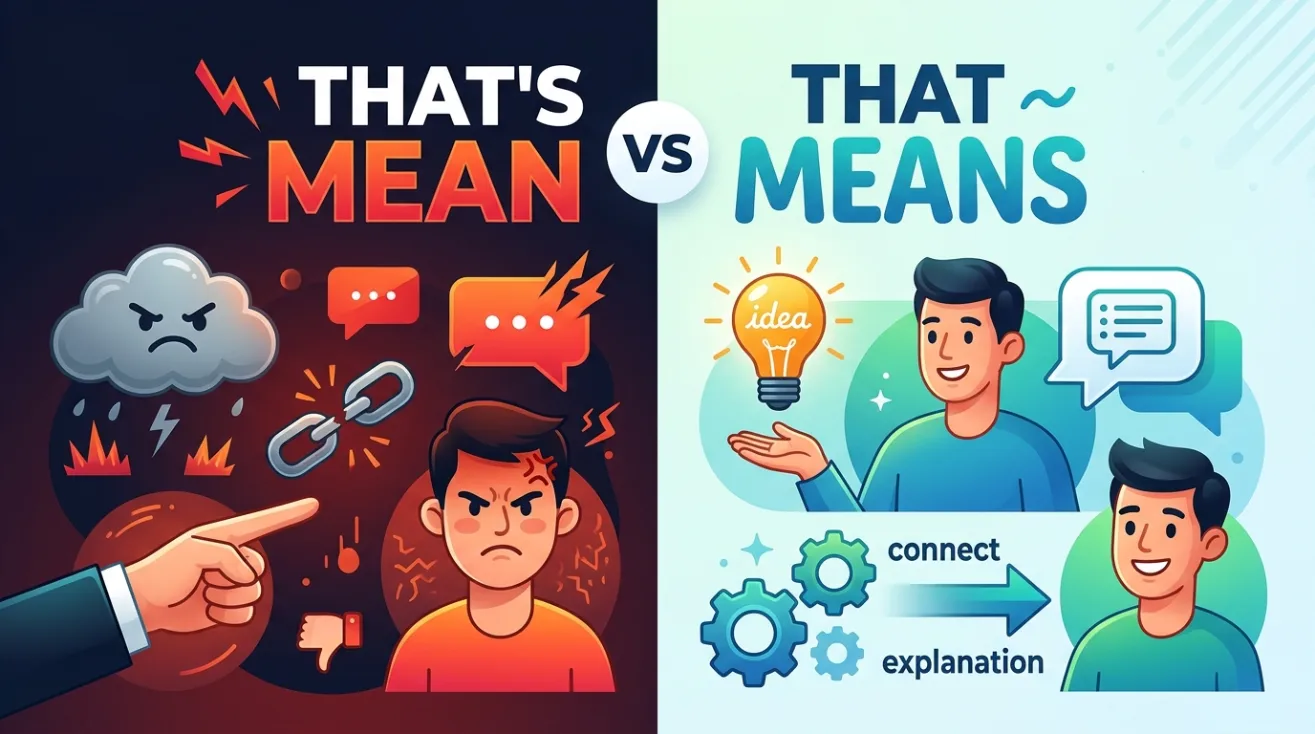
Many English learners type or say “that’s mean” vs “that means” because the two expressions look similar. However, only one of them is grammatically correct in standard English. Understanding this small difference can instantly improve your writing, speaking, and overall credibility.
The confusion usually happens because people mix up the verb “mean” with its third-person singular form “means.” They may also forget the apostrophe in “that’s,” creating another common mistake. Once you understand the basic grammar rule, choosing the correct phrase becomes effortless.
The good news is that this is one of the easiest grammar problems to fix. By learning how the verb changes depending on the subject, you’ll avoid an error that appears in emails, essays, social media posts, and even business communication.
The Core Rule: That’s Mean vs That Means
The rule is straightforward.
When the subject is “that,” the verb “mean” must become “means.”
So the correct expression is:
That means…
Not:
That mean…
Likewise, “that’s” is a contraction of “that is.” It cannot replace “that means.” Although they may appear in similar-looking sentences, they perform completely different grammatical jobs.
“That Means” Is Correct
The word “that” is a third-person singular subject.
In the present tense, third-person singular subjects take verbs ending in -s or -es.
Examples include:
- He runs.
- She works.
- It looks.
- That means everything.
- That means we should leave now.
This follows one of the most fundamental rules in English grammar.
“Thats Mean” Is Incorrect
There are actually two problems.
First, “that’s” is missing an apostrophe if you intended to write “that’s.”
Second, “mean” should become “means” because the subject is “that.”
Incorrect:
- That means we lost.
- That means we lost.
Correct:
- That means we lost.
If you intended to describe someone as unkind, then the sentence changes completely.
Example:
- That’s mean.
Here, mean is an adjective, not a verb.
That distinction causes much of the confusion.
Side-by-Side Comparison Table
| Situation | Example | Meaning | Correct Usage |
| Explaining a result | That means we won. | Indicates a conclusion | ✅ Correct |
| Explaining information | That means it’s finished. | Gives interpretation | ✅ Correct |
| Missing apostrophe | Thats means… | Spelling error | ❌ Incorrect |
| Wrong verb form | That mean… | Subject-verb disagreement | ❌ Incorrect |
| Describing behavior | That’s mean. | “Mean” is an adjective | ✅ Correct |
| Giving instructions | That means you should wait. | Explains consequence | ✅ Correct |
When to Use “That Means”
Use “that means” whenever you are explaining the meaning, consequence, conclusion, or implication of something.
Think of it as introducing an explanation.
Examples:
- That means the meeting starts early.
- That means we have enough time.
- That means the answer is correct.
- That means you passed the exam.
- That means everyone can participate.
Notice that every sentence explains what something indicates.
Common Patterns
You’ll frequently see that means followed by:
- a clause
- a conclusion
- an explanation
- an interpretation
- an action
Examples:
- That means we need more supplies.
- That means she’s arriving tomorrow.
- That means they agreed.
- That means nothing changed.
- That means we’re done.
These patterns appear constantly in everyday English.
Quick Test
Ask yourself:
- Am I explaining what something indicates?
- Is that the subject?
- Is the sentence in present tense?
- Should the verb agree with a singular subject?
If every answer is yes, write what it means.
When “That’s Mean” Is Correct
Many people think that means is always wrong.
It isn’t.
Here, mean functions as an adjective describing someone’s behavior.
Examples:
- That’s mean.
- That’s really mean.
- That’s incredibly mean.
- That’s a mean thing to say.
- That’s mean of him.
These sentences describe cruelty or unkindness.
Notice the difference.
That’s equals that is.
So:
That’s mean.
really means
That is mean.
The sentence has nothing to do with explaining meaning.
Common Usage Patterns for That’s Mean vs That Means
You can modify the adjective.
Examples:
- That’s extremely mean.
- That’s surprisingly mean.
- That’s unbelievably mean.
- That’s honestly mean.
- That’s a little mean.
In every case, mean remains an adjective.
The Meaning Difference Between That’s Mean and That Means
This tiny grammar difference completely changes the sentence.
Compare them.
That means…
You are explaining what something indicates.
Example:
- That means the store is closed.
Now compare it with:
That’s mean.
You are describing behavior.
Example:
- That’s mean to say.
One explains information.
The other expresses an opinion.
Although only one letter separates them, the meanings are entirely different.
This explains why learners often confuse them.
Why the Confusion Persists
Several factors contribute to this mistake.
First, spoken English can make the meaning sound less noticeable. Fast speech sometimes hides the final -s, especially for beginners.
Second, many learners memorize phrases instead of grammar rules. They recognize the sound but do not analyze the sentence structure.
Third, missing apostrophes are extremely common online. People frequently type thats instead of that’s, creating additional confusion.
Another reason is autocorrect. Some devices fail to catch grammar mistakes because mean is a correctly spelled word.
Finally, learners often translate directly from another language, where verbs may not change depending on the subject.
Formal vs Casual Contexts
Grammar expectations become stricter in professional writing.
In formal contexts, always use correct subject-verb agreement.
Examples include:
- academic essays
- research papers
- business reports
- legal documents
- professional emails
Writing:
That mean…
may immediately reduce your credibility.
Casual conversations are more forgiving, but standard grammar is still expected.
Social media users sometimes type:
- thats mean
- that mean
- thats means
These forms are common online, yet they remain grammatically incorrect unless “that’s mean” is being used as “that is mean.”
Clear grammar improves communication regardless of the setting.
Case Studies / Pop Culture Examples
Imagine a classroom discussion.
The teacher says:
“The exam average was 92%.”
A student replies:
“That means everyone prepared well.”
This is correct because the student is explaining the implication.
Now imagine two friends watching a television show.
One character insults another.
A friend comments:
“That’s mean.”
Here, the speaker criticizes rude behavior.
Consider workplace communication.
Manager:
“The client approved the proposal.”
Employee:
“That means we can begin production.”
Again, the phrase introduces a logical conclusion.
Now imagine siblings arguing.
One child takes another’s toy.
A parent responds:
“That’s mean.”
Here, mean describes behavior rather than explaining meaning.
Understanding the context instantly tells you which expression belongs.
Advanced Scenarios & Flowchart
Sometimes both expressions appear close together.
Example:
“That means you’re finished.”
Explanation:
The sentence explains a conclusion.
Now compare:
“That’s mean, isn’t it?”
Explanation:
The speaker comments on someone’s behavior.
Use this decision guide.
Is the sentence explaining information?
Yes
Use That means
No
Does it mean describing someone’s behavior?
Yes
Use That’s mean
No
Does the subject need a present-tense verb?
Yes
Use means
No
Check whether mean is functioning as an adjective.
This simple process prevents nearly every mistake.
Quick Reference Table
| If You Want To… | Use This |
| Explain a result | That means |
| Explain a conclusion | That means |
| Explain a consequence | That means |
| Describe unkind behavior | That’s mean |
| Write standard grammar | That means |
| Say “That is mean” | That’s mean |
Common Mistakes When Using That’s Mean vs That Means
Even advanced writers occasionally make these errors.
Mistake 1: Writing “That mean”
Wrong:
- That means we should go.
Correct:
- That means we should go.
Mistake 2: Forgetting the apostrophe
Wrong:
- That’s mean.
Correct:
- That’s mean.
Mistake 3: Mixing two different meanings
Wrong:
- That means…
Correct:
- That means…
or
- That’s mean.
depending on the intended message.
Mistake 4: Translating directly
Many learners use the base verb because their native language does not change verbs according to the subject.
English requires agreement.
Mistake 5: Ignoring context
Always ask whether the meaning is acting as a verb or an adjective.
That single question solves most problems.
Memory Tricks to Remember That’s Mean vs That Means
Remember this simple formula:
That + verb = means
Think of similar examples.
- That looks
- That works
- That sounds
- That feels
- That means
Notice the consistent -s ending.
Now remember the adjective version.
That’s = That is
If you can replace it with “that is,” you’re probably describing something.
Example:
That is mean.
That’s mean.
Perfect.
Another helpful trick is to listen for the hidden sentence.
Ask yourself:
“Am I really saying that is?”
If yes, use that.
If you’re explaining a consequence, choose that means instead.
Why Precision Matters (SEO/Authority)
Grammar influences trust more than many writers realize.
Readers often judge the quality of an article within seconds. Small grammar mistakes can make otherwise valuable content seem rushed or unreliable. Whether you’re writing blog posts, marketing copy, newsletters, or academic assignments, using that means correctly signals attention to detail.
Search engines also reward content that satisfies readers. While search algorithms do not directly rank pages based on a single grammar rule, well-written articles typically produce better user engagement. Visitors stay longer, understand information more easily, and are more likely to share accurate content. That combination contributes to stronger SEO performance over time.
Professional communication benefits as well. Employers, clients, teachers, and colleagues notice polished writing. A sentence like “That means…” may seem minor, but repeated mistakes can reduce confidence in your expertise. Correct grammar supports your authority and helps your ideas stand out instead of distracting readers with avoidable errors.
A Quick Quiz
Fill in the blanks with mean, means, or that’s.
- _____ we need to leave before noon.
- The lights are off. That _____ the office is closed.
- _____ a very mean thing to say.
- If the road is blocked, that _____ we need another route.
- I can’t believe he laughed at her. _____ mean.
- The report is finished. That _____ we can submit it today.
- If the answer is correct, that _____ you solved the problem.
Answers
- That means
- means
- That’s
- means
- That’s
- means
- means
Conclusion
Understanding That’s Mean vs That Means becomes easier when you know the difference between a verb and an adjective. “That means” explains the meaning, result, or consequence of something, while “that’s mean” describes someone or something as unkind. Choosing the correct phrase makes your writing clearer and helps you avoid common grammar mistakes.
Whether you’re writing blog posts, emails, or academic assignments, remember this simple rule: use “that means” to explain an idea and “that’s mean” to describe unkind behavior. With regular practice and careful proofreading, you’ll use both expressions more confidently and communicate your ideas accurately.
Frequently Asked Questions
Is “that means” always grammatically correct?
“That means” is grammatically correct whenever that functions as the singular subject and means is the present-tense verb explaining a result, implication, or definition. It follows standard subject-verb agreement rules in English. However, it should not be used when you actually mean “that is mean,” because that requires the separate expression “that’s mean.”
Why do people write “that mean” instead of “that means”?
Many learners accidentally write “that mean” because they forget that that is a third-person singular subject. Others are influenced by spoken English, where the final -s can sound less noticeable. Direct translation from other languages and informal internet writing also contribute to this common grammar mistake.
Is “that’s mean” ever correct?
Yes. “That’s mean” is completely correct when mean is an adjective describing someone’s behavior or attitude. The contraction “that’s” stands for “that is,” making the sentence equivalent to “That is mean.” In this case, the sentence expresses an opinion rather than explaining a meaning or consequence.
What is the difference between “that means” and “that’s mean”?
The biggest difference is grammatical function. “That means” uses means as a verb to explain or interpret something, while “that’s mean” uses mean as an adjective to describe something as cruel or unkind. Even though the phrases look similar, they communicate completely different ideas.
Can I use “that means” in formal writing?
Absolutely. “That means” is appropriate for every level of writing, including academic papers, professional emails, business reports, legal documents, and published articles. It is standard English grammar and should be used whenever you’re explaining the significance or consequence of information.
Why is subject-verb agreement important in this phrase?
Subject-verb agreement ensures that verbs match their subjects correctly. Since that is singular, the verb must also take the singular present-tense form means. Using mean instead creates a grammatical error that can make your writing appear less polished and less professional.
How can I quickly remember which version to use?
A useful trick is to replace that’s with that is. If the sentence still makes sense, you’re probably describing something, so “that’s mean” is correct. If you’re explaining what something indicates or implies, choose “that means.” This simple test works in nearly every situation.
Do native English speakers ever confuse these expressions?
Native speakers occasionally make typing mistakes, especially in casual texting or social media, but they generally distinguish the two expressions naturally in speech. Most written errors come from fast typing, omitted apostrophes, or lack of proofreading rather than misunderstanding the grammar itself.
Does using the correct phrase improve SEO content?
Yes, indirectly. Search engines prioritize content that provides a positive user experience, and readers are more likely to trust, share, and stay engaged with articles that use correct grammar. Consistently writing “that means” correctly helps establish authority, reduces distractions, and contributes to higher-quality content that performs better over time.

Elliot Mason is a passionate English writer dedicated to making language learning clear, practical, and enjoyable. As an author at Grammar Alpha, he creates helpful content covering grammar, vocabulary, word meanings, sentence structure, common mistakes, and everyday English usage. His straightforward articles are designed for students, professionals, and English learners who want to communicate with greater confidence. Elliot believes that better English begins with understanding the basics, and his goal is to turn challenging language concepts into simple, useful lessons readers can apply every day.