
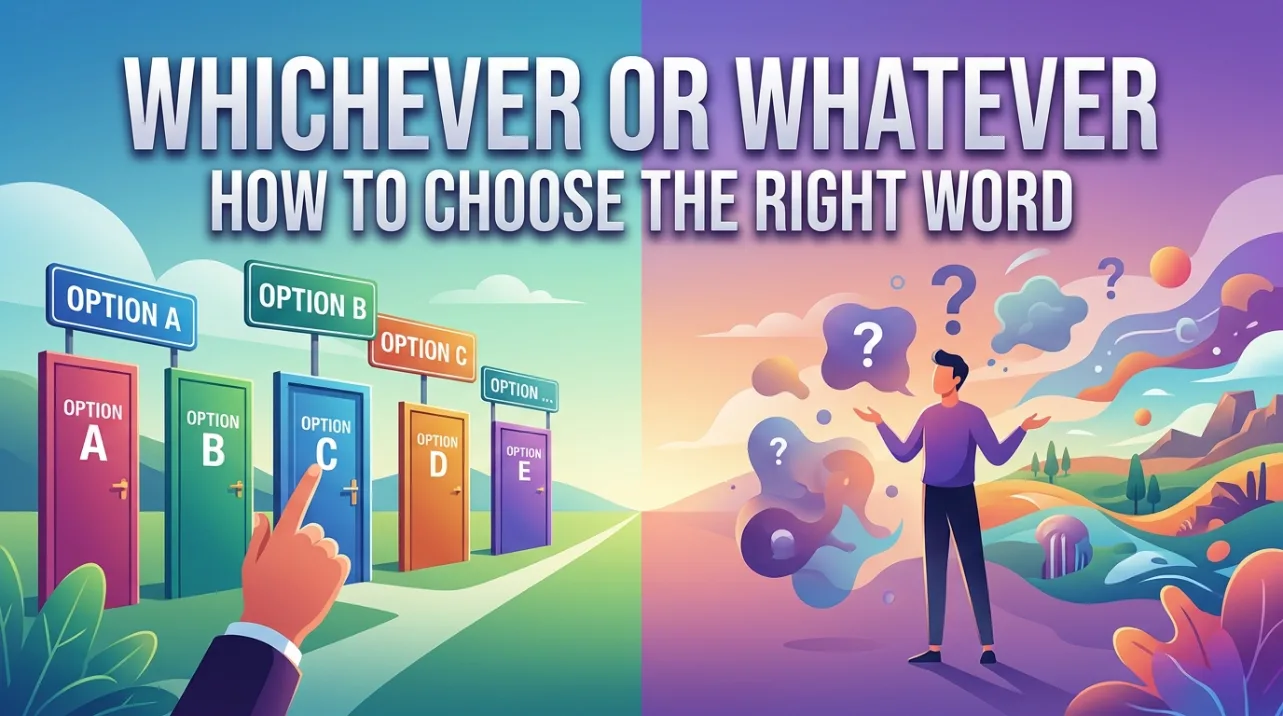
Choosing between whichever vs whatever seems simple until you have to write a sentence where both appear possible. The two words are closely related, both introduce choices, and both can function as pronouns or determiners. Yet they are not interchangeable in many situations. Understanding the distinction helps your writing sound more precise, more natural, and more grammatically accurate.
Here’s the key idea.
Whichever refers to a choice from a limited or identifiable set, while whatever refers to anything at all, without limitation. That small difference changes the meaning of an entire sentence. Whether you’re writing an academic paper, business email, blog post, or everyday message, knowing when to use each word prevents ambiguity and strengthens clarity.
Let’s break it down.
The Core Rule for Whichever vs Whatever
The easiest way to remember whichever vs whatever is by asking one question.
Is there a known set of choices?
If the answer is yes, use whichever.
If the answer is no, use whatever.
Although both words express freedom of choice, they point to different types of freedom.
Whichever = Any choice from a specific group.
Whatever = Absolutely anything, with no defined limits.
That’s the foundation.
Everything else builds on this rule.
When to Use Whichever
Use whichever when the options are limited, known, or implied.
Examples:
- Choose whichever seat is available.
- Wear whichever jacket fits you best.
- Pick whichever route is faster.
In each example, there is a recognizable group of choices.
When to Use Whatever
Use whatever when the possibilities are unlimited or unspecified.
Examples:
- Eat whatever you want.
- Say whatever comes to mind.
- Do whatever makes you happy.
The speaker places no boundaries on the available options.
Side-by-Side Comparison Table
| Situation | Whichever | Whatever | Correct Usage |
| Limited options | Yes | Rarely | Pick whichever book you like. |
| Unlimited choices | No | Yes | Read whatever interests you. |
| Known selection | Yes | Sometimes | Take whichever elevator arrives first. |
| Unknown possibilities | No | Yes | Bring whatever you need. |
| Formal writing | Very common | Very common | Depends on meaning. |
| Instructions | Often | Often | Choose based on available options. |
| Decision making | Yes | Sometimes | Use whichever for defined alternatives. |
| Open-ended freedom | No | Yes | Use whatever when no limits exist. |
Deep Dive into Whichever
Understanding whichever becomes much easier once you recognize that it always points toward selection. Even if the list of options is not directly mentioned, readers usually understand that a limited set exists. The word guides attention toward choosing among available alternatives rather than imagining endless possibilities.
Use Whichever for Limited Choices
Consider these examples.
- Choose whichever flavor you prefer.
- Sit in whichever chair is empty.
- Use whichever password works.
Although the number of options may vary, they all belong to a specific group.
Look at this:
Imagine entering a restaurant that offers ten desserts. You may choose whichever dessert you want. You cannot order a dessert that does not exist on the menu. The selection is broad but still limited.
Common Sentence Patterns
You’ll often see whichever is used in these structures.
- Whichever + noun
- Whichever route saves time.
- Whichever team wins.
- Whichever + clause
- Whichever works best for you.
- Whichever arrives first.
These patterns appear frequently in both spoken and written English.
Quick Test
Ask yourself these questions.
- Are the options known?
- Is someone choosing from a group?
- Can I identify the possible answers?
If you answered yes, whichever is probably correct.
Deep Dive into Whatever
Unlike whichever, whatever removes boundaries. It tells the reader that nearly anything is acceptable. Instead of choosing from a predefined collection, the speaker allows unrestricted possibilities.
That’s the difference.
Use Whatever for Unlimited Possibilities
Examples include:
- Watch whatever you like.
- Cook whatever sounds good.
- Believe whatever you choose.
These examples do not restrict the available options.
Common Sentence Patterns
You’ll often encounter:
- Whatever + noun
- Whatever reason.
- Whatever decision.
- Whatever + clause
- Whatever happens.
- Whatever you decide.
Notice that the meaning emphasizes openness instead of selection.
Recognizing the Pattern
Suppose someone says:
“Bring whatever you think we’ll need.”
There is no inventory to choose from. The listener decides based on judgment.
Now compare it.
“Bring whichever tool fits the bolt.”
Now the speaker assumes there is a toolbox with several available tools.
The difference becomes obvious.
The Difference Between Whichever and Whatever
The distinction between whichever vs whatever goes beyond grammar. It changes how readers interpret the situation. Even when both words seem possible, each creates a different mental picture.
Consider these examples.
Choose whichever movie you like.
The available movies are limited, perhaps those currently playing or those on a streaming list.
Now compare it.
Watch whatever movie you like.
The possibilities feel broader. Any movie in existence seems acceptable.
Another example:
- Take whichever bus arrives first.
- Take whatever transportation gets you there.
The first sentence refers to buses only.
The second includes buses, trains, taxis, bicycles, or anything else.
That subtle difference matters.
Why Whichever and Whatever Are Often Confused
Many English learners struggle with whichever vs whatever because the words overlap in casual conversation. Native speakers sometimes use whatever more loosely than grammar textbooks recommend. As a result, learners hear examples that blur the distinction.
Another reason is that both words contain ever, which suggests flexibility or openness. However, that shared ending does not mean identical meanings. The first part of each word changes everything.
Education also contributes to confusion. Many grammar lessons explain the definitions but rarely demonstrate how context changes the choice. Without seeing dozens of real examples, the difference remains abstract.
Translation creates another challenge. In many languages, one word covers both meanings, leaving learners without a direct equivalent. They naturally transfer that habit into English.
Finally, modern digital communication favors speed over precision. Text messages, social media posts, and online comments often prioritize convenience. Because readers usually understand the intended meaning, writers may choose whatever even when whichever would be technically more precise.
Formal vs Casual Contexts
Context influences word choice, even though the underlying grammar remains the same.
Formal Writing
Professional documents value precision.
Examples:
- Select whichever proposal best meets the requirements.
- Submit whatever supporting documents are necessary.
Each sentence communicates a different relationship between choices.
Academic writing, legal documents, and business communication generally follow this distinction carefully because ambiguity can create misunderstandings.
Casual Conversation
Everyday speech is more flexible.
People often say:
- Do whatever you want.
- Pick whatever you like.
Strictly speaking, the second sentence may involve a limited set of options, making whichever more accurate. Nevertheless, conversational English frequently accepts whatever without causing confusion.
Understanding the formal rule allows you to decide when precision matters.
Case Studies / Pop Culture Examples
Real-world language demonstrates how these words function naturally.
Classroom Instructions
A teacher says:
“Choose whichever topic interests you.”
The class has a list of approved topics.
Now compare another instruction.
“Write about whatever inspires you.”
Students may choose virtually any subject.
Restaurant Scenario
A server says:
“You may order whichever entrée you prefer.”
Only menu items qualify.
Now imagine a friend saying:
“Eat whatever makes you happy today.”
The suggestion extends beyond one menu or even one restaurant.
Workplace Communication
A manager writes:
“Use whichever template matches your project.”
Templates already exist.
Later the manager says:
“Include whatever information supports your recommendation.”
The supporting information is unrestricted.
Entertainment
Streaming platforms illustrate the difference clearly.
“Watch whichever episode you missed.”
The available episodes belong to one series.
“Watch whatever interests you tonight.”
The viewer may choose from every available program.
Advanced Uses of Whichever vs Whatever
Some situations require closer analysis because both words appear reasonable at first glance.
Consider this sentence.
“Take whichever keys open the door.”
The keys already exist.
Now consider:
“Bring whatever helps solve the problem.”
Possible solutions are unlimited.
Use this decision guide whenever you’re uncertain.
Is the speaker choosing from known options?
Yes
Use whichever.
No
Can almost anything qualify?
Yes
Use whatever.
No
Reconsider whether a limited group exists.
This simple sequence solves most grammar questions involving these words.
Quick Reference Table
| If You Mean… | Use |
| A choice from known options | Whichever |
| Anything at all | Whatever |
| Limited alternatives | Whichever |
| Unlimited freedom | Whatever |
| Selecting from a menu | Whichever |
| No restrictions | Whatever |
| Specific collection | Whichever |
| Open possibility | Whatever |
Common Mistakes When Using Whichever vs Whatever
Even experienced writers occasionally confuse these words. Most mistakes happen because the context feels flexible enough for either option, but one choice communicates the intended meaning more precisely.
Here are the most common errors.
Using Whatever for a Small List
Incorrect:
- Pick whatever shirt from these three options.
Better:
- Pick whichever shirt you prefer.
Assuming Both Words Always Mean the Same
Although overlap exists, they create different meanings.
Precision improves clarity.
Ignoring Context
Words never exist in isolation.
Always examine whether the sentence involves a defined group or unlimited possibilities.
Forgetting the Implied Group
Sometimes the list is not directly mentioned.
Example:
“Take whichever exit is closest.”
Drivers understand that highway exits form the available choices.
Overcorrecting
Some writers replace every whatever with whichever after learning the rule.
That creates equally inaccurate sentences.
Example:
“Do whatever makes you happy.”
Replacing it with whichever weakens the intended meaning because happiness is not restricted to a predefined list.
Memory Tricks for Whichever vs Whatever
Remembering grammar rules becomes easier when they connect to vivid mental images.
Picture a Menu
Menus contain limited options.
Think:
Whichever item on the menu.
Menus naturally suggest selection.
Picture the Whole World
Imagine standing in an open field.
Anything is possible.
Think:
Whatever exists.
The world has no menu.
Remember the Keyword
Associate:
- Whichever = Which one?
- Whatever = Anything.
That mental shortcut works surprisingly well.
Ask One Question
Before choosing the word, ask:
“Can I count or identify the options?”
If yes, choose whichever.
If not, choose whatever.
Why Precision Matters (SEO/Authority)
Accurate grammar builds trust. Readers notice when writing consistently uses words according to their intended meanings, even if they cannot always explain the rule. Small improvements accumulate into stronger credibility.
Search engines also reward content that satisfies user intent. Articles with precise language reduce ambiguity, improve readability, and answer questions more effectively. While choosing whichever instead of whatever will not directly change rankings, clear writing encourages longer reading sessions, better engagement, and fewer misunderstandings.
Professional editors, teachers, recruiters, and clients often judge writing quality through subtle details. Consistently selecting the correct word demonstrates careful thinking and attention to meaning. That attention enhances your authority whether you are publishing a blog, preparing academic work, writing marketing copy, or communicating in the workplace.
Finally, precision supports better communication across cultures. English learners rely on clear examples to build confidence, and accurate usage prevents unnecessary confusion. Mastering the difference between whichever vs whatever is a small grammar improvement that produces a noticeable impact on the overall quality of your writing.
A Quick Quiz
Fill in each blank with whichever or whatever.
- Choose __________ book from the reading list interests you most.
- Eat __________ you want after the race.
- Take __________ elevator arrives first.
- Say __________ feels right to you.
- Use __________ password successfully logs you into the account.
- Pack __________ clothing you think you’ll need.
- Pick __________ candidate best matches the job requirements.
Quiz Answers
- Whichever
- Whatever
- Whichever
- Whatever
- Whichever
- Whatever
- Whichever
Conclusion
Understanding whichever vs whatever is easier when you know how each word describes a choice. Use whichever when choosing from a specific or limited group of options. Use whatever when the possibilities are open-ended or unrestricted. Although the difference seems small, choosing the correct word makes your writing clearer and more natural in everyday and professional situations.
The easiest way to remember whichever vs whatever is to consider the context. If the reader can identify a set of available options, whichever is usually appropriate. If the choice is open-ended, whatever is often the better fit. With clear rules and practical examples, you can learn when to use each word in emails, academic papers, website content, and everyday conversations.
Frequently Asked Questions
Is whichever always more formal than whatever?
Not necessarily. Both whichever and whatever are grammatically correct in formal writing when used appropriately. The difference is based on meaning rather than formality. Whichever refers to choosing from a known or limited set of options, while whatever refers to unlimited possibilities. Formal documents simply tend to follow this distinction more consistently because precision is important.
Can whatever replace whichever in casual conversation?
In everyday speech, many native speakers use whatever even when whichever would be more precise. While listeners usually understand the intended meaning, this substitution is technically less accurate. If you’re writing professionally or academically, it’s better to choose the word that matches the situation instead of relying on casual usage.
How do I quickly decide between whichever and whatever?
Ask yourself one simple question: Are there specific choices available? If the answer is yes, use whichever because you’re choosing from a defined group. If the answer is no and almost anything could qualify, use whatever. This quick test works for the vast majority of situations.
Can both words appear in the same sentence?
Yes. There are situations where both words naturally belong in the same sentence because they perform different functions. For example, “Choose whichever book you like, and write about whatever idea it inspires.” The first word refers to selecting from available books, while the second allows unlimited ideas.
Why do English learners confuse these words?
Many languages do not distinguish between limited choices and unlimited possibilities using separate words. As a result, learners often translate directly from their native language. Additionally, casual English sometimes blurs the distinction, making it harder to identify the precise grammatical rule without studying real examples.
Is whichever a pronoun or a determiner?
It can function as both. As a pronoun, it replaces a noun, as in “Take whichever you prefer.” As a determiner, it modifies a noun, as in “Choose whichever option suits you best.” The same flexibility also applies to whatever, depending on how it is used in a sentence.
Do grammar checkers always catch mistakes involving these words?
Not always. Many grammar tools focus on spelling and sentence structure rather than subtle meaning differences. Because both whichever and whatever are valid English words, software may not recognize when one fits the context better than the other. Human judgment is still the most reliable way to choose correctly.
Does using the correct word improve writing quality?
Yes. Selecting the appropriate word makes your writing more precise and easier to understand. Readers appreciate clear communication, and editors often notice these small details. Correct usage also strengthens your credibility, especially in business, academic, legal, and educational writing where accuracy matters.
Are there situations where either word is acceptable?
Occasionally, both words may seem acceptable because the context is broad enough to support more than one interpretation. However, one choice usually communicates the intended meaning more clearly. If the sentence implies a limited set of options, whichever is generally preferred. If the possibilities are truly unrestricted, whatever is the stronger and more accurate choice.

Elliot Mason is a passionate English writer dedicated to making language learning clear, practical, and enjoyable. As an author at Grammar Alpha, he creates helpful content covering grammar, vocabulary, word meanings, sentence structure, common mistakes, and everyday English usage. His straightforward articles are designed for students, professionals, and English learners who want to communicate with greater confidence. Elliot believes that better English begins with understanding the basics, and his goal is to turn challenging language concepts into simple, useful lessons readers can apply every day.