
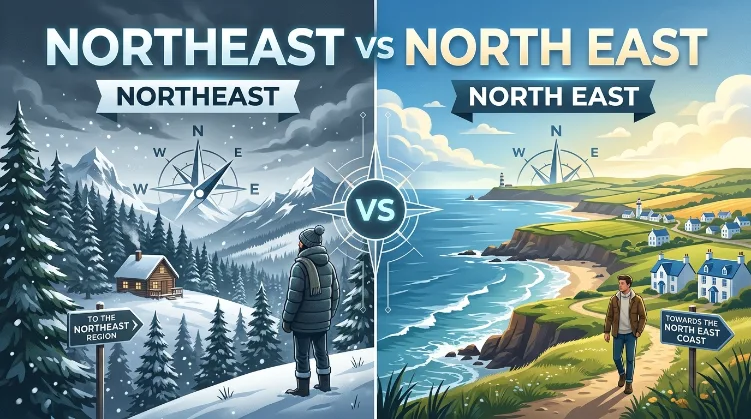
The difference between northeast vs north east can be confusing because both forms appear in English writing. Dictionaries, regional names, and different writing conventions can make it difficult to know which spelling to choose.
In modern American English, northeast is generally the preferred spelling for a compass direction, movement, or descriptive term. However, North East may appear in established regional names, particularly in Britain. Understanding when to use each form helps you write clearly and avoid common spelling mistakes.
In this guide, you’ll learn the key differences between northeast and north east, with simple rules, practical examples, comparison tables, and tips to help you choose the correct form.
Northeast vs North East: The Basic Rule
At its simplest, northeast is normally written as one word when referring to:
- A compass direction
- A geographic region
- Movement toward that direction
- An adjective describing something located there
Examples:
- We drove northeast for three hours.
- The storm moved northeast overnight.
- She lives in the Northeast.
- A northeast wind brought cooler temperatures.
By contrast, north east as two words usually appears only when the writer intentionally treats north and east as separate directional ideas or follows a publication style that preserves spacing.
Northeast, The Standard Modern Form
Modern dictionaries overwhelmingly prefer the northeast.
It works as:
- Noun
- Adjective
- Adverb
Examples:
- The airplane headed northeast.
- Vermont lies in the Northeast.
- They explored the northeast corner of the park.
- A northeast breeze arrived before sunset.
This is the spelling recommended in most American publications.
North East, The Separated Form
The two-word version still exists, but its use is much narrower.
Examples include:
- the north east corner of an ancient castle
- communities in the North East of England
- older publications following historical conventions
In these situations, the writer may be emphasizing north and east individually or following a regional naming convention.
Side-by-Side Comparison Table
| Situation | Example | Meaning | Correct Usage |
| Compass direction | Drive northeast | One combined direction | Northeast |
| Wind direction | Northeast wind | Wind from the northeast | Northeast |
| Geographic region in the U.S. | The Northeast | Named region | Northeast |
| Corner of a room | Northeast corner | Combined direction | Northeast |
| Historic British writing | North East England | Regional convention | North East |
| Separate directional emphasis | North, then east | Two directions | North east may appear |
When to Use Northeast
Most writing falls into this category.
Whenever the direction functions as a single concept, write northeast as one word.
Examples:
- Birds migrate northeast each spring.
- The road curves northeast after the bridge.
- The fire spread toward the northeast.
- They purchased land in the Northeast.
Notice that each example treats the direction as one unified idea.
Northeast as a Noun
A noun names a place or direction.
Examples:
- The storm came from the northeast.
- Our destination is the Northeast.
The second example uses capitalization because it refers to a recognized geographic region.
Northeast as an Adjective
Here, northeast modifies another noun.
Examples:
- northeast entrance
- northeast border
- northeast highway
- northeast corner
The word stays together because it acts as one descriptive term.
Northeast as an Adverb
It can also describe movement.
Examples:
- Walk northeast until you reach the river.
- The ship sailed northeast.
Again, the single-word spelling remains standard.
Quick Test
Ask yourself these questions:
- Does it describe one compass direction?
- Is it one geographic region?
- Does it describe movement?
- Is it modifying another noun?
If you answered yes, write northeast.
When Might North East Be Used?
Although uncommon in American English, the spaced version still appears in specific situations.
One example is North East England, where the spacing forms part of an official regional name used by many organizations.
Another situation occurs in older books, atlases, and historical documents.
Examples:
- North East Derbyshire
- North East England
- North East Coast Railway
These names preserve historical spelling conventions.
Separate Directional Thinking
Sometimes a writer wants readers to think of north first and east second.
Example:
- Move north, east of the river.
Although this sentence is different from the compass direction northeast, similar constructions sometimes create the appearance of north east.
Patterns You’ll Notice
The two-word spelling appears more often in:
- Older publications
- Historical documents
- Some British organizations
- Official regional names
- Archived government materials
Outside these contexts, northeast is preferred.
Northeast vs North East: Does the Meaning Change?
The spelling can subtly influence meaning.
Consider these examples.
Northeast
This immediately signals one precise compass direction, exactly halfway between north and east.
Example:
- Continue northeast.
Readers instantly know the intended direction.
North East
This can sometimes suggest two separate concepts.
Example:
- Northern and eastern districts.
Although related, this emphasis differs slightly from the unified compass direction.
This nuance explains why careful editors often choose the single-word version whenever precision matters.
Why Northeast vs North East Causes Confusion
Several factors keep this question alive.
First, English has evolved over centuries. Older forms often separated compound directions before dictionaries standardized them.
Second, American and British English occasionally differ.
Third, maps, government agencies, and regional organizations sometimes preserve traditional spellings.
Fourth, search engines expose readers to every variation ever published.
As a result, people naturally assume both versions are equally acceptable everywhere.
They are not.
Modern American English overwhelmingly favors the northeast.
Formal vs Casual Contexts
Choosing the correct form depends partly on the audience.
Academic Writing
Universities generally expect:
- northeast
Example:
- The glacier retreated toward the northeast.
Business Writing
Professional documents nearly always use:
- northeast
Example:
- The company expanded into the Northeast market.
Journalism
Most American newspapers follow:
- northeast
Unless quoting an official organization with a different spelling.
Everyday Conversation
People rarely notice the difference in speech because pronunciation stays identical.
Writing, however, should still follow standard spelling.
British Context
Some organizations officially use:
- North East
Always preserve official names exactly as written.
Case Studies / Pop Culture Examples
Maps provide excellent examples.
A navigation app may instruct:
- Head northeast.
Weather forecasts commonly say:
- Winds become northeast at 15 mph.
Academic geography textbooks usually refer to:
- the Northeast United States
Meanwhile, regional British organizations may use:
- North East England
Government agencies keep the spelling because it forms part of the official regional title.
Historical newspapers also contain thousands of examples using north east, reflecting earlier spelling conventions rather than current grammar recommendations.
These real-world examples demonstrate that context matters more than habit.
Advanced Scenarios & Flowchart
Use this simple decision guide.
Is it a compass direction?
Yes
Use **northeast**
No
Is it describing movement?
Yes
Use **northeast**
No
Is it a recognized region?
Yes
Use **Northeast** if that is the official American regional name.
No
Is it an official British regional name?
Yes
Preserve **North East**.
No
Use **northeast**.
Quick Reference Table
| Situation | Best Choice |
| Compass direction | Northeast |
| Wind direction | Northeast |
| Geographic region in the U.S. | Northeast |
| Movement | Northeast |
| Corner of a map | Northeast |
| Official British regional name | North East |
| Historical quotation | Keep original spelling |
| Modern American writing | Northeast |
Common Northeast vs North East Spelling Mistakes
Even experienced writers make these errors.
Writing “north east” in American business documents
Modern style guides recommend northeast instead.
Capitalizing every occurrence
Only capitalize Northeast when referring to the recognized region.
Correct:
- We moved northeast.
Correct:
- We moved to the Northeast.
Changing official names
Never alter official regional titles.
If an organization is named North East Something, preserve the official spelling.
Confusing directions with regions
Direction:
- Travel northeast.
Region:
- Visit the Northeast.
These serve different grammatical roles.
Memory Hacks That Actually Work
Remember this simple phrase:
One direction, one word.
That rule solves most cases instantly.
Another trick:
Imagine a compass.
The point between north and east is one location, so write one word:
northeast
For regions, think of proper names.
If referring to the American region, capitalize it:
The Northeast
If copying an official British place name, keep its official spacing.
Finally, ask yourself:
“Would a GPS write it this way?”
Nearly every modern GPS displays:
northeast
That visual cue helps reinforce the standard spelling.
Why Precision Matters (SEO/Authority)
Correct spelling improves more than grammar.
It strengthens credibility.
Readers subconsciously judge expertise through consistency.
Search engines also recognize standardized terminology more effectively, helping content align with common search intent.
Professional editors expect consistent compound direction formatting.
Businesses benefit because polished writing builds trust with customers.
Students receive higher marks when following accepted style conventions.
Researchers avoid ambiguity by using standardized directional language.
Small grammar choices communicate attention to detail.
Using northeast correctly signals that your writing follows modern English conventions, while preserving North East only in official names demonstrates respect for regional identity and editorial accuracy.
A Quick Quiz
Fill in the blanks with northeast, North East, or Northeast where appropriate.
- The hikers walked __________ for nearly two hours.
- Boston is located in the __________ region of the United States.
- The weather report predicted a strong __________ wind.
- The museum sits in the __________ corner of the city map.
- She accepted a job with an organization based in __________ England.
- The airplane turned __________ after takeoff.
- We spent our vacation exploring the __________ United States.
Answer Key
- northeast
- Northeast
- northeast
- northeast
- North East
- northeast
- Northeast
Conclusion
Understanding northeast vs north east becomes easier when you know how context affects spelling. In modern American English, northeast is the standard form for compass directions, movement, and general descriptions. Use Northeast with a capital letter when referring to the recognized U.S. region. In contrast, North East may be correct in established regional names, such as North East England, or in historical references that preserve the original spelling.
To choose the right form, consider whether you mean a single compass direction or a specific place name. Following these simple rules helps you avoid common spelling mistakes and keep your writing clear, consistent, and professional. Whether you’re writing an essay, business report, or blog post, using the correct form makes your message easier to understand and more polished.
Frequently Asked Questions
Is northeast one word or two words?
In most modern English, especially American English, northeast is written as one word. This applies when referring to the compass direction, movement, wind direction, or a descriptive adjective. The two-word version, north east, is generally limited to certain historical texts, British regional names, or situations where the writer intentionally separates the two directions.
Should I capitalize Northeast?
Capitalize Northeast only when it refers to a specific geographic region, such as the Northeast of the United States. If you are simply describing direction, location, or movement, keep it lowercase. For example, “The birds flew northeast” uses lowercase, while “She moved to the Northeast” requires capitalization because it names a recognized region.
Is north east ever incorrect?
Not always. While north east is uncommon in modern American English, it is still correct in certain official names, historical documents, and some British contexts. However, if you are writing general American English, using northeast is almost always the preferred and recommended choice according to major dictionaries and style guides.
Why do British publications sometimes use North East?
Many British organizations and regions have official names that preserve the spaced version, such as North East England. These spellings are part of the official identity of those places rather than a general grammar rule. When referring to official names, you should always keep the spelling exactly as the organization or region uses it.
Is northeast correct in business and academic writing?
Yes. Professional documents, academic papers, government reports, and business communication generally prefer northeast as one word. Using the standard spelling improves clarity and demonstrates familiarity with accepted editorial conventions. Unless an official name requires otherwise, this is the safest choice for formal writing.
Can northeast be a noun, adjective, and adverb?
Yes. Northeast is versatile and functions as multiple parts of speech. It can be a noun (“The northeast experienced heavy snow”), an adjective (“The northeast entrance is closed”), or an adverb (“Drive northeast for ten miles”). The spelling remains the same in each grammatical role.
How do style guides treat northeast?
Most modern style guides and dictionaries recommend northeast as a single compound word for general usage. Publications following American editorial standards consistently use this form. Some British publications may preserve North East when referring to official regional names, but the one-word spelling remains the dominant recommendation for ordinary directional writing.
Does using the wrong spelling affect SEO?
While search engines generally understand both variations, using the standard spelling consistently improves readability, professionalism, and topical authority. It also aligns your content with user expectations and established language conventions. High-quality SEO writing benefits from consistent grammar because it enhances trust, reduces confusion, and creates a better overall user experience.
How can I quickly remember the difference?
A simple memory trick is “One direction, one word.” Since northeast represents a single compass direction between north and east, write it as one word. Only switch to North East when it is part of an official regional name or when quoting historical material that preserves the original spelling.

Daniel Carter is a passionate English writer dedicated to making language learning simple, practical, and engaging. At Grammar Alpha, he shares clear and reliable insights on grammar, vocabulary, word meanings, sentence structure, and everyday English usage. His easy-to-follow articles help students, professionals, and language learners strengthen their writing and communication skills. With a strong focus on clarity and accuracy, Daniel turns complex English concepts into useful lessons, empowering readers to write with confidence, speak naturally, and use English effectively every day.