
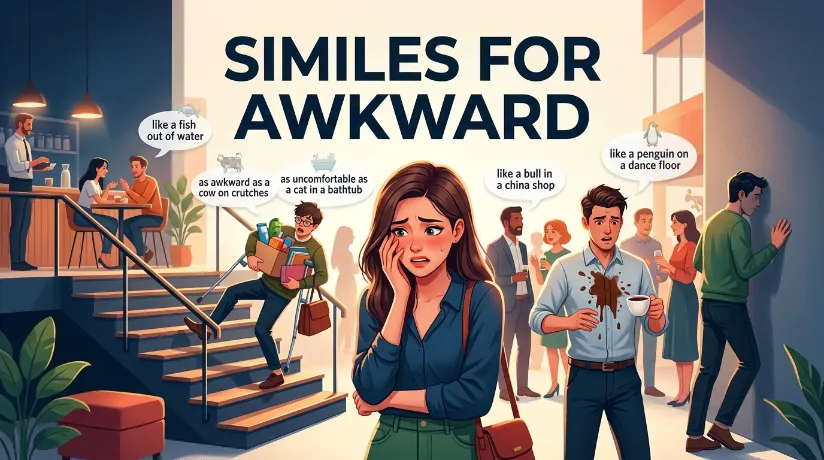
Awkward moments happen to everyone. Whether someone trips over their own feet, struggles through an uncomfortable conversation, or feels completely out of place, the right comparison can make that feeling much more vivid. That is where the best similes for awkward become useful. They turn ordinary descriptions into memorable images that readers instantly understand.
In this guide, you’ll discover a wide variety of original similes for awkward, each with a clear meaning and practical example. You’ll also learn how to choose the right simile for different situations, from funny stories to emotional writing and creative fiction. By the end, you’ll have plenty of fresh ideas to make your writing more expressive and engaging.
What Are the Best Similes for Awkward?
Similes for awkward compare an awkward person, situation, or feeling to something else using words such as “like” or “as.” Instead of simply saying someone felt awkward, a simile paints a picture that helps readers experience the emotion.
For example:
- As awkward as a penguin climbing a ladder.
- Like a violin playing in the middle of a football game.
- As awkward as wearing shoes on the wrong feet.
Each comparison creates an image that feels both relatable and memorable.
Unlike plain descriptions, similes encourage readers to imagine the scene. That extra layer of imagery makes stories, essays, speeches, and conversations far more interesting.
Here is another example:
Instead of writing:
The interview was awkward.
You could write:
The interview felt like two strangers trying to dance without hearing the same music.
The second version instantly creates a stronger impression.
Why These Similes Matter
Choosing the right similes for awkward does more than improve your vocabulary. It helps readers connect emotionally with your writing.
Here’s why.
They Create Clear Mental Pictures
A good simile transforms an invisible feeling into something readers can see.
For example:
She stood there like a flamingo trying to ice skate.
Readers immediately picture uncertainty and imbalance.
They Add Humor
Many awkward situations are unintentionally funny.
Creative similes allow writers to make readers smile without needing long explanations.
They Improve Storytelling
Whether you’re writing fiction or personal essays, descriptive comparisons help scenes come alive.
Instead of saying someone was nervous, you can compare them to something unstable, confused, or misplaced.
They Make Characters Memorable
Readers often remember colorful descriptions long after they forget ordinary sentences.
A unique simile gives personality to both characters and situations.
They Keep Writing Fresh
Repeating words like awkward, uncomfortable, or embarrassing becomes boring.
Using different similes adds variety while keeping your writing natural.
How to Choose the Right Simile
Not every awkward moment feels the same.
Some are funny.
Some are painful.
Others are simply strange.
Choosing the best simile depends on the mood you want to create.
Simple Decision Table
| Situation | Best Style | Example |
| Funny conversation | Humorous | Like a clown at a funeral. |
| Social anxiety | Emotional | Like a bird trapped inside a room. |
| Embarrassing mistake | Creative | Like dropping spaghetti onto a white shirt. |
| Public speaking | Powerful | As shaky as a chair with one leg shorter. |
| Romantic tension | Gentle | Like two magnets turned the wrong way. |
| Children’s writing | Playful | Like a duck wearing roller skates. |
| Poetry | Imaginative | Like a lonely cloud drifting against the wind. |
| Fiction | Vivid | Like a compass spinning without north. |
Now consider this.
The strongest similes fit naturally into the scene. They should support your message instead of distracting readers.
Best Similes for Awkward
Funny Similes for Awkward
Humorous comparisons make uncomfortable moments easier to enjoy. These similes are perfect for storytelling, casual writing, and entertaining speeches.
1. As awkward as a giraffe in a phone booth
Meaning: Extremely uncomfortable in a tight situation.
Example: He looked as awkward as a giraffe in a phone booth during the family photo.
2. Like a duck trying ballet
Meaning: Clumsy while attempting something graceful.
Example: She danced like a duck trying ballet.
3. As awkward as socks over sandals at a fashion show
Meaning: Completely out of place.
Example: His formal speech sounded as awkward as socks over sandals at a fashion show.
4. Like a mime at a karaoke contest
Meaning: Unable to fit the situation.
Example: I felt like a mime at a karaoke contest during the debate.
5. As awkward as a cat wearing rain boots
Meaning: Unsteady and uncomfortable.
Example: The puppy walked as awkward as a cat wearing rain boots.
6. Like an umbrella opened indoors
Meaning: Something feels strangely out of place.
Example: The surprise compliment landed like an umbrella opened indoors.
7. As awkward as a fish riding a bicycle
Meaning: Completely unnatural.
Example: His attempt to flirt felt as awkward as a fish riding a bicycle.
8. Like a chicken trying to whistle
Meaning: Trying something impossible.
Example: He explained the software like a chicken trying to whistle.
9. As awkward as a pirate at a spelling bee
Meaning: Looking completely mismatched.
Example: He stood as awkward as a pirate at a spelling bee.
10. Like a penguin wearing flip-flops
Meaning: Walking in an uncomfortable way.
Example: She crossed the stage like a penguin wearing flip-flops.
11. As awkward as juggling water balloons
Meaning: Difficult to manage without mistakes.
Example: Leading both meetings felt as awkward as juggling water balloons.
12. Like a squirrel giving a business presentation
Meaning: Nervous and restless.
Example: The intern looked like a squirrel giving a business presentation.
13. As awkward as a robot telling jokes
Meaning: Lacking natural expression.
Example: His greeting sounded as awkward as a robot telling jokes.
14. Like a camel riding a skateboard
Meaning: Extremely unbalanced.
Example: The costume made him move like a camel riding a skateboard.
15. As awkward as toothpaste on pizza
Meaning: Something that clearly does not belong.
Example: The random comment felt as awkward as toothpaste on pizza.
Emotional Similes for Awkward
These similes capture the inner discomfort that often comes with embarrassment, uncertainty, or insecurity.
16. Like a bird trapped inside a windowless room
Meaning: Feeling anxious and unable to escape.
Example: She felt like a bird trapped inside a windowless room after everyone stared.
17. As awkward as a cracked mirror
Meaning: Feeling imperfect or self-conscious.
Example: He smiled as awkward as a cracked mirror reflecting too much.
18. Like rain falling during a wedding ceremony
Meaning: A beautiful moment interrupted by discomfort.
Example: The silence settled like rain falling during a wedding ceremony.
19. As awkward as unfinished words
Meaning: Unable to express feelings.
Example: Their goodbye felt as awkward as unfinished words.
20. Like a shadow searching for sunlight
Meaning: Feeling lost and uncertain.
Example: She wandered through the party like a shadow searching for sunlight.
21. As awkward as holding a fragile secret
Meaning: Feeling nervous about saying the wrong thing.
Example: He answered as awkward as someone holding a fragile secret.
22. Like a candle flickering in the wind
Meaning: Emotionally uncertain.
Example: Her confidence shook like a candle flickering in the wind.
23. As awkward as an unopened letter
Meaning: Filled with uncertainty.
Example: The conversation remained as awkward as an unopened letter.
24. Like standing outside your own home
Meaning: Feeling disconnected.
Example: He felt like standing outside his own home during the reunion.
25. As awkward as borrowed shoes
Meaning: Feeling uncomfortable in someone else’s role.
Example: The new manager looked as awkward as borrowed shoes.
26. Like a song missing its chorus
Meaning: Something important feels absent.
Example: Their friendship felt like a song missing its chorus.
27. As awkward as frozen laughter
Meaning: Joy suddenly interrupted.
Example: The room became as awkward as frozen laughter.
28. Like a puzzle with one missing piece
Meaning: Almost fitting in, but not completely.
Example: He felt like a puzzle with one missing piece at the gathering.
29. As awkward as waiting for an answer that never comes
Meaning: Filled with uncertainty.
Example: The silence stretched as awkward as waiting for an answer that never comes.
30. Like walking barefoot across cold stones
Meaning: Quietly uncomfortable.
Example: The interview felt like walking barefoot across cold stones.
Creative Similes for Awkward
These imaginative comparisons are ideal for fiction, blogs, poetry, and descriptive writing where originality matters.
31. Like a compass spinning without north
Meaning: Completely unsure where to go.
Example: He entered the room like a compass spinning without north.
32. As awkward as a key that almost fits
Meaning: Close to belonging but not quite.
Example: Their conversation felt as awkward as a key that almost fits.
33. Like two clocks ticking different times
Meaning: People failing to connect.
Example: The couple talked like two clocks ticking different times.
34. As awkward as a bridge ending halfway
Meaning: Incomplete and uncomfortable.
Example: His explanation was as awkward as a bridge ending halfway.
35. Like a kite caught in telephone wires
Meaning: Trapped in an embarrassing situation.
Example: She stood like a kite caught in telephone wires.
36. As awkward as winter arriving in summer
Meaning: Unexpected and misplaced.
Example: The sudden confession felt as awkward as winter arriving in summer.
37. Like ink spilled across a perfect painting
Meaning: Ruining an otherwise smooth moment.
Example: His interruption landed like ink spilled across a perfect painting.
38. As awkward as stairs leading nowhere
Meaning: Confusing and pointless.
Example: The meeting became as awkward as stairs leading nowhere.
39. Like a boat anchored in the sky
Meaning: Completely impossible to place.
Example: The strange compliment sounded like a boat anchored in the sky.
40. As awkward as sunshine during a midnight dream
Meaning: Something feels beautifully strange but misplaced.
Example: Their unexpected reunion felt as awkward as sunshine during a midnight dream.
Best Similes for Awkward
Powerful Similes for Awkward
These similes create a stronger emotional impact. They work well in novels, speeches, and dramatic scenes where awkward changes the mood.
41. As awkward as a cracked bridge during a storm
Meaning: Feeling unstable and unsafe.
Example: The tense meeting became as awkward as a cracked bridge during a storm.
42. Like a spark landing in dry leaves
Meaning: A small mistake causing instant tension.
Example: His careless joke landed like a spark in dry leaves.
43. As awkward as silence after bad news
Meaning: Deep, uncomfortable, quiet.
Example: The room felt as awkward as silence after bad news.
44. Like a tower leaning in the wind
Meaning: Barely holding together.
Example: Her confidence looked like a tower leaning in the wind.
45. As awkward as a heartbeat echoing in an empty hall
Meaning: Every small action feels obvious.
Example: Walking into the interview felt as awkward as a heartbeat echoing in an empty hall.
46. Like a candle burning underwater
Meaning: Trying hard in impossible circumstances.
Example: His speech sounded like a candle burning underwater.
47. As awkward as thunder without rain
Meaning: Something feels incomplete yet unsettling.
Example: The argument ended as awkward as thunder without rain.
48. Like a locked gate without a key
Meaning: Unable to move forward.
Example: Their conversation felt like a locked gate without a key.
49. As awkward as broken wings before flight
Meaning: Wanting to succeed but feeling helpless.
Example: She stepped on stage as awkward as broken wings before flight.
50. Like an echo that never fades
Meaning: An embarrassing moment that lingers.
Example: His mistake followed him like an echo that never fades.
Modern Similes for Awkward
Modern comparisons help younger readers relate to everyday situations.
51. As awkward as forgetting your microphone is on
Meaning: Accidentally exposing yourself.
Example: His comment became as awkward as forgetting your microphone is on.
52. Like replying to an old message by mistake
Meaning: Creating unexpected embarrassment.
Example: I felt like replying to an old message by mistake.
53. As awkward as typing in the wrong group chat
Meaning: Speaking where you should not.
Example: His announcement landed as awkward as typing in the wrong group chat.
54. Like buffering during an important video call
Meaning: Slow and uncomfortable timing.
Example: Her answer came like buffering during an important video call.
55. As awkward as waving at someone who wasn’t waving at you
Meaning: Public embarrassment.
Example: The misunderstanding felt as awkward as waving at someone who wasn’t waving at you.
56. Like forgetting someone’s name after meeting them five times
Meaning: Socially uncomfortable.
Example: He smiled like forgetting someone’s name after meeting them five times.
57. As awkward as a phone ringing during complete silence
Meaning: Suddenly drawing attention.
Example: His laugh sounded as awkward as a phone ringing during complete silence.
58. Like sending an unfinished email
Meaning: Leaving something incomplete.
Example: My explanation felt like sending an unfinished email.
59. As awkward as wearing headphones with no music playing
Meaning: Feeling disconnected.
Example: He stood there as awkward as wearing headphones with no music playing.
60. Like joining the wrong online meeting
Meaning: Completely out of place.
Example: I entered the classroom like joining the wrong online meeting.
Poetic Similes for Awkward
These comparisons are softer and more artistic. They work beautifully in poems, reflective essays, and emotional storytelling.
61. As awkward as autumn leaves in spring
Meaning: Beautiful but out of season.
Example: Their reunion felt as awkward as autumn leaves in spring.
62. Like moonlight trapped inside a bottle
Meaning: Something lovely but unnatural.
Example: Her smile looked like moonlight trapped inside a bottle.
63. As awkward as mist hiding the sunrise
Meaning: Something preventing clarity.
Example: The misunderstanding lingered as awkward as mist hiding the sunrise.
64. Like a lonely star at dawn
Meaning: Feeling isolated.
Example: He stood like a lonely star at dawn.
65. As awkward as waves forgetting the shore
Meaning: Losing direction.
Example: Their friendship became as awkward as waves forgetting the shore.
66. Like petals falling before blooming
Meaning: Hope disappearing too early.
Example: Her excitement faded like petals falling before blooming.
67. As awkward as wind caught in still trees
Meaning: Energy with nowhere to go.
Example: The silence remained as awkward as wind caught in still trees.
68. Like frost resting on summer flowers
Meaning: Beauty interrupted.
Example: His apology arrived like frost resting on summer flowers.
69. As awkward as rivers flowing backward
Meaning: Completely unnatural.
Example: The conversation became as awkward as rivers flowing backward.
70. Like clouds searching for the sea
Meaning: Wandering without belonging.
Example: She walked through the crowd like clouds searching for the sea.
How to Use These Similes Naturally
Using similes for awkward effectively is about choosing the right comparison for the right moment. A clever simile should improve your writing, not distract from it.
Here are a few practical tips.
Match the Mood
A funny scene deserves a playful simile.
Example:
He looked as awkward as a penguin wearing flip-flops when he tried to dance.
A serious scene needs something more emotional.
Example:
She felt like a bird trapped inside a windowless room after everyone stared at her.
Keep It Relevant
Your comparison should fit the situation.
Instead of using random images, choose ones readers can picture immediately.
Good:
The silence was as awkward as waiting for an answer that never comes.
Less effective:
The silence was like a purple bicycle floating in soup.
The second example is unusual, but it does not clearly communicate awkwardness.
Avoid Overusing Similes
Too many comparisons can overwhelm readers.
Instead of writing three similes in one paragraph, choose the strongest one.
Weak:
He looked like a duck, like a fish, and like a camel all at once.
Better:
He looked as awkward as a duck trying ballet.
Let the Simile Support the Story
A simile should enhance the scene instead of replacing it.
Example:
Everyone stopped talking. He cleared his throat, as awkward as a robot telling jokes, before introducing himself.
The comparison strengthens the description without interrupting the flow.
Common Mistakes to Avoid
Even great similes lose their impact when used incorrectly.
Using Clichés Too Often
Readers have seen certain comparisons countless times.
Creating fresh imagery keeps your writing interesting.
Mixing Different Images
Avoid combining unrelated comparisons.
Poor example:
She looked like a fish climbing a mountain while flying like an airplane.
One clear comparison is usually enough.
Choosing Confusing Comparisons
If readers cannot understand the image quickly, the simile loses its power.
Keep comparisons simple and visual.
Ignoring the Tone
A humorous simile may ruin an emotional scene.
Likewise, a poetic comparison might feel out of place in lighthearted dialogue.
Repeating the Same Simile
Variety keeps readers engaged.
Instead of using one favorite comparison throughout your writing, rotate among different styles.
Tips for Writing Better Similes
Anyone can create memorable similes with a little practice.
Observe Everyday Life
Interesting comparisons often come from ordinary experiences.
Watch how people move, react, and interact.
Think Visually
Ask yourself:
“What does this awkward moment actually look like?”
The answer often becomes the beginning of a great simile.
Focus on One Quality
Don’t compare everything.
Choose one specific feeling, such as nervousness, imbalance, silence, or embarrassment.
Keep the Language Simple
The best similes are easy to imagine.
Readers should understand them instantly.
Make Them Original
Instead of repeating familiar comparisons, experiment with fresh combinations.
For example:
- As awkward as a bookmark in the wrong chapter
- Like sunshine arriving after everyone has gone home
- As awkward as a puzzle piece from another box
Unique images make your writing stand out.
Read Your Sentence Aloud
If the comparison sounds natural in conversation, it will probably work well in writing too.
Similes by Writing Situation
Different situations call for different types of smiles. Choosing the right style helps your writing feel more natural and engaging.
| Writing Situation | Best Type of Simile | Why It Works | Example |
| Fiction | Creative | Builds vivid scenes | Like a compass spinning without north. |
| Comedy | Funny | Makes readers laugh | As awkward as a giraffe in a phone booth. |
| Romance | Emotional | Shows vulnerability | Like a puzzle with one missing piece. |
| Poetry | Poetic | Adds beauty and symbolism | Like a lonely star at dawn. |
| Personal Essay | Emotional | Helps readers relate | As awkward as borrowed shoes. |
| Speech | Powerful | Creates memorable imagery | Like an echo that never fades. |
| Blog Writing | Modern | Sounds current and relatable | As awkward as typing in the wrong group chat. |
| Children’s Stories | Funny | Easy to imagine | Like a duck trying ballet. |
| Classroom Writing | Simple | Clear and descriptive | As awkward as wearing shoes on the wrong feet. |
| Social Media | Modern | Quick and engaging | As awkward as waving at someone who wasn’t waving at you. |
The best similes for awkward are the ones that fit the tone, audience, and purpose of your writing. Whether you want readers to laugh, empathize, or picture an unforgettable scene, the right comparison can transform an ordinary sentence into one that stays with them.
Final Thoughts
In conclusion, the best similes for awkward can make your writing more vivid, expressive, and memorable. Whether you are describing an uncomfortable conversation, a nervous first meeting, or an embarrassing moment, the right comparison helps readers picture the situation and understand the emotions behind it. Similes add creativity to ordinary descriptions, making stories, school assignments, blog posts, and everyday conversations more engaging.
As you explore different similes, look for comparisons that sound natural, match the situation, and clearly express the feeling you want to convey. Do not be afraid to experiment with original ideas or create your own comparisons. With regular practice, you can develop a unique writing style that captures even the most uncomfortable moments in an interesting way. By using the best similes for awkward thoughtfully, you can connect with your readers, strengthen your descriptions, and make your writing more enjoyable and meaningful.
Frequently Asked Questions
What makes a good simile for awkward situations?
A good simile for awkwardness is easy to understand, matches the mood, and creates a clear mental image. It should help readers picture the discomfort without needing extra explanation. For example, saying someone looked like a penguin wearing flip-flops immediately suggests clumsy movement and social discomfort in a fun way.
Can I create my own similes instead of using common ones?
Absolutely. Original similes often make your writing stand out because readers have not seen them before. Start by thinking about the feeling you want to describe, then compare it to something with similar qualities. For instance, as awkward as a bookmark in the wrong chapter is fresh, memorable, and easy to visualize.
Are funny similes better than serious ones?
Neither type is better in every situation. Funny similes work well in humorous stories, casual conversations, and lighthearted blog posts. Serious or emotional similes are more suitable for novels, personal essays, and dramatic scenes where the goal is to build empathy instead of making readers laugh.
How can students use similes for awkward in school writing?
Students can use similes to make essays, creative stories, and classroom assignments more descriptive. Instead of writing, The presentation was awkward, they might write, The presentation felt like a kite caught in telephone wires. This creates a stronger image and demonstrates more advanced descriptive writing skills.
Should every paragraph include a simile?
No. Too many similes can make writing feel crowded and repetitive. Use them only when they genuinely improve a description or highlight an important moment. A few carefully chosen comparisons usually have a greater impact than adding one to every paragraph.
What’s the difference between a simile and a metaphor?
A simile compares two different things using words such as like or as. A metaphor states that one thing is another without those comparison words. For example, He was like a fish out of water is a simile, while He was a fish out of water is a metaphor.
Can similes for awkwardness improve creative writing?
Yes. Creative writing becomes more vivid when readers can imagine emotions instead of simply reading about them. Original similes help reveal character personalities, strengthen dialogue, and make scenes easier to remember. They also add rhythm and variety to your writing style.
How do I avoid writing confusing similes?
Choose comparisons that readers can understand immediately. Avoid combining unrelated ideas or using objects that have no clear connection to awkwardness. After writing a simile, read it aloud and ask yourself whether someone unfamiliar with your writing would instantly understand the image.
Are modern similes appropriate for professional writing?
It depends on your audience. Modern similes, such as references to group chats or video calls, work well in blogs, online articles, and informal presentations. For professional reports or academic papers, simpler and more timeless comparisons usually create a stronger and more polished impression.
How can I practice writing better similes every day?
A simple exercise is to observe one everyday situation and write three different comparisons for it. If someone spills coffee during a meeting, think of three original ways to describe the awkward moment. Over time, this habit builds creativity and helps you develop a unique writing voice.

Daniel Carter is a passionate English writer dedicated to making language learning simple, practical, and engaging. At Grammar Alpha, he shares clear and reliable insights on grammar, vocabulary, word meanings, sentence structure, and everyday English usage. His easy-to-follow articles help students, professionals, and language learners strengthen their writing and communication skills. With a strong focus on clarity and accuracy, Daniel turns complex English concepts into useful lessons, empowering readers to write with confidence, speak naturally, and use English effectively every day.