
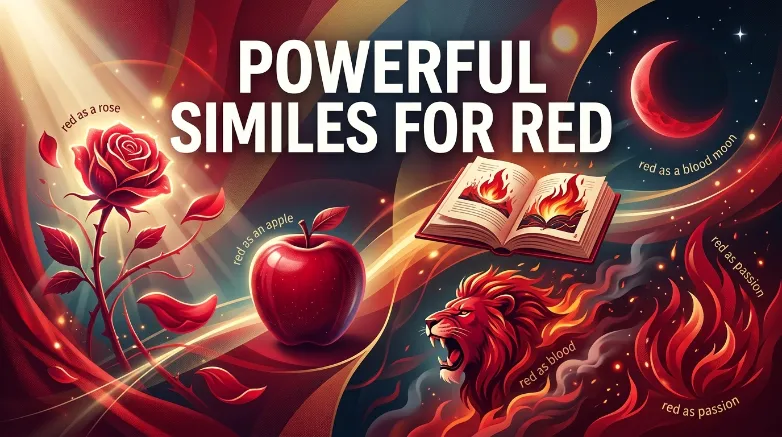
Red is one of the most striking colors in the English language. It can represent love, anger, courage, passion, danger, beauty, warmth, or celebration, depending on how it is used. That is why writers often rely on powerful similes for red to paint vivid pictures that readers can instantly imagine.
In this guide, you’ll discover a fresh collection of original similes for red, organized into easy-to-browse categories. You’ll also learn what makes a great simile, how to choose the right one, and why these comparisons make your writing stronger. Whether you’re writing a story, poem, speech, essay, or social media caption, you’ll find plenty of creative inspiration here.
What Are Powerful Similes for Red?
Powerful similes for red compare something to another object that is naturally red or strongly associated with the color. These comparisons use words like “as…as” or “like.”
Instead of simply saying someone looked red, a simile creates a memorable image.
For example:
- As red as a blazing sunset
- Like a glowing ruby
- As red as fresh cherries
Each comparison helps readers picture the exact shade, mood, or intensity.
Here’s why.
Different red objects create different emotions.
A rose suggests romance.
A firetruck suggests brightness.
A volcano suggests danger.
A crimson flag may suggest power or warning.
Choosing the right comparison makes your writing more expressive without adding unnecessary words.
Why These Similes Matter
Colors affect how readers feel before they even think about the words. A carefully chosen red simile can instantly make a sentence more emotional and memorable.
For example, compare these two sentences.
- Her cheeks turned red.
- Her cheeks turned as red as ripe strawberries.
The second sentence paints a clearer picture while adding warmth and personality.
Powerful similes also help you:
- Create vivid descriptions
- Show emotion without explaining it directly
- Improve storytelling
- Make poetry more expressive
- Strengthen speeches and essays
- Keep readers engaged
- Avoid repetitive descriptions
Now consider this.
Instead of repeating “very red” throughout your writing, you can choose a comparison that perfectly matches the scene.
How to Choose the Right Simile
Not every red object fits every situation. The best simile depends on the feeling you want your reader to experience.
Ask yourself these simple questions:
- Is the moment happy or sad?
- Is the red bright or dark?
- Is the emotion calm or intense?
- Should the comparison feel modern or poetic?
Simple Decision Table
| Writing Goal | Best Type of Red Simile | Example |
| Romance | Flowers, hearts, sunsets | As red as a velvet rose |
| Embarrassment | Faces, tomatoes, apples | As red as a ripe tomato |
| Anger | Fire, lava, flames | Like a furnace at full heat |
| Danger | Blood, warning lights, volcanoes | As red as an emergency flare |
| Nature Writing | Leaves, berries, birds | Like autumn maple leaves |
| Fantasy | Rubies, dragons, enchanted gems | As red as a dragon’s jewel |
| Children’s Stories | Candy, balloons, apples | As red as a shiny candy apple |
| Poetry | Dawn, roses, sunsets | Like the first blush of sunrise |
| Horror | Crimson skies, blood, glowing embers | As red as haunted embers |
| Celebration | Fireworks, ribbons, ornaments | Like festive holiday ribbons |
Choosing a simile that matches the mood keeps your writing believable and engaging.
Best Powerful Similes for Red
Positive and Beautiful Similes for Red
These similes celebrate beauty, warmth, joy, and elegance.
- As red as a blooming rose, perfect for describing romance and timeless beauty.
Example: Her smile was as red as a blooming rose beneath the evening light. - Like a polished ruby, ideal for luxury and brilliance.
Example: The pendant shone like a polished ruby. - As red as a glowing sunset, great for peaceful scenes.
Example: The horizon turned as red as a glowing sunset. - Like a basket of ripe cherries, cheerful and lively.
Example: The decorations looked like a basket of ripe cherries. - As red as a festive ribbon, excellent for holiday writing.
Example: The gift sparkled as red as a festive ribbon. - Like a fresh apple at harvest, warm and inviting.
Example: The orchard was filled with fruit like fresh apples at harvest. - As red as blooming poppies, ideal for spring descriptions.
Example: The meadow stretched as red as blooming poppies. - Like a velvet heart, soft and romantic.
Example: Her dress shimmered like a velvet heart. - As red as a cheerful balloon, playful and fun.
Example: The kite floated as red as a cheerful balloon. - Like a bright cardinal’s feathers, colorful and natural.
Example: His scarf stood out like a bright cardinal’s feathers. - As red as a carnival banner, energetic and festive.
Example: The entrance glowed as red as a carnival banner. - Like sparkling cranberry juice, fresh and vibrant.
Example: The drink glistened like sparkling cranberry juice. - As red as coral blossoms, tropical and unique.
Example: The garden bloomed as red as coral blossoms. - Like a painted autumn leaf, rich with seasonal charm.
Example: The forest looked like painted autumn leaves. - As red as a glowing lantern, comforting and welcoming.
Example: The porch light burned as red as a glowing lantern.
Emotional Similes for Red
These comparisons express strong feelings like embarrassment, love, excitement, and nervousness.
- As red as blushing cheeks, perfect for shy characters.
Example: Emma became as red as blushing cheeks after the compliment. - Like a racing heartbeat, ideal for excitement.
Example: His face flushed like a racing heartbeat. - As red as a secret finally revealed, symbolic and emotional.
Example: Her expression became as red as a secret finally revealed. - Like love written in color, poetic and heartfelt.
Example: The roses bloomed like love written in color. - As red as first love, soft and romantic.
Example: The evening sky felt as red as first love. - Like excitement bursting through a smile, energetic.
Example: Her cheeks glowed like excitement bursting through a smile. - As red as joyful laughter, expressive and warm.
Example: The decorations felt as red as joyful laughter. - Like happiness wrapped in velvet, elegant and emotional.
Example: The curtains looked like happiness wrapped in velvet. - As red as hopeful dreams, imaginative and uplifting.
Example: The painted sky became as red as hopeful dreams. - Like courage wearing crimson, symbolic and inspiring.
Example: The flag waved like courage wearing crimson. - As red as heartfelt gratitude, warm and sincere.
Example: Her bouquet seemed as red as heartfelt gratitude. - Like unforgettable memories, meaningful and nostalgic.
Example: The old scarf remained like unforgettable memories. - As red as silent affection, gentle and subtle.
Example: The tiny flowers glowed as red as silent affection. - Like warm family traditions, comforting.
Example: The ornaments hung like warm family traditions. - As red as an excited child’s smile, joyful and vivid.
Example: The balloons floated as red as an excited child’s smile.
Powerful and Intense Similes for Red
These similes emphasize strength, danger, determination, and raw energy.
- As red as molten lava, ideal for intense emotions.
Example: His anger burned as red as molten lava. - Like roaring flames, dramatic and energetic.
Example: The clouds glowed like roaring flames. - As red as a blazing furnace, perfect for heat.
Example: The metal became as red as a blazing furnace. - Like a volcano before eruption, full of tension.
Example: The sky looked like a volcano before the eruption. - As red as burning embers, rich and glowing.
Example: The fireplace remained as red as burning embers. - Like a warning flare, ideal for danger.
Example: The beacon flashed like a warning flare. - As red as a battle flag, symbolic of courage.
Example: The banner stood as red as a battle flag. - Like fierce determination, emotional and motivational.
Example: Her eyes shone like fierce determination. - As red as a charging wildfire, fast and unstoppable.
Example: The horizon spread as red as a charging wildfire. - Like lightning striking fire, highly dramatic.
Example: The explosion flashed like lightning striking fire. - As red as a warrior’s shield, bold and fearless.
Example: The emblem gleamed as red as a warrior’s shield. - Like glowing iron in a forge, strong and industrial.
Example: The steel burned like glowing iron in a forge. - As red as the heart of a volcano, vivid and unforgettable.
Example: The crater glowed as red as the heart of a volcano. - Like a phoenix rising through flames, symbolic of rebirth.
Example: The sunrise appeared like a phoenix rising through flames. - As red as unstoppable courage, inspirational and original.
Example: His determination stood as red as unstoppable courage.
Creative and Imaginative Similes for Red
These original comparisons work well in fantasy, creative writing, and descriptive storytelling.
- As red as a dragon’s treasured jewel.
Example: The crystal glowed as red as a dragon’s treasured jewel. - Like a sunset trapped inside glass.
Example: The ornament sparkled like a sunset trapped inside glass. - As red as a fire spirit’s cloak.
Example: The cape flowed as red as a fire spirit’s cloak. - Like enchanted rose petals drifting through the wind.
Example: The magical dust floated like enchanted rose petals drifting through the wind. - As red as a spell cast at sunrise.
Example: The glowing symbol appeared as red as a spell cast at sunrise. - Like the heartbeat of a phoenix.
Example: The gemstone pulsed like the heartbeat of a phoenix. - As red as a wizard’s glowing crystal.
Example: The staff shone as red as a wizard’s glowing crystal. - Like an enchanted cherry moon.
Example: The night sky glimmered like an enchanted cherry moon. - As red as a fairy’s secret garden.
Example: The flowers bloomed as red as a fairy’s secret garden. - Like a magical ember frozen in time.
Example: The gem sparkled like a magical ember frozen in time. - As red as the crown of a fire king.
Example: The royal jewel shone as red as the crown of a fire king. - Like crimson clouds painted by giants.
Example: The evening sky stretched like crimson clouds painted by giants. - As red as a comet wrapped in flames.
Example: The magical arrow flew as red as a comet wrapped in flames. - Like an ancient ruby awakening.
Example: The relic glowed like an ancient ruby awakening. - As red as the doorway to another world.
Example: The portal shimmered as red as the doorway to another world.
How to Use These Similes Naturally
The best similes feel effortless. They should strengthen your writing instead of distracting from it. A carefully chosen comparison gives readers a vivid picture without making the sentence feel forced.
Here’s the key.
Match the tone, setting, and emotion of your simile to the situation. A playful comparison works well in children’s stories, while a dramatic one fits action scenes or poetry.
Consider these examples:
In Everyday Conversation
Instead of saying:
His face became red.
Try:
His face turned as red as a ripe tomato after everyone laughed.
Instead of:
The flowers were red.
Say:
The flowers glowed like polished rubies beneath the morning sun.
In Creative Writing
Simple description:
The sky was red.
Improved description:
The evening sky stretched like a blazing furnace, filling the valley with fiery light.
Another example:
Her scarf was red.
Better version:
Her scarf fluttered like a cardinal’s feathers against the snowy landscape.
In Poetry
Poetry often benefits from softer, more symbolic comparisons.
Example:
Her heart bloomed like a crimson rose after spring rain.
Or:
The horizon blushed as red as hope returning at dawn.
In Stories
Character descriptions become more memorable with meaningful similes.
Example:
The dragon’s eyes glowed like burning embers hidden beneath ash.
Example:
The king’s cape flowed as red as a victorious banner.
In Essays
Even formal writing can include occasional similes when appropriate.
Example:
The warning signs spread across the city like bright red flags before a storm.
In Speeches
Powerful comparisons help audiences remember key points.
Example:
Let your determination burn like molten lava, impossible to stop.
Common Mistakes to Avoid
Even beautiful similes lose their impact when they are overused or poorly matched. Avoid these common mistakes to make your writing stronger.
Using Overly Common Comparisons
Some similes have appeared so often that they no longer surprise readers.
Examples include:
- As red as blood
- As red as a tomato
- Like fire
These still work, but mixing them with fresher comparisons creates more engaging writing.
Choosing the Wrong Mood
Not every red object carries the same feeling.
For example:
- Like a blooming rose fits romance.
- Like a warning flare fits danger.
- Like a carnival balloon fits celebration.
Using the wrong comparison can confuse readers.
Adding Too Many Similes
Every sentence does not need one.
For example:
The sunset was like lava, the flowers were like roses, the sky was like cherries, and the clouds were like ribbons.
This overwhelms the reader.
Instead, choose one strong comparison.
Mixing Different Images
Avoid combining unrelated comparisons.
Poor example:
His anger was like a rose, a volcano, and a strawberry.
Better:
His anger burned like molten lava.
The image stays focused.
Making Similes Too Complicated
Readers should understand your comparison immediately.
Instead of:
Like the crimson reflection bouncing from twenty enchanted mirrors beneath an ancient mountain.
Try:
Like a glowing ruby beneath sunlight.
Simple often creates the strongest image.
Tips for Writing Better Similes
Writing memorable similes becomes easier with practice. These techniques help you create comparisons that feel fresh and natural.
Observe Nature
Nature offers endless shades of red.
Notice:
- Sunsets
- Roses
- Poppies
- Cardinals
- Maple leaves
- Cherries
- Cranberries
- Coral flowers
These provide authentic inspiration.
Think Beyond Objects
Compare red to emotions, experiences, or ideas.
Examples:
- Like courage standing tall
- Like excitement before victory
- Like hope at sunrise
- Like celebration filling the streets
Abstract comparisons often feel more poetic.
Match the Context
Ask yourself:
- Is this scene peaceful?
- Is it dangerous?
- Is it funny?
- Is it romantic?
Then choose a comparison that supports that feeling.
Avoid Repeating the Same Image
If you’ve already used roses several times, switch to:
- Rubies
- Lanterns
- Embers
- Fireworks
- Autumn leaves
- Berries
- Crimson silk
Variety keeps readers interested.
Use the Five Senses
Great similes do more than describe color.
Think about:
- Heat
- Texture
- Movement
- Light
- Emotion
Example:
The banner waved like glowing embers carried by the wind.
Readers can almost see it moving.
Keep Your Audience in Mind
Children usually enjoy simple comparisons.
Example:
As red as a candy apple.
Adults often appreciate more symbolic language.
Example:
Like the final blaze of sunset before nightfall.
Read Your Sentence Aloud
If the simile sounds awkward, simplify it.
Natural rhythm makes writing more enjoyable to read.
Powerful Similes for Red in Different Writing Situations
Different writing situations need different comparisons. This table helps you choose the best powerful simile for red for your content.
| Writing Situation | Simile Type | Example | Purpose |
|---|---|---|---|
| Romance | Roses, hearts | As red as a velvet rose | Shows love |
| Poetry | Sunrises, dreams | Like the first blush of dawn | Adds beauty |
| Adventure | Fire, lava | As red as molten lava | Builds excitement |
| Fantasy | Dragons, gems | Like a dragon’s treasured ruby | Sparks imagination |
| Horror | Embers, crimson skies | As red as haunted embers | Creates suspense |
| Children’s Books | Apples, candy | Like a shiny candy apple | Keeps it simple |
| Nature | Berries, leaves | As red as autumn maple leaves | Adds realism |
| Speeches | Banners, flames | Like courage burning brightly | Inspires listeners |
| Essays | Signals, flags | As red as an emergency signal | Highlights ideas |
| Social Media | Cherries, sunsets | Like a sunset dipped in ruby | Grabs attention |
| Holidays | Ribbons, ornaments | As red as a festive ribbon | Creates a festive mood |
| Historical Fiction | Royal banners | Like a crimson royal banner | Fits the setting |
Choose a simile that suits your audience, tone, and purpose. The right comparison makes your powerful similes for red more vivid, natural, and memorable.criptions more vivid, memorable, and enjoyable to read.
Final Thoughts
Finding the perfect powerful similes for red is about more than choosing colorful words. The right comparison helps readers see, feel, and remember your writing. Whether you are describing a glowing sunset, an embarrassed face, a heroic banner, or a magical gemstone, a carefully selected simile adds depth and emotion. Instead of relying on the same familiar comparisons every time, explore fresh ideas that match your scene, audience, and purpose. A simple change from an ordinary description to a vivid simile can make a sentence stand out and leave a stronger impression on anyone who reads it.
As you continue writing, build a personal collection of your favorite red similes and practice using them in different situations. Experiment with comparisons inspired by nature, emotions, celebrations, or imagination until you discover what fits your style best. Reading your work aloud can also help you decide whether a simile sounds smooth and natural. The more thoughtfully you choose your comparisons, the more engaging and memorable your writing will become. With creativity and careful word choice, powerful similes for red can transform ordinary descriptions into vivid scenes that readers will easily picture and enjoy.
Frequently Asked Questions
What makes a simile for red more effective than simply saying something is red?
A strong simile gives readers a clear mental image instead of just naming a color. For example, saying “as red as a glowing ember” suggests warmth and intensity, while “as red as a ripe cherry” feels fresh and cheerful. The comparison adds mood as well as color.
Can I create my own powerful similes for red?
Absolutely. Original similes often make your writing more memorable. Think about objects, emotions, or scenes that naturally remind you of red. For example, instead of using a common comparison, you might write “like the last spark of a campfire at dusk” to create a unique image.
Are similes for red suitable for professional writing?
They can be, but only when they fit the purpose. Creative essays, speeches, presentations, and marketing content often benefit from vivid comparisons. However, highly technical or scientific documents usually require straightforward language instead of figurative expressions.
Which similes for red work best in children’s stories?
Children respond well to familiar and colorful objects. Comparisons such as “as red as a shiny apple,” “like a bright balloon,” or “as red as a juicy strawberry” are easy to understand and help young readers picture the scene quickly.
How can I avoid overusing red similes?
Use similes only where they add something meaningful. If every sentence contains a comparison, readers may lose interest. Instead, choose one or two strong similes in important moments and allow simple descriptions to balance the writing.
Should every red simile describe the same shade of red?
No. Red has many different shades and moods. A comparison to a ruby suggests a deep, rich color, while a comparison to coral flowers creates a lighter, softer image. Matching the shade to the situation makes your writing feel more accurate.
Are powerful similes for red useful in poetry?
Yes. Poetry often relies on vivid imagery to create emotion. A line such as “the horizon blushed like a crimson dream” evokes a stronger emotional response than simply stating that the sky was red. Symbolic comparisons also add rhythm and beauty.
How do I know if a simile sounds natural?
Read the sentence aloud. If the comparison flows smoothly and supports the surrounding description, it likely works well. If it feels forced or interrupts the sentence, try replacing it with a simpler or more familiar image that better fits the context.
Can red similes express emotions instead of physical color?
Definitely. Red is often associated with love, excitement, embarrassment, courage, and anger. For example, “his determination burned like glowing coals” emphasizes emotion rather than describing the actual color of an object, making the writing more expressive.
What is the biggest mistake writers make when using similes for red?
One common mistake is choosing comparisons that do not match the mood. A playful image like “as red as a candy apple” may feel out of place during a tense battle scene. Always select a simile that supports the emotion, setting, and audience of your writing.

Elliot Mason is a passionate English writer dedicated to making language learning clear, practical, and enjoyable. As an author at Grammar Alpha, he creates helpful content covering grammar, vocabulary, word meanings, sentence structure, common mistakes, and everyday English usage. His straightforward articles are designed for students, professionals, and English learners who want to communicate with greater confidence. Elliot believes that better English begins with understanding the basics, and his goal is to turn challenging language concepts into simple, useful lessons readers can apply every day.