
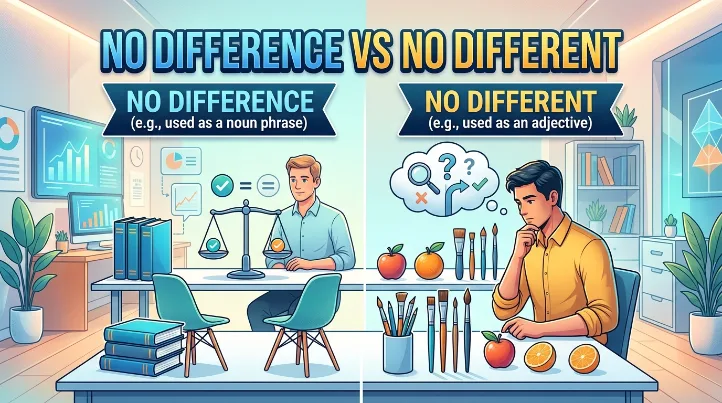
No difference vs no different is a common grammar question because the two expressions look almost identical, but they serve completely different grammatical roles. Many English learners, students, and even native speakers occasionally mix them up in writing or conversation.
Understanding the distinction is easier than it first appears. The key is recognizing that difference is a noun, while different is an adjective. Once you understand how nouns and adjectives work in a sentence, choosing the correct phrase becomes much more natural.
This guide explains the difference between no difference and no different, when to use each expression, common mistakes, sentence patterns, examples, and answers to frequently asked questions.
Here’s the simple truth:
No difference is normally a complete noun phrase.
No different is an adjective phrase that usually needs a comparison, such as from or than.
For example:
- ✅ There is no difference between the two phones.
- ✅ The second version is no different from the first.
The first sentence says that there is no distinction. The second describes one thing as being the same or similar to another.
No Difference vs No Different: The Core Rule Explained Simply
At its core, the distinction between no difference vs no different is based on parts of speech.
- Difference = noun
- Different = adjective
That single fact explains nearly every situation.
A noun names a person, place, thing, idea, or concept. A difference is something we can identify or discuss.
An adjective describes a person, place, thing, or situation. Different describes how one thing compares with another.
Because of this:
No difference usually means that there is no distinction or change.
No different usually means that something is not different from something else.
Compare these examples:
- There is no difference between the two answers.
- The second answer is no different from the first.
Both sentences communicate a similar overall idea, but their grammatical structures are different.
Understanding “No Difference”
No difference refers to the absence of any distinction, change, or variation between two or more things.
Because difference is a noun, it can be used in many different sentence structures.
Examples:
- I noticed no difference after updating the software.
- There was no difference in quality.
- Scientists found no difference between the groups.
- We saw no difference in customer satisfaction.
- The new recipe makes no difference to the final taste.
- There is no difference between these two options.
In each example, difference acts as a noun.
You can often recognize this structure because it follows verbs such as:
- notice
- see
- find
- make
- have
- show
- create
For example:
I noticed no difference.
Here, difference is the thing that was noticed.
No Difference vs No Different: Why “Difference” Is a Noun
One of the easiest ways to understand no difference vs no different is to look at the grammatical role of each word.
The word difference refers to a distinction or variation.
For example:
There is a difference between the two designs.
Here, difference is the subject of the sentence.
You can also say:
I can see a difference.
Here, difference is the object of the verb see.
You can make the noun negative by using no:
I can see no difference.
This means that you cannot identify any distinction.
Other examples include:
- We found no difference in the results.
- She noticed no difference in his behavior.
- The test showed no difference between the two samples.
- There was no difference in price.
- I can make no difference to the final decision.
The important point is that no difference is built around a noun.
Understanding “No Different”
Now let’s look at the other expression in no difference vs no different.
No different uses different, which is an adjective.
An adjective describes something.
For example:
This phone is different.
Here, different describes the phone.
When we say:
This phone is no different from the older model.
We are saying that the phone is not different from the older model.
Examples:
- This phone is no different from the older model.
- Her response was no different from yesterday’s.
- Life today is no different from life decades ago in some ways.
- My opinion is no different from yours.
- The final product looks no different from the prototype.
- His situation is no different from mine.
Notice that no different usually appears after a linking verb such as is, was, are, or looks.
The expression also normally introduces a comparison.
No Difference vs No Different: The Main Grammatical Difference
The easiest way to remember no difference vs no different is this:
No difference = noun phrase
No different = adjective phrase
Look at these two sentences:
There is no difference between the two products.
The two products are no different from each other.
The first sentence talks about the absence of a difference.
The second sentence describes the products as being the same or not different.
This is why you should not simply replace one expression with the other.
For example:
- ✅ There is no difference between them.
- ❌ There is no different between them.
And:
- ✅ The two products are no different from each other.
- ❌ The two products are no difference from each other.
The grammatical structures are different.
When Should You Use “No Difference”?
Use no difference when you want to say that there is no distinction, variation, or noticeable change.
It is especially common when discussing:
Results
The experiment showed no difference between the two groups.
Quality
There was no difference in the quality of the products.
Price
I found no difference in price between the two stores.
Appearance
I could see no difference between the original and the copy.
Performance
The update made no difference to the computer’s performance.
Opinions
There is no difference in our opinions on this issue.
The phrase is useful in both everyday English and formal writing.
When Should You Use “No Different”?
Use no different when you are describing one person, thing, place, or situation in comparison with another.
For example:
This method is no different from the previous one.
Here, different is describing this method.
More examples:
- My answer is no different from yours.
- The new version is no different from the old one.
- Her experience was no different from mine.
- The situation today is no different from last year.
- His explanation was no different from the one we heard earlier.
The comparison makes the meaning clear.
No Difference vs No Different Examples
Looking at the expressions side by side can make the distinction easier.
| No Difference | No Different |
| There is no difference between them. | They are no different from each other. |
| I noticed no difference. | The new version is no different from the old one. |
| We found no difference in quality. | This product is no different from that one. |
| The update made no difference. | The result is no different from before. |
| There was no difference in price. | His opinion is no different from mine. |
The first column uses difference as a noun.
The second uses different as an adjective.
Is “No Difference” Grammatically Correct?
Yes, no difference is completely grammatically correct.
It is a noun phrase that means there is no distinction, change, or variation.
For example:
There is no difference between these two sentences.
I noticed no difference after the update.
The study found no difference between the groups.
The expression is natural in everyday conversation, academic writing, business communication, and many other contexts.
You can also use it in common expressions such as:
- It makes no difference.
- There is no difference.
- I see no difference.
- We found no difference.
- It made no difference to me.
Is “No Different” Grammatically Correct?
Yes, no different can also be grammatically correct.
However, it normally works as part of a comparison.
For example:
The new design is no different from the old design.
Her answer was no different from mine.
This situation is no different from what happened before.
The expression can sometimes appear without from or than when the comparison is already obvious from the context.
For example:
The sequel is no different.
This could be perfectly understandable if everyone already knows that the speaker is comparing the sequel with the original movie.
However, when writing a standalone sentence, adding the comparison usually makes the meaning clearer.
No Different From vs No Different Than
A common question related to no difference vs no different is whether you should say no different from or no different than.
Both forms are used in English.
No Different From
No different from is widely accepted and is traditionally preferred in formal writing.
Examples:
- The new system is no different from the old one.
- Her experience was no different from mine.
- This problem is no different from the previous problem.
If you are unsure which form to use in academic or professional writing, no different from is generally a safe choice.
No Different Than
No different than is also common, particularly in American English.
Examples:
- The new system is no different than the old one.
- His response was no different than hers.
- The situation is no different than it was before.
The choice can depend on regional preference and style.
No Difference vs No Different in Academic Writing
Both expressions can appear in academic writing, but they are used differently.
No difference is especially common when discussing research results, measurements, experiments, or statistical findings.
For example:
The study found no difference between the control group and the experimental group.
Another example:
Researchers observed no difference in the participants’ responses.
In these sentences, difference refers to the absence of a measurable distinction.
No different, on the other hand, can be used when describing one result, condition, or situation as similar to another.
For example:
The results were no different from those reported in the previous study.
Both structures are correct, but their grammatical roles remain different.
Common Mistakes With No Difference vs No Different
Learners often make a few predictable mistakes when using these expressions.
Mistake 1: Using “No Different” as a Noun
Incorrect:
❌ There is no different between the two products.
Correct:
✅ There is no difference between the two products.
Why?
Because the sentence needs a noun after no in this structure. Difference is the noun.
Mistake 2: Using “No Difference” After “Is”
Incorrect:
❌ This phone is no difference from mine.
Correct:
✅ This phone is no different from mine.
Why?
After the linking verb is, the sentence needs an adjective to describe the phone. Different is the adjective.
Mistake 3: Forgetting the Comparison
Less natural in a standalone sentence:
The new version is no different.
Better:
The new version is no different from the old version.
The shorter sentence can still be correct when the comparison is already understood, but the longer structure is clearer when there is no previous context.
Mistake 4: Confusing “Difference” With “Different”
Remember:
Difference = a thing or concept
Different = a description
Compare:
I noticed a difference.
The two products are different.
This simple contrast can help you remember the correct structure.
No Difference vs No Different in Everyday Conversation
In everyday English, both expressions are useful.
Imagine that two friends are comparing two phones.
One person might say:
I tried both phones, but I noticed no difference.
The other person might say:
The second phone is no different from the first one.
Both sentences communicate a similar idea, but the grammatical structure is different.
Another example:
There is no difference between these two shirts.
versus:
These two shirts are no different from each other.
The first sentence focuses on the absence of a difference.
The second focuses on describing the shirts.
A Simple Trick to Remember No Difference vs No Different
If you regularly confuse these expressions, use this simple memory trick.
Ask yourself:
Am I naming a difference, or am I describing something?
If you are naming the absence of a difference, use:
No difference
If you are describing something as not different from another thing, use:
No different from
For example:
I see no difference.
You are talking about the thing called a difference.
But:
It is no different from mine.
You are describing it.
This quick question can help you choose the correct expression in most situations.
No Difference vs No Different: Quick Comparison
Here is the simplest comparison:
No difference
- Uses a noun.
- Refers to the absence of a distinction.
- Can usually stand as a complete noun phrase.
- Common with there is, notice, see, find, and make.
- Example: There is no difference between the two answers.
No different
- Uses an adjective.
- Describes something as not different.
- Usually appears after a linking verb.
- Commonly takes from or than.
- Example: The second answer is no different from the first.
Once you recognize the noun-versus-adjective distinction, the choice becomes much easier.
No Difference vs No Different: More Example Sentences
Here are some additional examples to help you understand the pattern.
Examples With No Difference
- There is no difference between the two plans.
- I noticed no difference after changing the settings.
- The researchers found no difference between the groups.
- This small adjustment made no difference.
- We could see no difference in the final results.
- There was no difference in the quality of the materials.
- The new method made no difference to the outcome.
- I can find no difference between these images.
- The two products have no difference in price.
- The change made no difference to our decision.
Examples With No Different
- This model is no different from the previous model.
- Her answer was no different from mine.
- The new process is no different from the old process.
- His experience was no different from ours.
- The final result was no different from what we expected.
- This situation is no different from the previous one.
- The second option is no different from the first.
- Their approach is no different from ours.
- The new policy is no different from the old policy.
- The latest version looks no different from the original.
Can “No Difference” and “No Different” Be Interchanged?
Usually, no.
Although the two expressions can communicate a similar general idea, they are not grammatically interchangeable.
For example:
There is no difference between the two products.
You cannot replace difference with different:
❌ There is no different between the two products.
Likewise:
The products are no different from each other.
You cannot replace different with difference:
❌ The products are no difference from each other.
The words may be related in meaning, but their grammatical functions are different.
Why Do People Confuse No Difference vs No Different?
The confusion is understandable because difference and different come from the same word family.
They both relate to the idea of things not being the same.
However, English uses them differently.
Difference is a noun:
There is a difference.
Different is an adjective:
They are different.
When you add no, you get:
There is no difference.
and:
They are no different from each other.
Learning the word family and the grammatical role of each word is more useful than simply memorizing individual sentences.
Conclusion
Choosing between no difference vs no different becomes much easier once you understand the role each phrase plays in a sentence. No difference is a noun phrase that refers to the absence of any distinction, while no different is an adjective phrase used to compare one thing with another.
The key difference is simple: difference is a noun, whereas different is an adjective. This grammatical distinction explains why the two expressions cannot normally be used interchangeably.
Use no difference when you want to say that two things have no noticeable distinction, change, or variation. For example, There is no difference between the two products clearly states that the products have no meaningful distinction.
Use no different when describing one thing in relation to another. For example, The new product is no different from the old one describing the new product as being the same or similar to the old product.
You should also remember that no different from is generally a clear and widely accepted choice, especially in formal writing. No different than is also used, particularly in American English.
Instead of memorizing dozens of individual sentences, focus on identifying whether your sentence needs a noun or an adjective. That simple habit will make your English grammar more accurate and natural.
The easiest rule to remember is:
No difference = absence of a distinction.
No different = comparison with something else.
Once this distinction becomes familiar, choosing between no difference and no different will feel much more natural. Whether you are writing an academic paper, a business email, a blog post, or simply speaking English in everyday life, understanding this small grammatical difference can help make your communication clearer, smoother, and more professional.
Frequently Asked Question
Is “no difference” grammatically correct?
Yes, no difference is completely grammatically correct. It is a noun phrase that means there is no distinction between two or more things. It commonly appears in expressions such as there is no difference, I noticed no difference, and we found no difference between the results.
Is “no different” grammatically correct?
Yes, no different can also be grammatically correct, but it has a different grammatical function. It is an adjective phrase and usually compares one thing with another. For example, The new policy is no different from the old one is correct.
What is the main difference between no difference and no different?
The main distinction is grammatical. Difference is a noun, while different is an adjective. Use no difference when referring to the absence of a distinction. Use no different when describing one thing as similar to another.
Should I use “no different from” or “no different than”?
Both forms are used in English. No different from is widely accepted and is often preferred in formal writing. No different than is also common, especially in American English. For formal or academic writing, no different from is generally a safe choice.
Can “no difference” be used in academic writing?
Yes. No difference is very common in academic writing, especially when describing research findings, experiments, measurements, or statistical results. For example, researchers may report that a study found no difference between the two groups.
Can “no different” appear without “from” or “than”?
Yes, but the comparison should normally be clear from the context. For example, The sequel is no different can be understood if the listener already knows that it is being compared with the original. In a standalone sentence, no different from is usually clearer.
Why do learners confuse these two expressions?
Learners often confuse them because difference and different are closely related words. Both communicate ideas about comparison and similarity. The easiest solution is to remember that difference is a noun, while different is an adjective.
Do native English speakers make mistakes with these phrases?
Native speakers can sometimes use informal or shortened structures, especially in casual conversation. However, in careful writing, using the appropriate noun or adjective structure makes the sentence clearer and more professional.
Which expression is more common in everyday English?
Both are common, but they are used in different structures. No difference is often used when discussing changes, results, or distinctions. No different is generally used when directly describing one thing in relation to another.
How can I remember which one to use?
Associate difference with a thing because it is a noun, and associate different with a description because it is an adjective. Ask yourself whether you are talking about the absence of a difference or describing something as not different from another thing.

Alexander Brooks is an experienced English writer and language educator focused on helping readers build grammar, vocabulary, writing, and communication skills. At Grammar Alpha, he creates accurate, well-researched, and practical content designed for students, professionals, and English learners. His work explains grammar rules, word usage, sentence structure, and common mistakes in clear, accessible language. Alexander values accuracy, clarity, and trustworthy information, with a goal of making English learning easier while helping readers communicate confidently and effectively in professional and daily situations.