
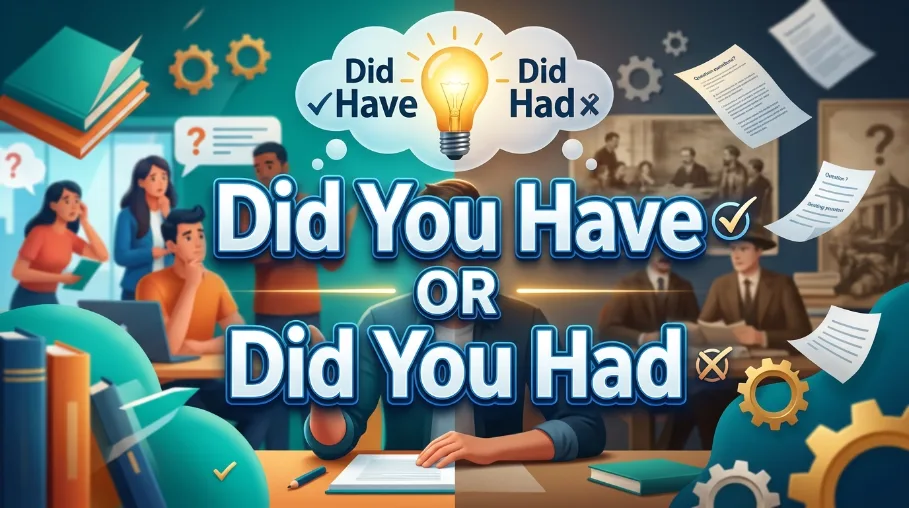
Using “did you have” or “did you had” correctly is a common grammar question for English learners. Both phrases refer to the past, but only one is grammatically correct in standard English.
The correct phrase is “did you have.” The phrase “did you had” is incorrect because the helping verb did already places the sentence in the past tense. After did, the main verb must remain in its base form.
This simple rule is useful in everyday conversations, school assignments, professional emails, interviews, and English tests. Once you understand how did works as an auxiliary verb, this mistake becomes much easier to avoid.
The Core Rule Explained Simply
Whenever you use did in a question or negative sentence, the verb that follows must be in its base form.
For example:
- ✅ Did you have lunch?
- ✅ Did she call you?
- ✅ Did they finish the project?
Not:
- ❌ Did you had lunch?
- ❌ Did she called you?
- ❌ Did they finished the project?
The helping verb already shows that the sentence refers to the past. Therefore, the main verb does not need to change to its past form.
The basic formula is:
Did + subject + base verb
For example:
Did + you + have + lunch?
Understanding the Role of “Did”
The word did is an auxiliary verb, also called a helping verb. It is commonly used to form:
- Questions
- Negative sentences
- Emphatic statements
When did is used, the main verb stays in its base form.
Examples:
- Did you eat breakfast?
- Did he drive home?
- Did they arrive early?
- Did we make the right decision?
Notice that the verbs remain eat, drive, arrive, and make, rather than ate, drove, arrived, or made.
Why “Did You Had” Is Incorrect
Many learners assume that both verbs should be in the past because the sentence refers to something that already happened.
Consider:
❌ Did you had dinner?
The problem is that did has already marked the sentence as past tense. The verb had is also a past form of have, so using both together creates an incorrect construction.
The correct sentence is:
✅ Did you have dinner?
Only the auxiliary verb did carry the past tense in a simple past question. The main verb returns to its base form.
Did You Have or Did You Had; Side-by-Side Comparison
| Situation | Correct Example | Incorrect Example |
| Asking about possession | ✅ Did you have enough money? | ❌ Did you had enough money? |
| Asking about an experience | ✅ Did you have fun? | ❌ Did you had fun? |
| Asking about food | ✅ Did you have breakfast? | ❌ Did you had breakfast? |
| Asking about time | ✅ Did you have time to finish? | ❌ Did you had time to finish? |
| Asking about a meeting | ✅ Did she have a meeting? | ❌ Did she had a meeting? |
| Past negative | ✅ I didn’t have any questions. | ❌ I didn’t had any questions. |
When to Use “Did You Have”
Use “did you have” when asking about something that happened or existed in the past.
The question may be about an experience, possession, meal, event, opportunity, feeling, or situation.
Examples:
- Did you have a good weekend?
- Did you have any questions?
- Did you have enough sleep?
- Did you have trouble finding the office?
- Did you have permission to enter?
The structure remains:
Did + subject + base verb
Examples in Everyday Conversations
At school:
Teacher: Did you have enough time to finish the exam?
Student: Yes, I did.
At work:
Manager: Did you have a chance to review the report?
Employee: Yes, I finished reading it yesterday.
At home:
Parent: Did you have dinner already?
Child: Yes, about an hour ago.
With friends:
Friend: Did you have fun at the concert?
Response: Absolutely. It was amazing.
While traveling:
Hotel receptionist: Did you have any problems finding the hotel?
Guest: No, everything went smoothly.
Different Types of Questions Using “Did You Have”
You can use this structure in many situations.
Experiences
- Did you have fun?
- Did you have a good vacation?
- Did you have an enjoyable weekend?
Possessions
- Did you have your passport?
- Did you have enough cash?
- Did you have your phone with you?
Health
- Did you have a headache?
- Did you have a fever?
- Did you have any pain afterward?
Meetings
- Did you have a meeting today?
- Did you have time to speak with the client?
- Did you have an appointment?
Education
- Did you have homework?
- Did you have class yesterday?
- Did you have any questions during the lecture?
Although the situations change, the grammar pattern stays the same.
Positive, Negative, and Question Forms
Understanding these three forms makes the rule easier to remember.
Positive statement:
- You had breakfast.
Question:
- Did you have breakfast?
Negative:
- You didn’t have breakfast.
Notice that the positive statement uses had because there is no auxiliary did.
The question and negative sentence use have because did or didn’t already expresses the past.
| Positive Statement | Question | Negative Statement |
| She had a meeting. | Did she have a meeting? | She didn’t have a meeting. |
| They had enough food. | Did they have enough food? | They didn’t have enough food. |
| We had time. | Did we have time? | We didn’t have time. |
| He had permission. | Did he have permission? | He didn’t have permission. |
Did You Have or Did You Had; Examples Across Different Tenses
The form of have changes depending on the tense and structure.
Present:
- Do you have a car?
Simple past:
- Did you have a car?
Future:
- Will you have a car next year?
Present perfect:
- Have you had a car before?
Past perfect:
- Had you had a car before moving abroad?
Each tense follows its own grammatical pattern.
When Does “Had” Become the Correct Choice?
Now that you know why “did you have” is correct, you may wonder when had ” should be used.
Use had when it functions as the main verb in a past-tense statement or when it forms part of the past perfect tense.
Using “Had” in Positive Statements
Examples:
- I had a great day.
- She had three meetings yesterday.
- They had enough food for everyone.
- We had an exciting vacation.
- He had plenty of time before the deadline.
There is no did in these sentences, so had correctly expresses the past.
Compare:
| Statement | Question |
| I had breakfast. | Did you have breakfast? |
| She had a meeting. | Did she have a meeting? |
| They had enough money. | Did they have enough money? |
| We had visitors. | Did you have visitors? |
Using “Had” in the Past Perfect Tense
Had is also used to form the past perfect tense.
The basic formula is:
Had + past participle
The past perfect is generally used to show that one past action happened before another past action.
Examples:
- She had finished the report before the meeting started.
- They had already left when I arrived.
- I had eaten before the movie began.
- We had completed the project before the deadline.
- He had forgotten his keys before leaving home.
Did You Have or Did You Had; Questions in the Past Perfect
Past perfect questions begin with had, not did.
Examples:
- Had you finished your homework before dinner?
- Had they arrived before the rain started?
- Had she spoken to the manager earlier?
- Had we met before that conference?
These questions are different from simple past questions because they refer to an earlier action in relation to another past event.
Pattern Comparison
Simple past statement:
Subject + had + object
Example:
- She had a bicycle.
Simple past question:
Did + subject + have + object
Example:
- Did she have a bicycle?
Past perfect statement:
Subject + had + past participle
Example:
- She had bought a bicycle before college.
Past perfect question:
Had + subject + past participle
Example:
- Had she bought a bicycle before college?
These structures may all refer to the past, but they serve different grammatical purposes.
“Did You Have” vs. “Had You”
The phrases “did you have” and “had you” can both refer to the past, but they are used differently.
“Did You Have”
Did you have is normally used for a simple past question.
Examples:
- Did you have breakfast?
- Did you have enough sleep?
- Did you have a ticket?
- Did you have any questions?
The speaker is simply asking about a past event, situation, possession, or experience.
“Had You”
Had you is commonly used to form a past perfect question.
Examples:
- Had you finished eating before they arrived?
- Had you met him before the conference?
- Had you completed the assignment before class?
Here, two past events are connected, and the speaker is asking about the earlier one.
Comparing the Meaning
Did you have dinner?
This asks whether dinner happened.
Had you had dinner before the movie started?
This asks whether dinner had already happened before another past event.
The second sentence contains had had, which is grammatically correct because the first had is the auxiliary for the past perfect, while the second had is the past participle of have.
Did You Have or Did You Had; Why the Confusion Persists
People Associate Every Past Event with a Past Verb
Many learners think every verb in a past-tense sentence must appear in its past form.
For example, they may think:
❌ Did you went?
But English uses:
✅ Did you go?
The same rule applies to have:
❌ Did you had?
✅ Did you have?
Other examples include:
- ❌ Did she saw him?
- ✅ Did she see him?
- ❌ Did they came early?
- ✅ Did they come early?
- ❌ Did he ate lunch?
- ✅ Did he eat lunch?
Native Language Influence
Learners may transfer grammar patterns from their first language into English. In some languages, the main verb may remain in a past form even when another word marks the past.
English follows a different pattern when using did.
Learning Through Conversation
Fast spoken English can sometimes make grammatical patterns difficult to recognize. Learners may hear a phrase incorrectly and later reproduce it in writing.
Reading correct examples can help reinforce the proper structure.
Irregular Verbs Cause Extra Problems
English contains many irregular verbs:
- Go → went
- Eat → ate
- See → saw
- Have → had
- Come → came
- Buy → bought
Because these forms are common, learners may assume they should always be used when talking about the past.
However, after did, the base form is required:
- Did you go?
- Did you eat?
- Did you see?
- Did you have one?
- Did you come?
- Did you buy it?
Formal vs. Casual Contexts
The grammar rule for “did you have” does not change between formal and casual English.
What changes is the vocabulary and tone.
Formal Examples
- Did you have an opportunity to review the proposal?
- Did you have sufficient information to complete the task?
- Did you have any concerns about the new policy?
- Did you have access to the required documents?
- Did you have time to attend the meeting?
Casual Examples
- Did you have fun?
- Did you have lunch yet?
- Did you have a good day?
- Did you have enough sleep?
- Did you have your keys?
The grammar remains the same in both situations.
What to Avoid
Avoid these incorrect forms:
- ❌ Did you had time?
- ❌ Did you had lunch?
- ❌ Did you had any questions?
- ❌ Did she had enough experience?
Use:
- ✅ Did you have time?
- ✅ Did you have lunch?
- ✅ Did you have any questions?
- ✅ Did she have enough experience?
Did You Have or Did You Had; Common Mistakes
Using Two Past Forms Together
A common mistake is using did followed by another past-tense verb.
Incorrect:
- ❌ Did you had breakfast?
- ❌ Did she went home?
- ❌ Did they saw the movie?
Correct:
- ✅ Did you have breakfast?
- ✅ Did she go home?
- ✅ Did they see the movie?
Confusing “Have” With “Had”
Many learners automatically change when they think about the past.
Instead, check whether it is already present.
If did is used, the main verb should normally remain in its base form.
Mixing Tenses
Incorrect:
- ❌ Did you have finished the report?
Correct options:
- ✅ Did you finish the report?
- ✅ Had you finished the report before the meeting?
Use the simple past or past perfect according to the meaning you want to express.
Forgetting the Base Form Rule
The same rule applies to many verbs:
| Incorrect | Correct |
| ❌ Did you wrote? | ✅ Did you write? |
| ❌ Did she drove? | ✅ Did she drive? |
| ❌ Did they took it? | ✅ Did they take it? |
| ❌ Did he made it? | ✅ Did he make it? |
| ❌ Did we found it? | ✅ Did we find it? |
Easy Memory Hacks
Hack 1: One Past Marker Is Enough
Think of did as carrying the past tense.
Because did already shows the past, the main verb does not need to change.
✅ Did you have?
❌ Did you had?
Hack 2: Use the Dictionary Form
After did, think of the dictionary form of the verb.
- have
- eat
- go
- write
- make
So:
- Did you have it?
- Did you eat?
- Did you go?
- Did you write?
- Did you make it?
Hack 3: Remember the Formula
Did + subject + base verb
For example:
Did + you + have + breakfast?
Hack 4: Swap the Verb
If you’re unsure about have, replace it with another verb.
You would not say:
❌ Did you went?
You would naturally say:
✅ Did you go?
The same rule applies to have:
❌ Did you had?
✅ Did you have?
Hack 5: Spot the Double Past
Whenever you see did followed by a past-tense verb, stop and check the sentence.
For example:
❌ Did she went?
✅ Did she go?
Quick Reference Table
| Situation | Correct Form |
| Simple past question | Did you have…? |
| Simple past statement | I had… |
| Past negative | I didn’t have… |
| Past perfect statement | I had finished… |
| Past perfect question | Had you finished…? |
| Incorrect simple past question | Did you had…? ❌ |
| Asking about possession | Did you have enough money? |
| Asking about an experience | Did you have fun? |
Advanced Examples
Sometimes have can appear more than once in a sentence, which can be confusing.
For example:
Did you have a good day?
This is a simple past question.
But:
Had you had a good day before the meeting started?
This is a past perfect question. The first had is the auxiliary verb, while the second had is the past participle of have.
Another example:
Did she have breakfast before class?
Simple past.
Had she had breakfast before class started?
Past perfect.
Understanding the role of each hand makes these sentences easier to understand.
Why Correct Grammar Matters
Correct grammar makes your writing clearer and easier to understand. It can also help your content appear more polished and trustworthy.
For students, understanding auxiliary verbs can help with grammar exercises and English tests.
For bloggers, businesses, and content creators, clear writing improves readability and helps readers understand the information quickly.
Grammar itself is not a direct search-ranking factor, but high-quality, readable content can create a better experience for visitors.
A Quick Quiz
Fill in each blank with the correct word.
- ______ you have enough time to finish the assignment?
- She ______ a wonderful vacation last summer.
- They ______ already left before we arrived.
- ______ he have any questions after the presentation?
- I ______ a headache yesterday morning.
- ______ you have breakfast before school?
- We ______ completed the project before the deadline.
- ______ they have permission to enter the building?
Answer Key
- Did
- had
- had
- Did
- had
- Did
- had
- Did
Conclusion
Choosing between “did you have” and “did you had” becomes easy once you understand the role of the helping verb did.
In simple past questions and negative sentences, did already shows the past tense, so the main verb remains in its base form.
That is why:
✅ Did you have?
is correct, while:
❌ Did you had?
is incorrect in standard English.
The same rule applies to other verbs:
- Did you go?
- Did she see?
- Did they eat?
- Did he write?
- Did you have it?
The easiest formula to remember is:
Did + subject + base verb
Once this pattern becomes familiar, you’ll be able to avoid one of the most common English grammar mistakes.
Frequently Asked Questions
Is “did you had” ever grammatically correct?
No. “Did you had” is not correct in standard English when “had” is being used as the main verb after the auxiliary did.
The correct form is:
✅ Did you have?
Why is “did you have” correct?
Did already mark the sentence as past tense. Therefore, the main verb remains in its base form.
Did + you + have
Can I use “had” after “did”?
Not when had is the main verb in a simple past question or negative sentence.
Incorrect:
❌ Did you had lunch?
Correct:
✅ Did you have lunch?
However, had can appear elsewhere in a sentence after did when it has a different grammatical role. For example:
Did you know that she had already left?
Here, had belongs to the past perfect clause, not directly to the did question structure.
What’s the difference between “did you have” or “did you had”?
Did you have is normally a simple past question:
Did you have breakfast?
Had you is commonly used to form a past perfect question:
Had you finished breakfast before the meeting started?
The second structure connects an earlier past event with another past event.
Does this rule apply to all verbs?
The base-form rule applies to the main verb after did.
For example:
- Did you go?
- Did she write?
- Did they eat?
- Did he make it?
- Did you have lunch?
Not:
- ❌ Did you went?
- ❌ Did she wrote?
- ❌ Did they ate?
- ❌ Did he made it?
- ❌ Did you had lunch?
Is “didn’t have” correct?
Yes.
I didn’t have enough time.
The negative auxiliary didn’t already mark the past, so the main verb stays as have.
Will using “did you had” affect my writing?
Yes. In formal, academic, and professional writing, “did you had” is considered a grammatical error and can make your writing look less polished.
Use “did you have” instead.
Do native English speakers ever make this mistake?
Native speakers normally use “did you have” automatically. The incorrect form may occasionally appear in nonstandard speech or writing, but it is not the standard grammatical form.
How can I practice using “did you have” correctly?
Practice making simple past questions using the formula:
Did + subject + base verb
For example:
- Did you have a good weekend?
- Did you have enough time?
- Did you have breakfast?
- Did she have any questions?
The more you practice this pattern, the more natural it becomes
Quick answer:
Did you have it? ✅
Did you have one? ❌
Remember: After “did,” use the base form of the verb.

Ethan Walker is a passionate English writer dedicated to making English grammar, vocabulary, and writing skills simple, practical, and engaging. At Grammar Alpha, he creates clear content covering grammar rules, word meanings, sentence structure, common English mistakes, punctuation, and everyday English usage. His articles help students, professionals, and English learners improve their communication skills and write with confidence. Ethan believes learning starts with clarity, and his goal is to turn complex language topics into lessons readers can understand and apply.