
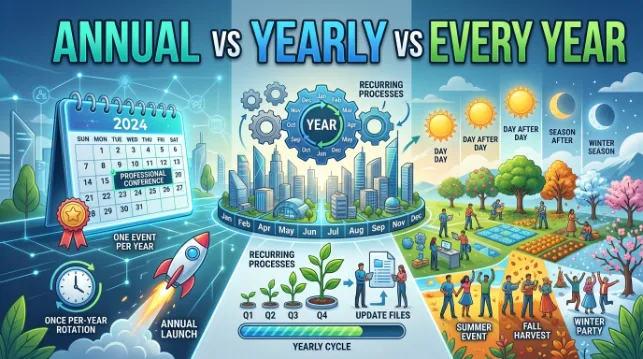
Choosing between annual vs yearly vs every year can seem easy until you start writing professionally. These three expressions all relate to something that happens once every twelve months, yet they are not always interchangeable. The differences involve grammar, tone, style, and context, not just meaning.
Whether you’re writing a business report, academic paper, email, website content, or casual message, knowing when to use annual vs yearly vs every year helps your writing sound more natural and authoritative. Although the basic meaning overlaps, each option has a preferred place in English.
Here’s the good news.
The rules are much simpler than they appear.
Once you understand how each expression functions in a sentence, choosing the correct one becomes automatic.
Annual vs Yearly vs Every Year: The Core Rule Explained Simply
At the most basic level, all three expressions refer to something occurring once each year.
The main difference is how they function.
- Annual is primarily an adjective and sounds more formal.
- Yearly is usually an adjective or adverb and feels more conversational.
- Every year is an adverbial phrase that emphasizes repetition over time.
Think of them this way.
If you’re describing a noun, choose between annual and yearly.
If you’re describing an action, every year often works best.
Annual
Annual usually appears before a noun.
Examples:
- Annual meeting
- Annual report
- Annual budget
- Annual conference
- Annual salary
It is extremely common in professional, legal, academic, financial, and government writing.
Yearly and Every Year
Yearly can modify both nouns and verbs.
Examples:
- Yearly inspection
- The company reviews salaries yearly.
Every year functions as a phrase describing when something happens.
Examples:
- We travel every year.
- They update the software every year.
- The flowers bloom every year.
Side-by-Side Comparison Table
| Situation | Example | Meaning | Correct Usage |
| Business document | Annual report | Official yearly publication | Annual |
| School schedule | Annual sports day | Event held once each year | Annual |
| Casual conversation | We visit every year. | Repeated yearly action | Every year |
| Personal routine | I get a checkup yearly. | Happens once each year | Yearly |
| Budget planning | Annual expenses | Expenses for one year | Annual |
| Gardening | Flowers bloom every year. | Natural yearly repetition | Every year |
| Company review | Yearly performance review | Once each year | Yearly |
| Financial planning | Annual income | Income earned in one year | Annual |
When to Use Annual
Annual is the standard choice whenever you’re describing something official, organized, or formal.
It gives writing a polished, professional tone. Because of this, you’ll see it in business documents, newspapers, research papers, and government publications.
Common combinations include:
- Annual report
- Annual conference
- Annual revenue
- Annual budget
- Annual meeting
- Annual leave
- Annual review
- Annual subscription
Notice something?
Nearly all of these involve organizations, institutions, or structured activities.
Examples:
- The company released its annual report yesterday.
- Our annual conference attracts thousands of visitors.
- Employees receive an annual performance review.
- The school hosts an annual science fair.
- We prepared the annual financial statement.
Quick Test
Choose annual if the noun sounds like an official event or document.
Ask yourself:
- Is it a report?
- Is it a meeting?
- Is it a budget?
- Is it an event?
- Is it a formal publication?
If the answer is yes, annual is probably the strongest choice.
Common Patterns with Annual
You’ll frequently encounter these phrases:
- Annual fee
- Annual subscription
- Annual rainfall
- Annual income
- Annual survey
- Annual celebration
- Annual award ceremony
- Annual audit
- Annual inspection
- Annual maintenance
These combinations have become standard English expressions.
When to Use Yearly
Yearly is slightly less formal than annual, although both are grammatically correct in many situations.
It works well when discussing habits, schedules, or repeated activities without emphasizing official status.
Examples:
- We conduct yearly inspections.
- She schedules a yearly checkup.
- The club organizes a yearly picnic.
- They publish a yearly newsletter.
Notice the difference?
These examples sound more conversational than those using annual.
Yearly as an Adverb
Unlike annual, yearly can also function as an adverb.
Examples:
- We travel yearly.
- Salaries increase yearly.
- The competition is held yearly.
This usage is grammatically correct, although many writers prefer it every year because it sounds more natural.
Patterns with Yearly
You’ll often hear:
- Yearly vacation
- Yearly expenses
- Yearly tradition
- Yearly review
- Yearly inspection
- Yearly celebration
- Yearly reminder
The Meaning Shift
Although all three expressions indicate once per year, they create slightly different impressions.
Annual suggests organization, planning, and professionalism.
Example:
- The museum released its annual report.
This feels official.
Yearly emphasizes frequency but sounds more neutral.
Example:
- We have a yearly family reunion.
This feels friendly and conversational.
Every year highlights repeated action.
Example:
- We visit the beach every year.
The focus is on the action rather than the noun.
That subtle distinction influences the overall tone of your writing.
Why Annual vs Yearly vs Every Year Can Be Confusing
Many learners assume these expressions are exact synonyms because dictionaries often define them similarly.
That creates confusion.
Native speakers often choose among them based on style, context, and common usage.
Another reason is that textbooks rarely explain collocations.
For example, native speakers almost always say:
- Annual report
- Annual meeting
- Annual conference
Even though the yearly report is understandable, it sounds less natural.
Likewise, people often prefer:
- We travel every year.
instead of:
- We travel yearly.
Both are correct, but one sounds more idiomatic.
Exposure to authentic English eventually teaches these preferences.
Annual vs Yearly vs Every Year in Formal and Casual Contexts
Choosing the right expression depends heavily on the situation.
Formal Writing
Professional documents generally favor annual expressions.
Examples:
- Annual review
- Annual earnings
- Annual conference
- Annual assessment
- Annual budget
These phrases appear in business, education, finance, healthcare, and law.
Casual Writing
Daily conversation is often favoured every year.
Examples:
- We go camping every year.
- I replace my phone every year.
- We celebrate together every year.
These sound natural and effortless.
Neutral Writing
Yearly sits comfortably between the two.
Examples:
- Yearly maintenance
- Yearly cleaning
- Yearly vacation
- Yearly planning
It is neither especially formal nor especially informal.
Case Studies / Pop Culture Examples
Many organizations consistently use annual in their official communications.
Examples include:
- Annual shareholder meeting
- Annual financial report
- Annual awards ceremony
- Annual membership fee
- Annual fundraising event
Educational institutions also rely heavily on annuals.
Examples:
- Annual graduation ceremony
- Annual alumni reunion
- Annual research symposium
In contrast, everyday speech typically sounds different.
Friends commonly say:
- We meet every year.
- We travel every year.
- We watch that movie every year.
Families also prefer:
- Our yearly vacation.
- Our yearly tradition.
The pattern becomes obvious once you compare formal documents with casual conversation.
Advanced Scenarios & Flowchart
Use this simple guide whenever you’re unsure.
Is it describing a noun?
Yes
Is the noun formal or official?
Yes
Use Annual
No
Use Yearly
No
Is it describing when an action happens?
Yes
Use Every year
No
Consider whether Yearly works as an adverb.
Examples:
- Annual conference
- Yearly cleaning
- Visit every year
Following this sequence eliminates most mistakes.
Annual vs Yearly vs Every Year: Quick Reference Table
| Expression | Best Use |
| Annual | Formal nouns, reports, meetings, budgets, official events |
| Yearly | Neutral descriptions, habits, recurring activities |
| Every year | Repeated actions, natural conversation, emphasis on frequency |
Common Mistakes That Lower Quality
Many experienced writers make predictable errors when choosing between these expressions.
One common mistake is replacing annual with yearly in official titles.
Incorrect:
- Yearly Report
Preferred:
- Annual Report
Another mistake is forcing annual into positions where an adverb is needed.
Incorrect:
- We travel annually.
Correct:
- We travel every year.
- We travel yearly.
Some writers also overuse yearly in formal business documents.
Although grammatically acceptable, annual usually sounds more professional.
Another frequent error is using different terms inconsistently within the same document.
For example:
- Annual report
- Yearly budget
- Every year revenue
Maintaining consistent terminology improves clarity and credibility.
Memory Hacks That Actually Work
The easiest way to remember these differences is to associate each expression with a simple image.
Think of annual as a business suit.
It belongs in offices, reports, conferences, budgets, and official announcements.
Think of yearly as casual business clothing.
It still looks professional but works in everyday situations.
Think of every year as ordinary conversation.
People naturally use it while telling stories and describing routines.
Another useful trick is to remember the grammar.
When a noun follows, consider whether it sounds official.
If it does, choose annual.
For recurring actions, every year is usually the safest option.
Why Choosing the Right Word Matters
Using annual, yearly, and every year correctly does more than improve grammar.
It also strengthens your credibility.
Readers expect professional writing to use standard English collocations. Choosing an annual report instead of a yearly report, or every year instead of an awkward construction, makes your content feel more polished and trustworthy.
Using natural language that matches search intent can improve readability and help your content align with what users are looking for. Someone looking for financial information is more likely to search for an annual report, while a reader seeking travel advice may search for destinations to visit every year. Matching these common patterns improves readability and supports SEO performance.
Finally, consistent word choice reduces ambiguity. Whether you’re writing marketing copy, academic research, business documentation, or blog articles, selecting the most appropriate expression helps readers understand your message quickly. Precision creates authority, and authority builds trust with both your audience and search engines.
A Quick Quiz
Fill in the blanks with annual, yearly, or every year.
- The company published its ______ report last week.
- We visit our grandparents ______ during the holidays.
- She schedules a ______ medical checkup.
- Employees attend the ______ safety meeting.
- The flowers bloom ______ without fail.
- Our club organizes a ______ charity event.
- We review our goals ______ to track progress.
Answer Key
- annual
- every year
- yearly
- annual
- every year
- annual (or yearly, depending on formality, but annual is preferred)
- every year (or yearly as an adverb, though every year sounds more natural)
Conclusion
Choosing between annual, yearly, and every year is less about strict grammar and more about using the expression that best fits your context. While all three communicate the idea of something happening once every twelve months, they create different impressions for readers. Annual is the preferred choice for formal writing, official documents, business communication, and established collocations like annual report or annual meeting. Yearly offers a more neutral tone and works well in everyday descriptions, while every year sounds the most natural when talking about recurring actions or personal habits. Understanding these distinctions helps your writing feel smoother, more polished, and more aligned with how native English speakers naturally communicate. Instead of treating these expressions as perfect synonyms, focus on the role they play in each sentence and the tone you want to achieve. That simple shift can dramatically improve clarity and professionalism.
Mastering annual vs yearly vs every year also strengthens your overall writing skills because it teaches you to think beyond dictionary definitions. Effective communication depends on choosing words that fit the audience, purpose, and setting. Business professionals, teachers, marketers, students, and content creators all benefit from using the most natural expression in each situation. Whether you’re drafting a formal report, publishing SEO content, writing an academic paper, or sending a friendly email, selecting the right term builds confidence and credibility. The more authentic your word choice, the easier your message is to understand. Over time, these small improvements add up, making your writing more authoritative, more engaging, and more trustworthy for both readers and search engines.
Frequently Asked Questions
Is annual the same as yearly?
Both words generally mean once every year, but they differ in tone and common usage. Annual is more formal and frequently appears in professional, legal, academic, and financial writing. Yearly is slightly more conversational and often sounds natural in everyday contexts. In many sentences they are interchangeable, but established phrases like annual report and annual conference are preferred over their yearly equivalents.
Should I use every year or yearly in everyday conversation?
In casual conversation, every year usually sounds more natural because it directly describes when an action happens. Native English speakers often say, “We travel every year,” instead of “We travel yearly.” Although yearly is grammatically correct, every year tends to flow more smoothly in speech and informal writing, making it the preferred choice for many everyday situations.
Why do businesses prefer the word annual?
Businesses typically use annual because it has become the standard adjective for official events, documents, and financial information. Expressions such as annual budget, annual review, and annual revenue sound professional and consistent with business English. Using these standard collocations improves readability and ensures documents match the expectations of employees, clients, investors, and other professional audiences.
Can yearly be used as an adverb?
Yes. Yearly can function as both an adjective and an adverb. As an adjective, it modifies a noun, such as yearly inspection. As an adverb, it modifies a verb, as in “The company updates its policies yearly.” Even so, many writers prefer every year instead of the adverb yearly because it sounds more natural in modern English.
Is annual always more formal than yearly?
Generally, yes. Annual carries a more formal and institutional tone, making it common in reports, contracts, academic writing, and government publications. Yearly feels slightly more relaxed and conversational. However, the difference is one of style rather than grammar, since both words accurately describe events that happen once each year.
Which term is better for SEO writing?
The best choice depends on the search intent and the phrases people commonly use. If you’re writing about finance, education, or corporate topics, annual often matches popular search terms like annual report or annual budget. For lifestyle or conversational topics, every year may better reflect how users search online. Good SEO writing prioritizes natural language while matching common keyword patterns.
Are there situations where only one option sounds correct?
Yes. Certain expressions have become fixed collocations in English. For example, annual report, annual meeting, and annual subscription are far more common than their yearly versions. On the other hand, phrases like “We go hiking every year” sound much more natural than “We go hiking yearly.” Learning these common patterns helps your writing sound fluent and idiomatic.
How can I quickly decide which expression to use?
Start by identifying what you’re describing. When modifying an official noun like a report, conference, or budget, annual is usually the best option. For recurring actions, every year is often the most natural choice. In neutral, conversational contexts, yearly also works well before a noun.This simple approach eliminates most uncertainty.
Do native English speakers notice the difference?
Most native speakers understand all three expressions immediately, but they often recognize when one sounds more natural than another. Using standard combinations such as annual meeting instead of yearly meeting, or every year instead of yearly in casual conversation, makes your writing feel more fluent. These subtle choices contribute to stronger communication and a more professional writing style.

Elliot Mason is a passionate English writer dedicated to making language learning clear, practical, and enjoyable. As an author at Grammar Alpha, he creates helpful content covering grammar, vocabulary, word meanings, sentence structure, common mistakes, and everyday English usage. His straightforward articles are designed for students, professionals, and English learners who want to communicate with greater confidence. Elliot believes that better English begins with understanding the basics, and his goal is to turn challenging language concepts into simple, useful lessons readers can apply every day.