
Learning the difference between year old vs years old is one of the most common grammar challenges in English. These two expressions look almost identical, yet they follow different grammatical rules. Using the wrong one can make writing appear less polished, especially in academic papers, business communication, and professional content.
The good news is that the rule is surprisingly simple. Once you understand when to use “year old” and when to use “years old,” you’ll rarely make the mistake again. This guide explains every rule in plain English, provides plenty of examples, and shows you exactly how to choose the correct form every time.
The Core Rule Explained Simply
Here’s the basic principle.
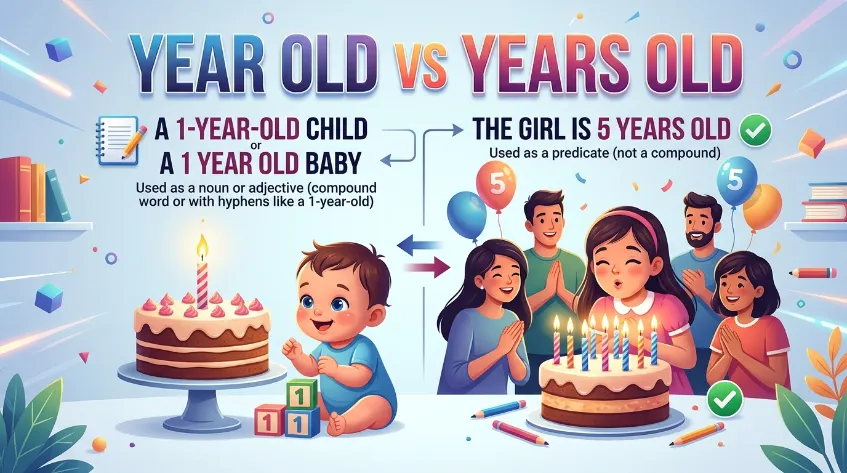
Use year-old with a hyphen when it comes before a noun as a compound adjective.
Use years old without a hyphen when it comes after a noun as part of the sentence.
That’s it.
Everything else grows from this one rule.
Using “Year-Old” Before a Noun
When a year-old describes a noun directly, it acts as a compound adjective.
Notice what happens.
- A 10-year-old boy
- A 5-year-old tree
- A 100-year-old building
- A 2-year-old company
In every example, year-old appears before the noun.
The entire phrase works together like one adjective.
Correct examples:
- She adopted a three-year-old cat.
- We visited a 500-year-old castle.
- They restored a 75-year-old bridge.
- The museum displayed a 2,000-year-old sculpture.
Using “Years Old” After a Noun
When talking about the age of something after mentioning it, use years old.
Examples include:
- The boy is 10 years old.
- The tree is 5 years old.
- The building is 100 years old.
- The company is 2 years old.
The noun comes first.
The age follows afterward.
No hyphen is needed.
Side-by-Side Comparison Table
| Situation | Example | Meaning | Correct Usage |
| Before a noun | A 12-year-old student | Describes the student | ✅ year-old |
| After a noun | The student is 12 years old | States the student’s age | ✅ years old |
| Before a noun | A 50-year-old tradition | Describes the tradition | ✅ year-old |
| After a noun | The tradition is 50 years old | States its age | ✅ years old |
| Before a noun | A 3-year-old horse | Modifies horse | ✅ year-old |
| After a noun | The horse is 3 years old | Gives age | ✅ years old |
| Before a noun | A 90-year-old church | Compound adjective | ✅ year-old |
| After a noun | The church is 90 years old | Predicate phrase | ✅ years old |
Deep Dive into Category 1
When to Use “Year-Old”
Think of year-old as one descriptive unit.
It comes before the noun and answers the question, “What kind?”
Examples:
- A 6-year-old child
- A 14-year-old student
- A 300-year-old monument
- A 40-year-old recipe
- A 9-year-old Labrador
The noun immediately follows.
This placement signals that the phrase is functioning as an adjective.
Notice another detail.
Even if the number is greater than one, we still write year, not years.
Correct:
- A 12-year-old girl
Incorrect:
- A 12-years-old girl
Why?
Because compound adjectives generally use the singular noun.
The adjective describes, rather than counts.
Examples in Different Contexts
Education:
- A 7-year-old learner joined the class.
Business:
- The company purchased a 20-year-old trademark.
History:
- Archaeologists discovered a 2,500-year-old tomb.
Healthcare:
- Doctors examined a 4-year-old patient.
Sports:
- The 18-year-old athlete won the championship.
Quick Test
Use year-old if these statements are true.
- The phrase comes before the noun.
- It describes the noun directly.
- The words are connected with hyphens.
- “Year” stays singular.
If every answer is yes, use year-old.
Deep Dive into Category 2
When to Use “Years Old”
Now look at the opposite situation.
The noun appears first.
Then you describe its age.
Examples:
- My nephew is 6 years old.
- That monument is 300 years old.
- The recipe is 40 years old.
- The patient is 4 years old.
- The athlete is 18 years old.
The age functions as part of the predicate.
It no longer modifies the noun directly.
Recognizing the Pattern
You’ll usually see verbs like:
- is
- was
- are
- were
- seems
- looks
- became
Examples:
- The castle is 700 years old.
- The laptop was 5 years old.
- Their dog is 9 years old.
- The tradition became 100 years old this year.
Common Sentence Patterns
Pattern 1:
Subject + is + number + years old
Example:
- The child is 8 years old.
Pattern 2:
Subject + was + number + years old
Example:
- She was 11 years old when she moved.
Pattern 3:
Subject + will be + number + years old
Example:
- He will be 16 years old next month.
The Meaning Shift
The meaning barely changes.
The grammar does.
Compare these:
- A 5-year-old horse won the race.
- The horse is 5 years old.
Both describe the same age.
The first sentence identifies what kind of horse.
The second sentence simply states the horse’s age.
Another example:
- A 40-year-old company expanded overseas.
- The company is 40 years old.
Again, the information stays the same.
Only the grammatical role changes.
This is why choosing the right form matters.
Readers immediately recognize correct grammar.
Why the Confusion Persists
Several reasons explain why people mix up year old vs years old.
First, the spoken versions sound nearly identical.
When people hear the phrases, they rarely notice punctuation or singular versus plural forms.
Second, many learners focus on pronunciation instead of sentence structure.
The grammar becomes hidden.
Third, online writing often contains mistakes.
Once incorrect examples spread across blogs and social media, they become easier to copy.
Another reason involves plural numbers.
People naturally think:
“Twelve means years.”
While that logic makes sense for counting, it doesn’t apply inside compound adjectives.
Finally, autocorrect tools sometimes overlook these errors because both versions contain correctly spelled words.
Formal vs Casual Contexts
Formal writing demands careful grammar.
Academic papers, legal documents, technical manuals, and business reports should always follow the standard rules.
Examples:
- The research involved 200-year-old artifacts.
- The equipment is 15 years old.
Professional writers maintain these distinctions because precision builds trust.
Casual communication can be more relaxed.
People may shorten sentences like:
- He’s ten.
- She’s five.
Even then, whenever the complete expression appears, the grammatical rule stays the same.
Correct:
- He’s 10 years old.
Incorrect:
- He’s 10 years old.
Professional environments reward grammatical accuracy.
Readers notice it.
Employers notice it.
Search engines increasingly reward well-written content too.
Case Studies / Pop Culture Examples
Consider news headlines.
Journalists regularly write:
- 10-year-old wins spelling competition.
- 85-year-old veteran honored.
The adjective comes before the noun.
Now read the article itself.
It may say:
- The winner is 10 years old.
- The veteran is 85 years old.
The wording changes naturally because the sentence structure changes.
Historical writing follows the same pattern.
Example:
- Researchers uncovered a 4,000-year-old settlement.
Later:
- The settlement is approximately 4,000 years old.
Books, newspapers, scientific journals, and government publications consistently apply this distinction.
That’s one reason the rule remains the accepted standard in modern English.
Advanced Scenarios & Flowchart
Sometimes sentences become more complex.
Here’s a simple decision process.
Ask yourself:
Is the age phrase before the noun?
Yes
Use year-old
Example: a 15-year-old athlete
No
Go to the next question.
Is the age phrase after the noun?
Yes
Use years old
Example: The athlete is 15 years old.
No
Check whether the sentence needs restructuring.
Another helpful decision path:
Start
Do you see a noun immediately after the age?
Yes
Use year-old.
No
Use years old if stating age after the subject.
This quick process eliminates nearly every mistake.
Quick Reference Table
| If You See This | Use This |
| Before a noun | year-old |
| After a noun | years old |
| Compound adjective | year-old |
| Predicate phrase | years old |
| Hyphen needed | year-old |
| No hyphen needed | years old |
| Describing a noun | year-old |
| Stating age | years old |
Common Mistakes That Lower Quality
Even experienced writers occasionally slip.
Here are the most frequent errors.
Using “years-old” before a noun
Incorrect:
- A 10-years-old child
Correct:
- A 10-year-old child
Leaving out the hyphen
Incorrect:
- A 10 year old child
Correct:
- A 10-year-old child
Using singular after the verb
Incorrect:
- The child is 10 year old.
Correct:
- The child is 10 years old.
Adding unnecessary hyphens
Incorrect:
- The child is 10-years-old.
Correct:
- The child is 10 years old.
Switching between styles
Incorrect:
- The 8 year old puppy slept.
Correct:
- The 8-year-old puppy slept.
Consistency creates stronger writing.
Memory Hacks That Actually Work
Remember this easy formula.
Before = Hyphen
If the age comes before the noun, connect the words.
Example:
- A 25-year-old engineer
Think:
“Age is acting like one adjective.”
Another trick:
After = Normal Counting
If you’re counting someone’s age after the verb, think naturally.
Example:
- The engineer is 25 years old.
One more memory aid.
Imagine replacing the age phrase with another adjective.
Instead of:
- A 25-year-old engineer
Think:
- A talented engineer.
Both adjectives appear before the noun.
Finally, remember this simple rhyme:
Before the noun, use one “year.”
After the noun, count your “years.”
It sticks surprisingly well.
Why Precision Matters (SEO/Authority)
Correct grammar does more than impress teachers.
It strengthens credibility.
Readers trust content that follows standard English conventions.
Small grammatical mistakes create friction.
Visitors may question the accuracy of the entire article, even when the facts are correct.
Polished writing helps businesses create a stronger professional image.
Students can produce better-quality assignments by using correct grammar.
Clear grammar improves readability, engagement, and credibility for bloggers and publishers.
Search engines increasingly evaluate overall content quality.
Although grammar alone is not a direct ranking factor, clear, well-structured writing improves user experience. Readers stay longer, understand information more easily, and are more likely to share trustworthy content. Using year old vs years old correctly contributes to that professional impression.
Precise grammar also helps editors, translators, and international audiences. Consistent language reduces ambiguity and ensures your message is understood exactly as intended. Whether you’re writing product descriptions, news articles, educational resources, or website copy, correct usage reinforces authority and attention to detail.
A Quick Quiz
Fill in the blanks with year-old or years old.
- The museum displayed a _____ manuscript.
- My cousin is fifteen _____.
- We adopted a _____ golden retriever.
- The bridge is over 120 _____.
- They hired a talented _____ software developer.
- The company is twenty-five _____ this year.
- She cared for a _____ rescue horse.
- That castle is nearly 900 _____.
Conclusion
Understanding the difference between year old vs years old is much easier once you recognize where each form belongs in a sentence. If the age phrase appears before a noun, use the hyphenated year-old because it functions as a compound adjective. If the age phrase comes after the noun, use years old without hyphens because it simply states the age. This straightforward rule applies whether you are talking about a 2-year-old puppy, a 100-year-old building, or saying that someone is 25 years old. By focusing on sentence structure instead of the number itself, you can avoid nearly every common mistake and write with greater confidence.
Correct grammar is more than a classroom requirement, it is a sign of professionalism and attention to detail. Whether you are writing blog posts, academic assignments, business reports, marketing content, or everyday emails, using year old and years old correctly helps your message appear polished and trustworthy. Readers notice clear, accurate writing, even if they cannot always explain why it feels more credible. Keep the simple rule in mind, practice with real examples, and double-check whether the age phrase comes before or after the noun. With consistent practice, choosing between year-old and years old will become automatic, improving both your grammar and the overall quality of your writing.
Frequently Asked Questions
Is it “10-year-old” or “10 years old”?
Both are correct, but they are used in different situations. Use 10-year-old before a noun, such as a 10-year-old student, because it acts as a compound adjective. Use 10 years old after the noun, as in The student is 10 years old, because the phrase states the person’s age rather than describing the noun directly.
Why is “year” singular in “10-year-old”?
The word year stays singular because the entire expression functions as a single compound adjective. In English, compound adjectives typically use the singular form of the noun they contain. That is why we write a 10-year-old child instead of a 10-years-old child, even though the age itself represents multiple years.
Should I always use hyphens with “year-old”?
Use hyphens only when a year-old appears before a noun. For example, a 15-year-old athlete is correct because the phrase modifies the noun. When the age appears after the noun, such as The athlete is 15 years old, you should not use hyphens because the phrase is no longer acting as an adjective.
Can I write “10 year old” without hyphens?
In standard English, this is considered incorrect when the phrase comes before a noun. The correct form is 10-year-old because the words work together as a compound adjective. Omitting the hyphens can make the sentence harder to read and does not follow accepted grammar conventions used in professional writing.
Does this rule apply to months, weeks, and days too?
Yes. The same grammar pattern applies to other units of time. For example, write a three-month-old baby, a two-week-old kitten, or a five-day-old chick when the phrase comes before a noun. After the noun, write The baby is three months old, following the same sentence structure as years old.
Is “years-old” ever correct with hyphens?
No. The form years-old is not considered standard English. Before a noun, the correct version is year-old, with the singular noun and hyphens. After a noun, the correct form is years old, with no hyphens. Mixing the two patterns creates a grammatical error that should be avoided in both formal and informal writing.
Do style guides agree on this rule?
Yes. Major English style guides and dictionaries consistently recommend using year-old as a hyphenated compound adjective before a noun and years old after a noun. Although minor formatting preferences may vary across publishers, this core grammar rule remains widely accepted in journalism, education, business writing, and academic publications.
Is this mistake common among native English speakers?
Yes. Even native speakers occasionally confuse year old and years old, especially in fast online writing or informal communication. The phrases sound almost identical when spoken, making it easy to overlook the grammatical difference. Paying attention to whether the age phrase comes before or after the noun is the simplest way to avoid the error.
Why is using the correct form important for SEO content?
Using year old vs years old correctly improves readability, professionalism, and user trust. While search engines do not rank pages solely based on grammar, well-written content generally provides a better user experience. Readers are more likely to stay on a page, share accurate content, and view the author as credible when grammar is consistent and correct.
What is the fastest way to remember the rule?
A simple memory trick is to think, before the noun, use one year. After the noun, count the years. If the age phrase directly describes a noun, use year-old with hyphens. If the sentence is simply stating someone’s or something’s age after the subject, use years old without hyphens. This quick reminder works in almost every situation.

Ethan Walker is a passionate English writer dedicated to making English grammar, vocabulary, and writing skills simple, practical, and engaging. At Grammar Alpha, he creates clear content covering grammar rules, word meanings, sentence structure, common English mistakes, punctuation, and everyday English usage. His articles help students, professionals, and English learners improve their communication skills and write with confidence. Ethan believes learning starts with clarity, and his goal is to turn complex language topics into lessons readers can understand and apply.