
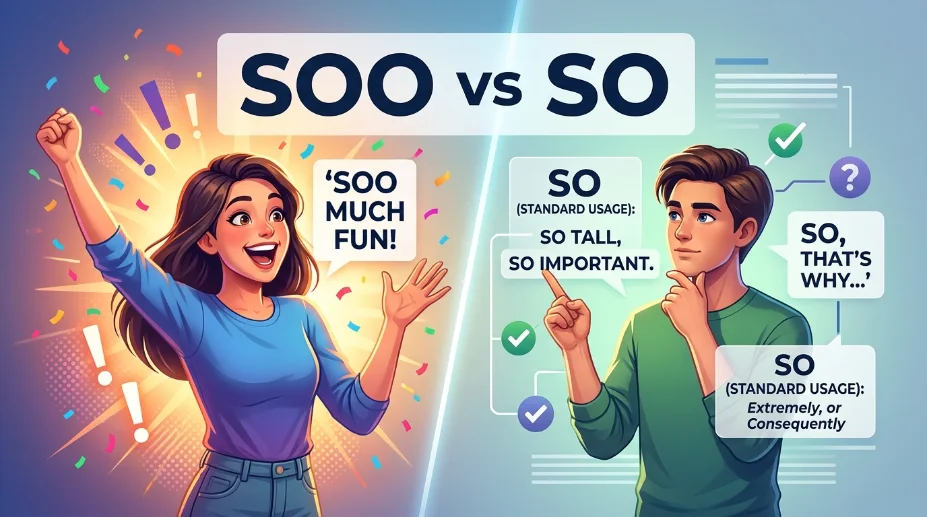
Many English learners and even native speakers occasionally wonder about “soo vs so.” At first glance, they look nearly identical, but only one is considered standard English in almost every situation. Knowing the difference helps you write more clearly, sound more professional, and avoid common spelling mistakes.
Here’s the simple truth.
“So” is the correct English word used to express degree, consequence, agreement, emphasis, and many other meanings. “Soo” is generally not a standard English word. Instead, it usually appears as a typo, an intentional spelling for emphasis in informal texting, or as part of a proper noun or name. Understanding this distinction instantly improves your grammar and writing accuracy.
Whether you’re writing emails, academic papers, social media posts, or blog articles, learning the correct use of soo vs so ensures your message stays clear and credible.
The Core Rule Explained Simply
The rule couldn’t be much easier.
Use “so” whenever you need the actual English word.
Avoid “soo” unless you’re intentionally stretching the spelling in casual online conversations or referring to a person’s name, place, or brand.
Think of it this way:
- So = Correct English word
- Soo = Usually incorrect spelling, unless used intentionally or as a proper noun
Let’s break each one down.
When to Use “So”
So is one of the most common words in English.
It performs many different grammatical jobs depending on the sentence.
Examples:
- I am so happy.
- It was raining, so we stayed home.
- So, what happened next?
- She isn’t tired, and so am I.
- That’s so interesting.
In every example above, so is the correct spelling.
When to Use “Soo”
In standard English grammar, soo is generally not correct.
However, you may see it in situations like these:
- “I’m sooo excited!”
- “That movie was sooo funny!”
- Personal names such as Kim Soo-hyun
- Place names containing “Soo”
- Brand names or usernames
Notice something important.
In internet slang, writers often extend it into sooo, soooo, or even soooooo for dramatic effect. This is intentional stylistic writing rather than proper grammar.
Side-by-Side Comparison Table
| Situation | Example | Meaning | Correct Usage |
| Showing degree | She is so kind. | Very | So |
| Showing result | It rained, so we left. | Therefore | So |
| Beginning conversation | So, what’s next? | Transition | So |
| Agreement | So do I. | Same applies | So |
| Internet emphasis | I’m sooo tired! | Extra emphasis | Informal only |
| Typo | This is soo nice. | Intended “so” | Incorrect |
| Proper name | Kim Soo: jin | Name | Correct |
| Brand or username | Soo Studio | Identifier | Correct |
Deep Dive into Category 1
Understanding Standard “So”
The word so has dozens of uses in English.
That makes it incredibly flexible.
Here are the most common ones.
Showing intensity
Examples:
- It’s so cold.
- The cake is so delicious.
- You look so confident.
In these cases, so means very.
Showing results
Examples:
- We were late, so we hurried.
- She practiced daily, so she improved.
- He forgot his keys, so he went back.
Here, so means therefore.
Introducing conversation
Examples:
- So, let’s begin.
- So, how was your trip?
- So, here’s the plan.
This use helps move a conversation forward naturally.
Common Patterns with “So”
You’ll frequently see patterns like:
- so + adjective
- so + adverb
- so that
- so + auxiliary verb
- and so on
- so far
- so much
- so many
- so little
- so long
Examples:
- She speaks so clearly.
- It was so hot that we stayed inside.
- So far, everything is working.
- We learned grammar, vocabulary, and so on.
Quick Test
Ask yourself these questions:
- Does the sentence need the actual English word?
- Does it express degree or result?
- Would a dictionary list it here?
If the answer is yes, use so.
Deep Dive into Category 2
Understanding “Soo”
Outside names and intentional internet slang, so has no grammatical role in standard English.
That’s why grammar checkers usually flag it.
Consider these examples.
Incorrect:
- I’m soo hungry.
- That’s soo beautiful.
- She is soo smart.
Correct:
- I’m so hungry.
- That’s so beautiful.
- She is so smart.
When “Soo” Is Acceptable
There are exceptions.
These include:
- Personal names
- Family names
- Company names
- Fictional characters
- Social media usernames
- Creative branding
Examples:
- Lee Soo-man
- Kim Soo-yeon
- Soo Beauty Studio
In these situations, Soo functions as a proper noun rather than an English grammar word.
Internet Writing Patterns
Online conversations often prioritize emotion over grammar.
That’s why you’ll see:
- sooo
- soooo
- sooooo
- soooo cute
- sooo excited
Although common on social media, these spellings should stay out of:
- Academic writing
- Business emails
- Professional reports
- Job applications
- Official documents
The Meaning Shift
Interestingly, the meaning rarely changes.
Instead, the tone changes.
Compare these:
- I’m so excited.
- I’m sooo excited.
Both express excitement.
The second simply exaggerates emotion.
Likewise:
- That’s so funny.
- That’s sooooo funny.
The meaning remains the same.
Only the emotional intensity increases.
Why the Soo vs So Confusion Persists
Several factors keep the soo vs so confusion alive.
First, texting habits encourage creative spelling.
Second, social media rewards expressive writing.
Third, people often imitate what they see online without realizing those spellings are informal.
Another reason is pronunciation.
When speaking, many people stretch the vowel sound:
“Sooooo good!”
Listeners may mistakenly assume the spelling should also stretch.
English doesn’t work that way.
Standard spelling remains so.
Soo vs So in Formal and Casual Contexts
Context matters.
Here’s how usage changes.
Formal Writing
Always choose so.
Examples include:
- School essays
- Research papers
- Business communication
- News articles
- Professional blogs
- Legal writing
Correct example:
The experiment was successful, so researchers continued.
Casual Writing
Writers sometimes use:
- sooo
- soooo
- sooooo
Examples:
- I’m sooo happy!
- You’re soooo funny!
- That concert was soooo good!
These are acceptable among friends but should never replace proper spelling in formal communication.
Case Studies / Pop Culture Examples
Let’s make this concrete.
Social Media
Instagram captions often include:
- “I’m sooo excited!”
- “This food is soooo good!”
These spellings add personality rather than grammatical correctness.
Academic Writing
A university essay would always use:
- The results were significant, so additional research followed.
Using soo here would appear careless.
Business Communication
Professional email:
- Sales increased, so we expanded production.
Not:
- Sales increased, soo we expanded production.
Everyday Conversation
Text message:
- I’m sooo tired.
Office memo:
- I’m so tired after the conference.
Different audiences expect different standards.
Advanced Scenarios & Flowchart
Sometimes the answer feels obvious.
Sometimes it doesn’t.
Use this decision guide.
Is it someone’s name?
Yes → Use Soo.
No →
Is it a company or brand?
Yes → Use Soo if that’s the official spelling.
No →
Is it standard English?
Yes → Use so.
No →
Are you intentionally exaggerating emotion in casual texting?
Yes → sooo is acceptable informally.
No → Use so.
Quick Reference Table
| Use This | When |
| So | Standard English |
| So | Showing degree |
| So | Showing results |
| So | Formal writing |
| So | Academic work |
| So | Professional communication |
| Soo | Proper names |
| Soo | Official brand names |
| Sooo | Informal texting only |
| Soooo | Social media emphasis |
Common Soo vs So Mistakes That Lower Quality
Even experienced writers occasionally slip up.
Here are the biggest mistakes.
- Writing so instead of so by accident.
- Copying informal internet spelling into professional writing.
- Assuming longer pronunciation requires longer spelling.
- Forgetting that Soo may be someone’s legal name.
- Using sooo in academic assignments.
- Believing spell check will always catch the error.
- Mixing formal and informal writing styles in the same document.
- Confusing expressive writing with correct grammar.
Proofreading usually catches these mistakes before publication.
Memory Hacks That Actually Work
Simple tricks make the rule unforgettable.
Hack 1
If it’s in a dictionary as a normal English word, it’s almost certainly so.
Hack 2
Ask whether you’re writing for school or work.
If yes, always use so.
Hack 3
If capitalized as part of someone’s name, Soo is probably correct.
Hack 4
Imagine removing extra letters.
“I’m sooo happy.”
The intended word becomes so.
Hack 5
Remember this sentence:
Only “so” does the grammar job. “Soo” usually does the naming job.
Why Precision Matters for Clear and Credible Writing
Small spelling choices have a surprisingly large impact.
Readers often judge credibility within seconds of opening a page. A simple mistake like writing so instead of so in professional content can make an article seem rushed or poorly edited. Consistently using correct grammar helps establish trust, especially for businesses, educators, and publishers who depend on clear communication.
Search engines also benefit from accurate language. While modern algorithms understand context, properly written content tends to deliver a better user experience, fewer misunderstandings, and stronger engagement signals. Using so correctly contributes to polished, authoritative writing that readers are more likely to share, reference, and return to over time.
A Quick Quiz
Fill in the blanks with so or Soo.
- She was ___ excited that she couldn’t sleep.
- It was raining, ___ we canceled the picnic.
- Kim ___-jin won the award.
- I’m ___ grateful for your help.
- The movie was ___ funny that everyone laughed.
- We finished early, ___ we went for coffee.
- The company’s founder is named ___ Min-ho.
Answers:
- so
- so
- Soo
- so
- so
- so
- Soo
Conclusion
Choosing between soo vs so is much easier once you understand the core rule. In nearly every sentence, so is the correct spelling because it is a standard English word with multiple grammatical functions. It can express a degree, introduce a result, begin a conversation, or emphasize an idea without breaking any writing rules. By contrast, soo is not recognized as a standard English word. It mainly appears in proper names, official brand names, or intentionally exaggerated informal writing on social media and in text messages. Keeping this distinction in mind helps you produce cleaner, more polished, and more trustworthy writing every time.
The best way to master soo vs so is to think about your audience before you write. If you’re creating an academic paper, business email, website article, or professional document, always use so unless you’re referring to a person’s name or another proper noun. If you’re chatting casually with friends online, stretched spellings like sooo may add personality, but they should stay in informal contexts. Developing this habit improves grammar, strengthens your credibility, and ensures readers focus on your ideas instead of your spelling. Small details often make the biggest difference in effective communication.
Frequently Asked Questions
Is soo ever a correct English word?
In standard English grammar, soo is not considered a correct word. It is usually a misspelling of so or an intentional stylistic variation used in casual texting and social media. However, Soo is perfectly correct when it appears as part of a person’s name, a business name, or another proper noun.
Should I write so or so in professional emails?
You should always use so in professional emails. Spellings like sooo or soooo are informal and are meant to show extra emotion in casual conversations. Professional communication values clear, standard grammar, making it the appropriate choice for workplace writing.
Why do people type sooo instead of so?
People often type solo to exaggerate emotion or enthusiasm in digital conversations. The additional letters imitate the way someone might stretch the word while speaking. Although this style is common in text messages and social media posts, it is not considered proper spelling in formal writing.
Can using so affect my writing credibility?
Yes, it can. If readers see soo where it should appear, they may assume the content was not carefully proofread. Consistently using the correct spelling helps create a professional impression, improves readability, and increases trust in your writing, especially in academic or business settings.
Is Soo correct in names?
Absolutely. Soo is a common element in many personal names, especially in Korean names and certain business or brand names. In these situations, Soo is a proper noun rather than an English vocabulary word, so its spelling should never be changed to so.
Can grammar checkers detect so?
Most modern grammar and spell-checking tools recognize soo as a potential mistake when it appears in ordinary sentences. However, they may not flag it if it is used as part of a proper name or if the software assumes it is intentional. Proofreading is still important to catch errors accurately.
Does so have more than one meaning?
Yes. So is an extremely versatile English word. It can mean very, indicate a result similar to therefore, introduce a new topic, show agreement, or connect ideas in many different sentence structures. Its flexibility is one reason it appears so frequently in both spoken and written English.
Is it acceptable to use sooo on social media?
Yes, using sooo on social media is generally acceptable because informal platforms encourage expressive language. Many users stretch words to communicate excitement, surprise, or humor. However, if your post represents a professional brand or business, sticking with so usually creates a more polished image.
How can I remember the difference between soo and so?
A simple memory trick is to remember that so is the dictionary word that performs the grammar job, while Soo is usually part of a name. If you’re writing a normal English sentence and not referring to someone’s name or intentionally exaggerating emotion in a casual message, so is almost always the correct choice.

Daniel Carter is a passionate English writer dedicated to making language learning simple, practical, and engaging. At Grammar Alpha, he shares clear and reliable insights on grammar, vocabulary, word meanings, sentence structure, and everyday English usage. His easy-to-follow articles help students, professionals, and language learners strengthen their writing and communication skills. With a strong focus on clarity and accuracy, Daniel turns complex English concepts into useful lessons, empowering readers to write with confidence, speak naturally, and use English effectively every day.