
Many English learners, professional writers, and even native speakers struggle with setup vs set up. At first glance, both forms look nearly identical. They contain the same words and sound exactly the same when spoken. That similarity causes thousands of writing mistakes every day.
The good news is that the rule is surprisingly simple. Once you understand the difference between setup and set up, you’ll rarely confuse them again. The trick is recognizing whether you’re using a noun or adjective or whether you’re using a verb.
Here’s the key idea.
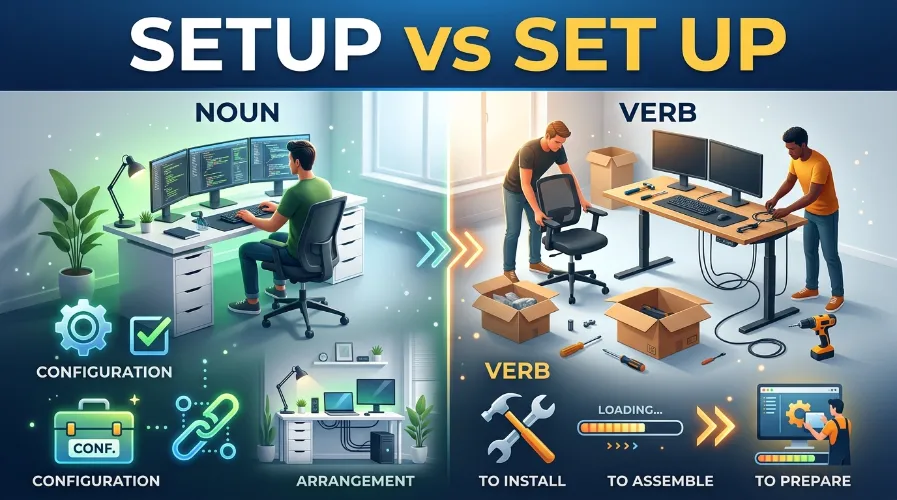
Setup is usually a noun or adjective, while set up is always a verb phrase. If you’re describing an action, choose set up. If you’re naming a thing, arrangement, or configuration, choose setup.
This guide explains every rule, shows practical examples, compares formal and casual writing, explores advanced situations, and provides easy memory tricks so you never hesitate again.
The Core Rule Explained Simply
The easiest way to remember setup vs set up is to identify what the word is doing in the sentence.
If it describes an action, use set up.
If it names a thing, arrangement, system, or preparation, use setup.
That’s really the foundation of the rule.
Look at these examples.
- We need to set up the conference room.
- The room’s setup looks professional.
The first sentence describes an action.
The second names the arrangement itself.
Everything else builds from this distinction.
Setup as a Noun or Adjective
Setup is one word when it functions as a noun.
Examples include:
- The computer setup took only ten minutes.
- Your desk setup is very organized.
- Their security setup prevented the attack.
- The camera setup is expensive.
It can also work as an adjective.
Examples:
- The setup process was easy.
- A setup guide was included.
- The setup screen appeared automatically.
In these cases, setup refers to a configuration, arrangement, preparation, or installation.
Set Up as a Verb
Set up is always two words when used as a verb.
Examples:
- Please set up the projector.
- They will set up the equipment tomorrow.
- I need to set up my email account.
- She set up the interview.
Every example describes someone performing an action.
If you can replace it with words like install, arrange, prepare, or organize, you almost certainly need to set up.
Side-by-Side Comparison Table
| Situation | Example | Meaning | Correct Usage |
| Installing software | Please set up Windows. | Perform an action | Set up |
| Computer configuration | My computer setup is fast. | Configuration | Setup |
| Preparing a meeting | Let’s set up the room. | Arrange something | Set up |
| Room arrangement | The meeting setup looks great. | Layout | Setup |
| Organizing equipment | We will set up the cameras. | Action | Set up |
| Equipment arrangement | The camera setup is expensive. | Configuration | Setup |
| Creating an account | Set up your profile. | Action | Set up |
| Existing configuration | Your account setup is complete. | Configuration | Setup |
Deep Dive into Setup
When to Use Setup
Use setup whenever you’re referring to an arrangement, system, structure, or completed configuration.
Think of it as naming something rather than doing something.
Examples include:
- The office setup encourages collaboration.
- Her gaming setup costs over $2,000.
- The classroom setup changed this semester.
- The laboratory setup follows safety guidelines.
- Their lighting setup creates excellent videos.
Notice that every sentence discusses the result rather than the action.
Here’s why:
Once the work has been completed, you’re talking about the finished arrangement.
Common Types of Setup
You’ll often encounter setup in technology.
Examples include:
- Computer setup
- Router setup
- Network setup
- Gaming setup
- Studio setup
You’ll also find it in everyday situations.
Examples:
- Wedding setup
- Classroom setup
- Kitchen setup
- Office setup
- Event setup
In each case, the word identifies an existing arrangement.
Quick Test for Setup
Ask yourself these questions.
- Am I naming a thing?
- Am I describing a configuration?
- Can I replace it with an arrangement?
- Can I replace it with configuration?
If the answer is yes, use setup.
Examples:
- The office setup is modern.
- My desk setup improves productivity.
- Their home theater setup sounds amazing.
Deep Dive into Set Up
When to Use Set Up
Use set up whenever someone is performing an action.
The phrase means:
- Arrange
- Install
- Prepare
- Build
- Establish
- Organize
Examples include:
- Please set up the chairs.
- We need to set up the display.
- They will set up a new office.
- She helped set up the event.
- I’ll set up your account today.
Each sentence focuses on doing something.
Common Verb Patterns
You’ll frequently see these combinations:
- Set up a meeting
- Set up a business
- Set up a website
- Set up an account
- Set up equipment
- Set up software
- Set up a network
- Set up furniture
All involve actions.
Quick Test for Set Up
Ask yourself:
- Is someone doing something?
- Can I replace it with arrange?
- Can I replace it with prepare?
- Can I replace it with install?
If yes, write set up.
Examples:
- Let’s set up the microphones.
- They set up the exhibition.
- We should set up the experiment.
The Meaning Shift
Although setup and set up are closely related, changing the spacing changes the grammatical role.
Compare these sentences.
- They will set up the office.
- The office setup looks impressive.
In the first sentence, the focus is on creating the arrangement.
In the second, the arrangement already exists.
Another example:
- I need to set up my computer.
- My computer setup includes three monitors.
One sentence describes an action.
The other names the result.
This small spelling change creates a completely different grammatical function.
Why the Confusion Persists
Several reasons explain why people confuse setup vs set up.
First, they sound identical in speech.
Second, English contains many similar word pairs.
Examples include:
- Login vs log in
- Backup vs back up
- Workout vs work out
- Shutdown vs shut down
- Checkout vs check out
Most follow the same pattern.
The closed form often becomes a noun.
The open form remains the verb.
Technology has also increased confusion.
Software often includes buttons labeled Setup, while instructions tell users to set up their devices.
Because readers see both versions frequently, the distinction becomes blurry.
Autocorrect does not always help either.
Many grammar checkers accept both spellings because each is correct in different situations.
That means writers must understand the grammar instead of relying on software.
Formal vs Casual Contexts
The grammar rule stays the same regardless of writing style.
Formal examples:
- Employees should set up their workstations before orientation.
- The laboratory setup complies with university standards.
- Engineers completed the network setup yesterday.
Business writing:
- Please set up the conference room before 8:00 a.m.
- Review the current security setup before installation.
Academic writing:
- Researchers set up the experiment carefully.
- The experimental setup minimized outside variables.
Casual writing:
- Can you set up Netflix?
- My gaming setup is awesome.
- Let’s set up camp.
- Nice desk setup.
The context changes.
The grammar never does.
Case Studies / Pop Culture Examples
Technology reviews provide excellent examples.
A YouTube creator might say:
Today I’ll set up my new PC.
Later in the same video:
Here’s my finished gaming setup.
Photography tutorials often say:
- I’ll set up the lights.
- This lighting setup produces soft shadows.
Cooking shows use similar language.
- Let’s set up the kitchen.
- Here’s my cooking setup.
Business articles frequently include examples such as:
- Entrepreneurs should set up legal structures before hiring employees.
- A strong accounting setup prevents costly mistakes.
Even sports broadcasting uses the pattern.
- Coaches set up offensive plays.
- The team’s defensive setup frustrated opponents.
Across industries, the same grammatical distinction appears again and again.
Advanced Scenarios & Flowchart
Sometimes sentences become longer and more complex.
Use this decision process.
Start here.
Is the phrase describing an action?
Yes.
Use set up.
Example:
We need to set up the presentation.
No.
Is it naming an arrangement or configuration?
Yes.
Use setup.
Example:
The presentation setup looks professional.
No.
Check whether another word would fit better.
Another useful shortcut:
Can you insert it before it?
- to set up a meeting ✔
- to setup a meeting ✘
That test works almost every time.
Quick Reference Table
| If You Mean | Use |
| Perform an action | Set up |
| Arrange something | Set up |
| Install something | Set up |
| Prepare something | Set up |
| Existing arrangement | Setup |
| Configuration | Setup |
| Layout | Setup |
| System design | Setup |
Common Mistakes That Lower Quality
Many experienced writers still make these mistakes.
Using setup as a verb
Incorrect:
- Please set up the computer.
Correct:
- Please set up the computer.
Using set up as a noun
Incorrect:
- My desk is comfortable.
Correct:
- My desk setup is comfortable.
Ignoring grammar because pronunciation is identical
Speech does not reveal the difference.
Writing must.
Copying incorrect online examples
Many blogs and social media posts misuse these terms.
Always apply the noun versus verb test.
Trusting spell check completely
Grammar software often accepts both forms.
Only context determines which one is correct.
Memory Hacks That Actually Work
These tricks make the distinction easy to remember.
Hack 1: Action equals two words
If someone is doing something, use set up.
Actions need space.
Hack 2: Thing equals one word
If you’re naming the result, use setup.
Objects stay together.
Hack 3: Replace the phrase
Replace it mentally.
- Arrange
- Install
- Prepare
If one fits, use set up.
Replace it with:
- Arrangement
- Configuration
- Layout
If one fits, use setup.
Hack 4: The “to” test
If you can say to set up, it’s always two words.
You never write to set up.
Hack 5: Finished versus unfinished
Still working?
Use set up.
Already finished?
Use setup.
Why Precision Matters (SEO/Authority)
Correct grammar strengthens credibility.
Readers notice polished writing, especially in business documents, academic papers, technical manuals, and marketing content. Small grammar mistakes can reduce trust, even when the overall message is clear. Using setup and set up correctly demonstrates attention to detail and professionalism.
Search engines also reward content that satisfies user intent. Articles that consistently use the correct grammatical form are easier to understand, which improves readability and user experience. Clear writing keeps visitors engaged longer, reduces confusion, and increases the likelihood that they will share or reference your content.
For businesses, accurate language contributes to a stronger brand image. A software company that instructs users to set up an application while referring to the completed setup appears more knowledgeable and reliable. Consistent grammar supports authority across websites, manuals, help centers, and marketing materials.
Professional editors, teachers, recruiters, and clients often evaluate writing quality quickly. Correct usage of common word pairs like setup vs set up may seem minor, but these details collectively shape the impression your writing leaves. Precision signals competence, and competence builds confidence.
A Quick Quiz
Fill in the blanks with setup or set up.
- Please ______ the projector before the meeting.
- My gaming ______ includes two monitors and a mechanical keyboard.
- We need to ______ a new email account.
- The laboratory ______ meets all safety requirements.
- They will ______ the stage before the concert begins.
- Her photography ______ produces professional results.
- Can you ______ the printer for the new employee?
- The office ______ encourages teamwork.
Answers
- set up
- setup
- set up
- setup
- set up
- setup
- set up
- setup
Conclusion
Understanding setup vs set up is much easier once you recognize the grammatical role each form plays. Set up is always a verb phrase, meaning it describes the action of arranging, installing, preparing, or organizing something. Setup, on the other hand, is generally a noun or adjective that refers to the finished arrangement, configuration, or system. Although they sound exactly the same, their spelling depends entirely on how they function in a sentence. This single distinction eliminates the vast majority of mistakes and helps you write with greater confidence in academic papers, professional emails, technical documentation, and everyday communication. Whenever you’re unsure, pause and ask whether you’re describing an action or naming a thing. That simple habit will guide you to the correct choice almost every time.
Mastering setup vs set up also improves the overall quality of your writing. Small grammar choices often have a significant impact on how readers perceive your expertise, whether you’re creating website content, writing reports, publishing blog posts, or communicating with clients. Consistent, accurate usage demonstrates attention to detail and strengthens your credibility. It also makes your writing easier to understand, which benefits both readers and search engines. The more you practice using these forms correctly, the more natural they become. By applying the noun-versus-verb rule, using the quick tests from this guide, and reviewing real-world examples, you’ll avoid one of English’s most common word pair mistakes and produce clearer, more professional writing every time.
Frequently Asked Questions
Is setup ever used as a verb?
No. In standard English, setup is not used as a verb. Whenever you’re describing the act of arranging, installing, or preparing something, the correct form is set up, written as two words. Using setup as a verb is considered a grammatical error, even though it is a common mistake in informal writing.
When should I use set up instead of setup?
Use set up whenever you’re expressing an action. If someone is installing software, organizing equipment, preparing a meeting room, or creating an account, the correct form is the two-word verb phrase set up. If the sentence answers the question “What is someone doing?”, set up is almost always the right choice.
Why do setup and set up sound exactly the same?
English contains many word pairs that are pronounced identically but have different grammatical functions. Setup and set up are one such pair. The pronunciation remains unchanged because the difference exists in spelling and grammar rather than speech. Writers must rely on context instead of pronunciation to choose the correct form.
Is computer setup correct?
Yes. Computer setup is correct because it refers to the computer’s configuration, arrangement, or installed system. However, if you’re talking about the action of installing or preparing the computer, you would write, “I need to set up my computer.” The meaning changes depending on whether you’re describing an action or a completed configuration.
Are setup and set up interchangeable?
No. They are closely related but not interchangeable. Set up functions only as a verb phrase, while setup functions primarily as a noun or adjective. Replacing one with the other changes the grammar of the sentence and often makes it incorrect. Choosing the proper form depends entirely on the role it plays within the sentence.
Do American and British English follow the same rule?
Yes. Both American English and British English follow the same grammatical distinction between setup and set up. Although spelling differences exist for many English words across regions, this particular rule remains consistent. Writers in both varieties use set up for actions and setup for configurations or arrangements.
Is the setup process grammatically correct?
Yes. In this case, setup functions as an adjective describing the type of process. The phrase refers to the installation or configuration process rather than the action itself. By contrast, you would write, “We need to set up the software,” because that sentence describes an action being performed.
What is the easiest way to remember the difference?
A simple memory trick is to associate actions with two words and things with one word. If someone can physically perform the action, use set up. If you’re naming the finished arrangement, system, or layout, use setup. You can also apply the “to” test: if you can say “to set up,” the correct spelling is always two words.
Are there other word pairs like setup vs set up?
Yes. English has several similar pairs that follow the same pattern. Examples include login vs log in, backup vs back up, checkout vs check out, shutdown vs shut down, and workout vs work out. In many cases, the one-word version is a noun or adjective, while the two-word version functions as a verb phrase.
Does using setup and set up correctly really matter?
Absolutely. Correct grammar improves clarity, professionalism, and credibility. Whether you’re writing a business proposal, technical guide, academic assignment, or SEO article, proper usage helps readers understand your message without confusion. Small grammar details contribute to a polished writing style and reinforce your authority as a careful and knowledgeable communicator.

Daniel Carter is a passionate English writer dedicated to making language learning simple, practical, and engaging. At Grammar Alpha, he shares clear and reliable insights on grammar, vocabulary, word meanings, sentence structure, and everyday English usage. His easy-to-follow articles help students, professionals, and language learners strengthen their writing and communication skills. With a strong focus on clarity and accuracy, Daniel turns complex English concepts into useful lessons, empowering readers to write with confidence, speak naturally, and use English effectively every day.