
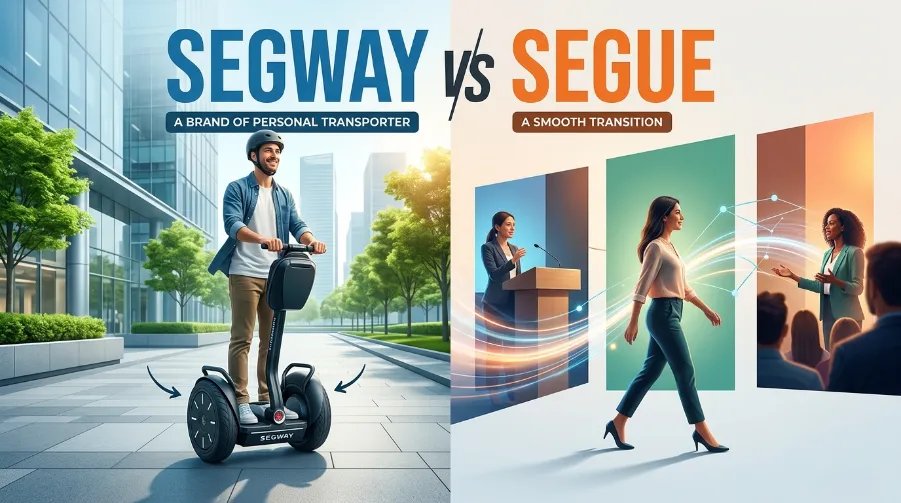
Choosing between segway or segue is one of the most common writing mistakes in English. Many people type “segway” when they actually mean “segue”, especially in emails, blog posts, presentations, and social media. Although the words sound exactly the same, they have completely different meanings.
Here’s the key point.
Segue is the correct word when you’re talking about a smooth transition from one topic, idea, or scene to another. Segway, on the other hand, is a brand name for the two-wheeled self-balancing personal transporter invented by Dean Kamen. Confusing them can instantly make polished writing look less professional.
Let’s break it down.
The Core Rule Explained Simply
The easiest way to remember segway or segue is this:
- Segue = A transition between ideas, topics, conversations, or scenes.
- Segway = A two-wheeled electric vehicle.
They sound identical, but they belong to completely different categories. One is a verb and noun related to communication. The other is a proper noun referring to a product.
When to Use Segue
Use segue whenever you’re describing a smooth movement from one subject to another.
Examples:
- Let’s segue into our next discussion.
- The speaker used a funny story as a segue into the main presentation.
- The movie segues from comedy into drama beautifully.
- She made a natural segue between the two topics.
Notice that every example involves transition, not transportation.
When to Use Segway
Use Segway only when referring to the electric personal transporter.
Examples:
- We rented a Segway during our city tour.
- The security guard patrolled the mall on a Segway.
- Learning to ride a Segway only took a few minutes.
- Tourists enjoyed exploring downtown on Segways.
This word never means “transition.”
Segway or Segue; Side-by-Side Comparison Table
| Situation | Example | Meaning | Correct Usage |
| Moving between ideas | Let’s segue into the next chapter. | Transition | Segue |
| Connecting presentation topics | The speaker used humor as a segue. | Smooth connection | Segue |
| Riding around a city | They rented a Segway. | Electric transporter | Segway |
| Guided sightseeing | We took a Segway tour. | Vehicle | Segway |
| Transitioning between songs | The DJ segued perfectly. | Musical transition | Segue |
| Campus transportation | Students rode Segways. | Personal transporter | Segway |
Deep Dive into Category 1, Segue
Understanding segue becomes much easier once you focus on the idea of flow.
A segue connects one idea to another without creating an awkward interruption. Writers, speakers, teachers, presenters, filmmakers, and musicians all use segues to maintain continuity.
When Should You Use Segue?
Use segue whenever something transitions smoothly.
Common situations include:
- Presentations
- Essays
- Speeches
- Conversations
- Podcasts
- Videos
- Movies
- Music
- News broadcasts
- Classroom lectures
Examples:
- Before discussing pricing, let’s segue into customer feedback.
- The professor segued from history into politics.
- The documentary segues naturally between interviews.
- That question provides the perfect segue into today’s lesson.
Examples Across Different Writing Styles
Academic
- The author segues from theory to practical application.
Business
- I’d like to segue into next quarter’s sales figures.
Journalism
- The article segues from local news to international affairs.
Entertainment
- The soundtrack segues perfectly into the next scene.
Daily Conversation
- That’s a great segue to my next point.
Quick Test
Ask yourself:
Am I talking about moving between ideas?
Is there a transition happening?
Would “smooth connection” fit here?
If you answered yes, choose segue.
Deep Dive into Category 2, Segway
Unlike segue, Segway refers to a physical object.
It is a trademarked brand name that became famous for its self-balancing electric scooters used for transportation, tourism, and security patrols.
When Should You Use Segway?
Use Segway only when discussing the vehicle.
Examples include:
- City tours
- Police patrols
- Campus transportation
- Warehouse mobility
- Recreational riding
Examples:
- We explored the waterfront on Segways.
- The officer rode a Segway through the park.
- Tourists quickly learned how to operate the Segway.
Common Patterns
You’ll often see these phrases:
- Segway tour
- Segway rider
- Segway rental
- Segway experience
- Segway training
These always involve the machine.
Segway or Segue; The Meaning Shift
Although segway and segue sound exactly alike, they represent two completely unrelated concepts.
Segue emphasizes continuity.
It creates a feeling that ideas naturally flow together.
Example:
- The host smoothly segued into audience questions.
Segway emphasizes movement through physical space.
Example:
- The guide rode a Segway across the plaza.
The pronunciation creates confusion because readers often assume identical sounds mean identical spelling.
English frequently breaks that expectation.
Why the Confusion Persists
Several factors explain why people continue mixing up segway or segue.
First, both words are pronounced the same.
Second, many people encounter Segway advertisements before ever seeing segue in writing.
Third, spell-check software often recognizes both words because each is legitimate in different contexts.
Fourth, autocorrect rarely understands what you intended.
Social media also reinforces the mistake because incorrect spellings spread rapidly.
Many readers never notice the difference.
As a result, even experienced professionals occasionally type segway when discussing transitions.
Segway or Segue; Formal vs Casual Contexts
The distinction becomes especially important in professional environments.
Formal Writing
Always use segue for transitions.
Examples include:
- Academic papers
- Research articles
- Corporate reports
- Business presentations
- Legal writing
- Professional emails
Correct:
- This section segues into our findings.
Casual Writing
Friends may overlook the mistake, but it is still incorrect.
Incorrect:
- Let me segway into another topic.
Correct:
- Let me segue into another topic.
When Discussing Transportation
Whether formal or informal, use Segway for the vehicle.
Example:
- Our company organized a Segway tour after the conference.
Case Studies / Pop Culture Examples
Many television hosts rely on effective segues.
Late-night talk shows constantly transition from interviews to comedy sketches, audience questions, and musical performances.
Radio DJs also master the art of the segue.
Instead of abruptly ending one song and starting another, they create seamless transitions that maintain listener engagement.
Podcast hosts frequently say:
“That brings us to today’s sponsor.”
This sentence acts as a segue.
Meanwhile, travel companies advertise Segway tours in cities around the world.
Visitors commonly explore parks, waterfronts, and historical districts using Segways rather than walking long distances.
These examples clearly separate the two meanings.
Segway or Segue; Advanced Scenarios & Flowchart
Sometimes choosing the correct word takes only one question.
Follow this simple guide.
Is the sentence about movement?
Is it movement between ideas?
Yes
Use segue
No
Continue
Is it movement using a two-wheeled electric vehicle?
Yes
Use Segway
No
You’re probably looking for segue if discussing writing, speaking, presentations, or conversations.
Advanced Examples
Correct:
- The professor segued into a discussion about ethics.
Correct:
- We booked a Segway tour downtown.
Incorrect:
- I’ll segway into my final point.
Correct:
- I’ll segue into my final point.
Segway or Segue; Quick Reference Table
| If You Mean… | Use |
| Transition between ideas | Segue |
| Smooth conversational connection | Segue |
| Presentation transition | Segue |
| Movie scene transition | Segue |
| Electric transporter | Segway |
| Guided riding tour | Segway |
| Personal mobility device | Segway |
| Two-wheeled vehicle | Segway |
Segway vs Segue; Common Mistakes That Lower Quality
Even strong writers make predictable errors.
Here are the most frequent ones.
Using “Segway” in Essays
Incorrect:
- Let’s Segway into the conclusion.
Correct:
- Let’s segue into the conclusion.
Capitalizing “Segue”
Unless it starts a sentence, segue is lowercase.
Incorrect:
- The Segue between chapters worked well.
Correct:
- The segue between chapters worked well.
Forgetting That Segway Is a Brand
Because Segway is a proper noun, capitalize it.
Incorrect:
- We rented a segway.
Correct:
- We rented a Segway.
Assuming Sound Determines Spelling
English contains many homophones.
Always choose the word that matches the meaning, not just the pronunciation.
Overusing “Segue”
Not every transition requires the actual word.
Sometimes phrases like these sound more natural:
- Next,
- Moving on,
- Turning to,
- Now let’s discuss,
- That leads us to,
Using variety improves readability.
Memory Hacks That Actually Work
Simple tricks make this distinction easy to remember.
Hack 1, Think of the Letter “U”
SegUe contains the letter U.
Imagine the U standing for “Up next.”
Transitions move up next.
Hack 2, Picture the Vehicle
Whenever you see a Segway, picture someone balancing on two wheels.
If no vehicle appears in your sentence, it’s probably wrong.
Hack 3, Ask One Question
Are you discussing:
- Ideas? Use segue.
- Transportation? Use Segway.
That single question solves nearly every case.
Hack 4, Remember Presentations
Speakers constantly use segues.
Tourists ride Segways.
Different activities, different words.
Why Precision Matters (SEO/Authority)
Correct word choice affects more than grammar.
It influences credibility, search visibility, and reader trust.
When readers notice mistakes like confusing segway or segue, they may question the overall quality of the content. Editors, recruiters, professors, and clients often view these errors as signs of weak proofreading, even if the rest of the writing is strong.
Search engines also reward content that demonstrates accuracy, clarity, and topical authority. While a single spelling error is unlikely to harm rankings by itself, repeated misuse of important terms can reduce the perceived quality of a page. Readers are also more likely to share and reference content that is polished and dependable.
Using segue correctly in articles, emails, presentations, and professional documents shows attention to detail. Likewise, reserving Segway exclusively for the well-known personal transporter prevents ambiguity and keeps your message clear. Precision strengthens communication, improves readability, and helps establish long-term trust with your audience.
A Quick Quiz
Fill in the blanks with segue or Segway.
- The presenter used a short story to ________ into the main topic.
- We rented a ________ during our sightseeing tour.
- The documentary smoothly ________ from one interview to the next.
- The security officer patrolled the airport on a ________.
- That’s the perfect ________ into our final discussion.
- The podcast host ________ naturally between different guest interviews.
- Our family booked a guided ________ tour through the historic district.
Answer Key
- segue
- Segway
- segued
- Segway
- segue
- segued
- Segway
Conclusion
Choosing between segway or segue becomes simple once you understand that the two words have completely different meanings. Segue refers to a smooth transition between ideas, topics, conversations, or scenes, making it the correct choice in writing, speaking, presentations, and storytelling. Segway, in contrast, is the name of a two-wheeled self-balancing personal transporter. Because the words are pronounced the same, they are often confused, but pronunciation should never determine spelling. Instead, focus on the meaning of your sentence. If you’re connecting thoughts, use segue. If you’re talking about transportation, use Segway. This small distinction makes a big difference in the quality and professionalism of your writing.
Strong writing depends on precision, and using the correct word is one of the easiest ways to build credibility with readers. Whether you’re drafting a business email, publishing a blog post, writing an academic paper, or preparing a speech, choosing segue instead of mistakenly typing segway demonstrates attention to detail. Likewise, correctly capitalizing Segway when referring to the vehicle shows an understanding of proper nouns. Developing this habit will help you avoid one of the most common homophone-related mistakes in English. The next time you pause to choose between segway or segue, remember one simple rule: ideas segue, people ride Segways. That single memory trick can save you from an error that even experienced writers occasionally make.
Frequently Asked Questions
Is “segway” ever correct when talking about writing?
No. When discussing a transition between ideas, topics, paragraphs, or conversations, “segue” is always the correct spelling. “Segway” refers only to the branded two-wheeled personal transporter. Although many people mistakenly use “segway” because it sounds identical to “segue,” it is considered incorrect in writing unless you are specifically referring to the vehicle.
Why do “segue” and “Segway” sound exactly the same?
The two words are homophones, meaning they share the same pronunciation but have different spellings and meanings. “Segue” comes from Italian and entered English as a term for a smooth transition, while “Segway” is a modern brand name. Their identical pronunciation is the main reason writers frequently confuse them, especially when typing quickly.
Can “segue” be used as both a noun and a verb?
Yes. “Segue” functions as both a noun and a verb. As a noun, it describes a smooth transition, such as “That joke was a perfect segue into the next topic.” As a verb, it describes the act of transitioning, as in “The presenter segued into the final section.” Both uses are standard in English.
Should “Segway” always be capitalized?
Yes. Segway is a trademarked brand name, so it should be capitalized whenever it refers to the self-balancing personal transporter. Writing it in lowercase is generally incorrect when referencing the brand. In contrast, segue is a common English word and is only capitalized when it begins a sentence or appears in a title.
Is using “segway” instead of “segue” considered a serious grammar mistake?
It is more accurately described as a word choice or spelling mistake than a grammar error. However, because the confusion is so common, readers often notice it immediately. In professional writing, academic work, or published content, using “segway” instead of “segue” can reduce your credibility and make your writing appear less carefully edited.
How can I remember the difference between “segue” and “Segway”?
A simple memory trick is to remember that ideas segue, people ride Segways. If your sentence involves a transition between thoughts, choose segue. If it involves transportation or a two-wheeled electric vehicle, choose Segway. Associating each word with a clear mental image makes the distinction much easier to remember.
Do spell-checkers always catch this mistake?
Not always. Since both segue and Segway are legitimate words, most spell-check tools accept either spelling. They usually cannot determine which word fits your intended meaning. That’s why proofreading for context is essential, especially in professional documents, blog posts, presentations, and academic assignments.
Is “segue” commonly used outside of writing?
Absolutely. Segue appears frequently in spoken English, especially in presentations, interviews, podcasts, television, radio, and public speaking. People often use phrases like “Let’s segue into our next topic” to indicate a smooth transition. The word is widely accepted in both formal and conversational settings whenever continuity between ideas is important.
Why is it important to use the correct word in SEO content?
Accurate language helps establish authority, trust, and professionalism, all of which contribute to a better user experience. Readers are more likely to stay engaged with content that is polished and error-free. While a single mistake may not drastically affect search rankings, consistently using the correct terms strengthens credibility and supports high-quality SEO writing that both users and search engines appreciate.

Alexander Brooks is an experienced English writer and language educator focused on helping readers build grammar, vocabulary, writing, and communication skills. At Grammar Alpha, he creates accurate, well-researched, and practical content designed for students, professionals, and English learners. His work explains grammar rules, word usage, sentence structure, and common mistakes in clear, accessible language. Alexander values accuracy, clarity, and trustworthy information, with a goal of making English learning easier while helping readers communicate confidently and effectively in professional and daily situations.