
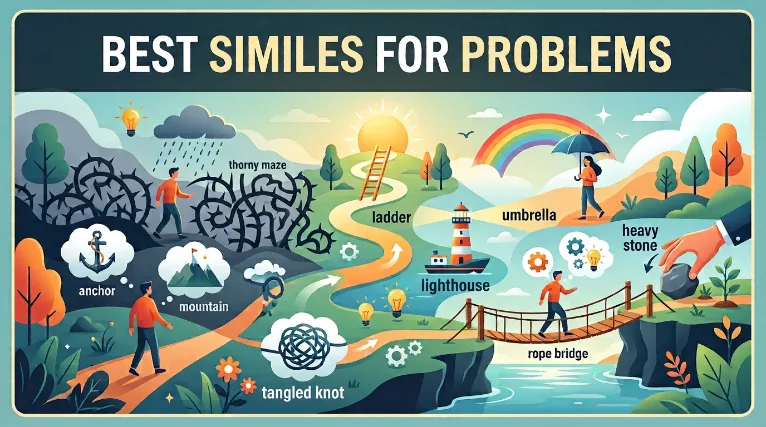
Every story, conversation, or piece of writing includes challenges. Instead of saying someone has a problem, you can make your writing more vivid with similes for problems. A well-crafted simile helps readers picture the difficulty, understand the emotion behind it, and remember your message.
In this guide, you’ll discover a large collection of original similes for problems, organized into easy-to-browse categories. You’ll also learn what these similes mean, when to use them, and how to choose the right one for different situations. Whether you’re writing fiction, essays, speeches, poems, or everyday messages, these examples will help you describe problems in fresh and memorable ways.
What Are Similes for Problems?
Similes for problems compare a challenge or difficulty to something else by using words like “as” or “like.” They help readers visualize the size, complexity, or emotional weight of an obstacle instead of simply calling it difficult.
For example:
- The problem spread like cracks in a windshield.
- Her worries clung like wet clothes after a storm.
- The project felt as tangled as a basket of fishing nets.
Each comparison paints a stronger mental picture than saying the problem was “hard.”
Good similes make writing:
- More descriptive
- More memorable
- More emotional
- More engaging
- Easier to imagine
Whether you’re describing school assignments, workplace challenges, relationships, or unexpected setbacks, the right simile adds life to your words.
Why These Similes Matter
Problems are something everyone experiences, but not every problem feels the same. Some are confusing. Others are exhausting. Some grow slowly, while others appear without warning.
That’s why choosing the right simile for problems matters.
A creative comparison can instantly show readers whether a challenge is:
- Small or overwhelming
- Temporary or ongoing
- Confusing or straightforward
- Stressful or humorous
- Personal or universal
Here’s why.
Instead of writing:
The meeting became difficult.
You could write:
The meeting became like rowing upstream against a strong current.
The second sentence creates movement, emotion, and a clear picture.
Now consider this.
Instead of saying:
She had many problems.
You could write:
Her problems stacked like books on an overloaded shelf.
Readers immediately imagine growing pressure.
Strong similes also make speeches, blogs, stories, and classroom assignments more enjoyable because they replace plain language with memorable imagery.
How to Choose the Right Simile
Not every simile fits every situation. The best comparison depends on what kind of problem you’re describing.
Ask yourself:
- Is the problem small or huge?
- Is it confusing or emotional?
- Is your audience formal or casual?
- Are you writing a story, essay, speech, or conversation?
Use this simple guide.
| Situation | Best Type of Simile | Example |
| Minor inconvenience | Light and relatable | Like a pebble in a shoe |
| Ongoing challenge | Persistent imagery | Like climbing a hill that never ends |
| Sudden crisis | Dramatic comparison | Like a bridge collapsing beneath your feet |
| Confusing issue | Maze or puzzle imagery | Like wandering through endless hallways |
| Emotional struggle | Heavy emotional images | Like carrying a backpack filled with stones |
| Funny situation | Playful comparison | Like chasing a runaway shopping cart |
| Professional writing | Clear and balanced | Like untangling a knot one strand at a time |
| Creative fiction | Rich imagery | Like fighting shadows in thick fog |
Choosing the right comparison helps readers experience the challenge instead of merely reading about it.
Best Similes for Problems
Powerful Similes for Problems
These similes describe serious obstacles, overwhelming situations, and major life challenges.
- Like carrying a mountain on your shoulders, a burden that feels impossible to bear.
- Like walking through a storm without shelter, facing constant hardship.
- Like climbing a cliff with bare hands, succeeding only through determination.
- Like rowing against a raging river, making progress despite resistance.
- Like dragging an anchor through mud, every step demands extra effort.
- Like standing before a locked gate without a key, feeling trapped.
- Like fighting waves during a hurricane, every challenge brings another.
- Like balancing on cracking ice, danger grows with every move.
- Like crossing a desert without water, hope becomes difficult to maintain.
- Like carrying burning coals in your hands, pain follows every decision.
- Like holding together a crumbling wall, constant effort prevents collapse.
- Like walking into thick smoke, the future becomes impossible to see.
- Like lifting an elephant alone, the task exceeds ordinary strength.
- Like chasing daylight before sunset, time always seems to run out.
- Like sailing through a sea of whirlpools, every direction carries risk.
Creative Similes for Problems
These comparisons use imaginative imagery to make writing more colorful.
- Like trying to fold the wind into a box, impossible to control.
- Like catching moonlight with a fishing net, chasing an unreachable solution.
- Like painting on moving water, progress disappears instantly.
- Like untangling headphones in complete darkness, confusing from the start.
- Like chasing butterflies during a tornado, impossible conditions.
- Like stacking clouds into neat piles, unrealistic expectations.
- Like solving a puzzle with missing pieces, information is incomplete.
- Like stitching rain into fabric, effort produces little result.
- Like baking bread without flour, essential parts are missing.
- Like planting seeds on solid rock, success has nowhere to grow.
- Like collecting smoke in your pockets, impossible to hold onto progress.
- Like building a staircase from sand, unstable foundations.
- Like drawing maps inside a whirlwind, plans constantly change.
- Like reading invisible ink at midnight, answers remain hidden.
- Like catching echoes with your hands, the solution slips away.
Emotional Similes for Problems
These similes highlight stress, fear, sadness, and emotional pressure.
- Like carrying invisible chains, emotional weight slows every step.
- Like sitting beneath endless rain clouds, sadness never seems to end.
- Like swallowing sharp stones, every moment feels painful.
- Like hearing thunder that never arrives, constant anxiety.
- Like living inside a shrinking room, pressure keeps increasing.
- Like holding your breath underwater, stress builds steadily.
- Like watching a candle fade in a strong wind, hope weakens.
- Like carrying winter inside your heart, emotional coldness remains.
- Like wearing shoes made of bricks, every step feels exhausting.
- Like chasing yesterday’s sunrise, longing for what cannot return.
- Like standing beneath falling walls, danger feels unavoidable.
- Like sleeping beside a ticking clock, worry never disappears.
- Like walking through endless fog, uncertainty surrounds every choice.
- Like hugging a cactus, every attempt to fix things hurts.
- Like carrying broken glass in your pockets, every movement causes pain.
Funny Similes for Problems
Not every challenge needs to sound dramatic. These playful similes add humor.
- Like chasing a chicken wearing roller skates, wildly unpredictable.
- Like teaching a goldfish to ride a bicycle, completely unrealistic.
- Like herding balloons during a windstorm, impossible to organize.
- Like arguing with an alarm clock, frustrating but pointless.
- Like chasing popcorn around the kitchen, everything scatters.
- Like trying to iron spaghetti, nothing cooperates.
- Like convincing a squirrel to share its snacks, highly unlikely.
- Like juggling slippery soap bars, difficult to keep under control.
- Like catching hiccups in a jar, impossible to manage.
- Like organizing cats into a marching band, complete chaos.
- Like pushing a shopping cart with square wheels, every step feels awkward.
- Like balancing pancakes on a trampoline, disaster seems inevitable.
- Like untangling Christmas lights with oven mitts, unnecessarily difficult.
- Like chasing your own shadow uphill, endless effort with little reward.
- Like trying to whisper during a fireworks show, impossible to be heard.
Everyday Similes for Problems
These simple comparisons work well in conversations, blogs, and everyday writing.
- Like a pebble in your shoe, small but constantly annoying.
- Like a traffic jam during rush hour, progress slows to a crawl.
- Like a dripping faucet at midnight, impossible to ignore.
- Like forgetting your keys every morning, frustratingly repetitive.
- Like a phone battery stuck at one percent, energy quickly disappears.
- Like waiting in the longest grocery line, patience gets tested.
- Like missing the last bus home, bad timing creates bigger trouble.
- Like trying to open a jar with wet hands, harder than expected.
- Like losing one sock in every laundry load, a recurring mystery.
- Like spilling coffee before an important meeting, an unfortunate start.
- Like searching for your glasses while wearing them, the answer is closer than you think.
- Like reading tiny print without glasses, understanding becomes difficult.
- Like carrying too many grocery bags at once, one more thing feels impossible.
- Like a computer freezing before you save your work, panic strikes instantly.
- Like hitting every red light in town, nothing seems to go your way.
Nature-Inspired Similes for Problems
Nature offers vivid imagery for describing challenges and obstacles.
- Like roots twisting beneath stone, progress comes slowly.
- Like a river carving through solid rock, persistence is required.
- Like climbing a waterfall, every step meets resistance.
- Like branches tangled after a storm, everything feels complicated.
- Like thunder rolling across distant hills, trouble keeps approaching.
- Like crossing a swamp after heavy rain, every move becomes harder.
- Like leaves caught in a whirlwind, control disappears.
- Like standing beneath an erupting volcano, danger grows rapidly.
- Like walking through thorn bushes barefoot, every step hurts.
- Like sailing beneath dark storm clouds, uncertainty hangs overhead.
- Like a tree bending in fierce wind, strength is constantly tested.
- Like crossing frozen rivers in spring, every decision carries risk.
- Like climbing dunes that keep shifting, progress never stays permanent.
- Like waves crashing against fragile cliffs, pressure never stops.
- Like lightning striking the same tree twice, problems return unexpectedly.
How to Use These Similes Naturally
Using similes for problems effectively is all about matching the comparison to the situation. A simple challenge deserves a simple simile, while a life-changing obstacle can support a stronger image.
Here’s how.
Instead of forcing a simile into every sentence, use one where it creates the biggest impact. Too many comparisons can overwhelm readers.
In Everyday Conversation
Simple similes sound natural and relatable.
Examples:
- “This assignment is like untangling a giant knot.”
- “Today’s schedule feels like running through quicksand.”
- “Our internet has been like a bridge with missing planks all week.”
- “This paperwork is like climbing stairs that never end.”
In Stories
Choose vivid imagery that helps readers picture the challenge.
Example:
The village’s troubles spread like cracks across frozen glass, reaching every family before anyone noticed.
In Essays
Professional writing benefits from balanced comparisons.
Example:
Solving climate issues is like repairing a ship while sailing through rough seas, requiring careful planning and teamwork.
In Speeches
Powerful similes help audiences remember important points.
Example:
Every great achievement begins by facing problems like mountains that seem impossible until someone starts climbing.
In Creative Writing
Don’t be afraid to invent fresh imagery.
Example:
His worries circled his mind like birds trapped inside an empty cathedral.
Now consider this.
Always choose a comparison your readers can easily picture. Familiar images usually create the strongest connection.
Common Mistakes to Avoid
Even excellent similes for problems lose their impact when they’re overused or poorly matched.
Using Clichés Too Often
Readers have seen comparisons like “as hard as a rock” countless times.
Instead, create something fresh.
Better example:
- Like carrying tomorrow on your back.
Mixing Unrelated Images
Don’t combine different comparisons in one sentence.
Poor:
The problem was like a volcano sailing through a maze.
The images compete instead of helping.
Choosing Similes That Are Too Dramatic
A tiny inconvenience doesn’t need an extreme comparison.
Instead of:
Losing my pencil was like surviving a hurricane.
Try:
Losing my pencil was like searching for one puzzle piece under the couch.
Using Too Many Similes
One or two strong comparisons create more impact than several in one paragraph.
Weak:
The problem was like a mountain, like a storm, like a maze, like quicksand, like an avalanche.
Better:
The problem felt like climbing a mountain with no visible summit.
Forgetting the Audience
Children, professionals, and poetry readers appreciate different styles.
Match your similes to your readers’ expectations.
Repeating the Same Image
If every challenge is compared to a mountain, readers quickly lose interest.
Instead, rotate among images involving:
- Nature
- Travel
- Weather
- Sports
- Everyday life
- Animals
- Buildings
- Technology
- Art
- Food
Variety keeps your writing engaging.
Tips for Writing Better Similes
Anyone can create original similes for problems with a little practice.
Observe Everyday Life
Many of the best comparisons come from ordinary experiences.
Examples include:
- Waiting in traffic
- Fixing broken furniture
- Gardening
- Cooking
- Traveling
- Playing sports
These familiar situations instantly connect with readers.
Focus on One Quality
Ask yourself:
What makes this problem difficult?
Is it:
- Heavy?
- Confusing?
- Endless?
- Painful?
- Slow?
- Unexpected?
Then build your comparison around that single idea.
Use Strong Visual Images
Readers remember pictures more than abstract ideas.
Instead of:
Like being stressed.
Write:
Like carrying a backpack that grows heavier every mile.
Avoid Copying Common Expressions
Invent something readers haven’t seen before.
Instead of:
- Like climbing a mountain.
Try:
- Like repairing a watch while wearing boxing gloves.
Read Your Sentence Aloud
Good similes sound smooth.
If the comparison feels awkward or confusing, simplify it.
Keep It Relevant
A humorous comparison belongs in casual writing.
A thoughtful comparison fits academic or professional work.
Matching tone improves clarity.
Experiment with Different Subjects
Problems can be compared to almost anything.
Ideas include:
- Seasons
- Weather
- Rivers
- Machines
- Musical instruments
- Animals
- Space
- Sports
- Games
- Cities
The more sources of inspiration you explore, the more original your writing becomes.
Similes by Writing Situation
Different writing situations call for different kinds of similes for problems. The table below can help you choose comparisons that match your audience and purpose.
| Writing Situation | Best Simile Style | Example |
| School essay | Clear and descriptive | Like solving a puzzle with hidden pieces |
| Business presentation | Professional | Like repairing an engine while it is running |
| Fiction | Vivid and emotional | Like wandering through a forest where every path disappears |
| Poetry | Symbolic | Like winter refusing to leave the valley |
| Speech | Inspirational | Like climbing a mountain one steady step at a time |
| Children’s story | Simple and playful | Like chasing bubbles in the wind |
| Personal journal | Honest and emotional | Like carrying rain inside your pockets |
| Blog post | Relatable | Like hitting every red light on the way home |
| Motivational writing | Hopeful | Like planting flowers in rocky soil |
| Social media | Short and memorable | Like trying to catch smoke with your hands |
| Novel dialogue | Natural | Like pushing a cart with one wobbly wheel |
| News commentary | Balanced | Like steering through heavy fog |
| Self-help article | Encouraging | Like untangling one knot at a time |
| Technical explanation | Logical | Like tracing a single wire through a complex machine |
| Humor writing | Funny | Like teaching ducks to stand in a straight line |
Choosing the right style helps your comparison feel authentic instead of forced.
The best similes for problems are those that fit naturally into the situation, strengthen your message, and create a vivid mental picture. Whether you’re writing an essay, crafting a story, giving a speech, or simply describing a difficult day, thoughtful comparisons can transform ordinary language into writing that readers remember. By using fresh imagery, avoiding repetition, and matching the tone to your audience, you’ll create similes that are both original and effective.
Final Thoughts
Finding the best similes for problems is more than collecting clever comparisons. The right simile turns an ordinary sentence into one that readers can clearly picture and remember. Whether you are describing a personal struggle, a workplace challenge, or a fictional conflict, a meaningful comparison helps communicate both the situation and the emotion behind it. Instead of relying on overused expressions, look for fresh images inspired by everyday life, nature, or common experiences. A well-chosen simile makes your writing feel more authentic, engaging, and memorable without making it difficult to understand.
As you continue writing, experiment with different styles until you discover what fits your audience and purpose best. A playful simile may brighten a casual conversation, while a thoughtful comparison can strengthen an essay or speech. Read your work aloud to see if each simile sounds natural and supports your message instead of distracting from it. The more you practice creating original comparisons, the easier it becomes to describe challenges with confidence and creativity. Over time, your writing will become richer, clearer, and far more enjoyable for every reader.
Frequently Asked Questions
What makes a good simile for problems?
A good simile clearly compares a problem to something readers can easily imagine. It should match the size, seriousness, or emotion of the challenge without feeling exaggerated. For example, comparing a confusing issue to “a maze without signs” creates a stronger image than simply calling it difficult.
Can I create my own similes for problems?
Yes. In fact, original similes often make writing more memorable. Think about the main quality of the problem, such as being confusing, heavy, or never-ending, then compare it to a familiar experience. For example, “like trying to fold a map during a windstorm” is a fresh and imaginative comparison.
Are similes for problems suitable for academic writing?
Yes, when used carefully. Academic writing usually benefits from clear and moderate comparisons rather than dramatic ones. A sentence like “The research process was like assembling a puzzle with missing pieces” can make an explanation easier to understand while maintaining a professional tone.
What is the difference between a simile and a metaphor?
A simile compares two things using words such as “like” or “as,” while a metaphor states that one thing is another. For example, “The problem was like a tangled rope” is a simile, whereas “The problem was a tangled rope” is a metaphor.
How many similes should I use in one piece of writing?
Quality is more important than quantity. One strong simile in a paragraph often creates a greater impact than several comparisons placed together. Use similes only where they improve understanding or add emotion, rather than filling every sentence with descriptive language.
Can similes make difficult topics easier to explain?
Absolutely. Similes simplify complex ideas by connecting them to familiar experiences. For instance, explaining a complicated project as “like building a bridge one beam at a time” helps readers understand the process without requiring technical knowledge.
Which similes work best for children’s writing?
Children respond well to simple, colorful comparisons they can easily imagine. Similes involving animals, toys, weather, or everyday activities usually work well. For example, “The problem bounced around like a rubber ball” is easy for young readers to picture and understand.
Should I avoid humorous similes in serious writing?
Not always, but they should match the tone. A funny comparison may be perfect for a blog post or speech, while a serious report usually requires a more thoughtful image. Consider your audience before choosing a playful or dramatic simile for a problem.
How can I make my similes sound more original?
Start by observing ordinary experiences instead of copying familiar expressions. Everyday moments, hobbies, travel, cooking, or sports can inspire fresh ideas. Rather than using “like climbing a mountain,” try something unique, such as “like fixing a puzzle while the pieces keep changing shape.”
Why are similes useful in storytelling?
Similes help readers connect emotionally with characters and situations by creating vivid mental pictures. Instead of saying a character struggled, you can write that the challenge felt “like walking through deep snow with every step growing heavier.” This paints a scene that readers can imagine and remember.

Daniel Carter is a passionate English writer dedicated to making language learning simple, practical, and engaging. At Grammar Alpha, he shares clear and reliable insights on grammar, vocabulary, word meanings, sentence structure, and everyday English usage. His easy-to-follow articles help students, professionals, and language learners strengthen their writing and communication skills. With a strong focus on clarity and accuracy, Daniel turns complex English concepts into useful lessons, empowering readers to write with confidence, speak naturally, and use English effectively every day.