
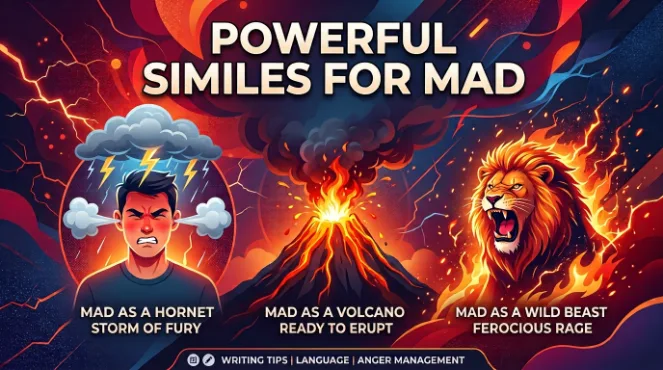
Being angry is a universal human emotion, but describing it in a fresh and memorable way can be surprisingly difficult. That is where powerful similes for mad come in. Instead of simply saying someone was angry, a vivid simile paints a clear picture that helps readers feel the emotion. Whether you are writing a story, creating dialogue, improving your essays, or adding personality to your everyday conversations, the right comparison can make your words far more engaging.
In this guide, you will discover a wide collection of powerful similes for mad, each with its meaning and a practical example. You will also learn when to use different types of similes, how to choose the most effective one for your audience, and simple techniques for making your writing sound more natural. Every example is original, easy to understand, and designed to help you express anger with creativity and precision.
What Are Powerful Similes for Mad?
Powerful similes for mad are comparisons that describe anger by using the words “like” or “as.” They compare a person’s emotions to something familiar, making the feeling easier to imagine.
For example:
- As fierce as a wildfire suggests uncontrollable anger.
- Like a kettle ready to whistle describes someone who is about to explode with frustration.
- As sharp as broken glass shows anger that hurts everyone nearby.
Unlike ordinary descriptions, similes create vivid mental images. Readers do not just understand the emotion, they experience it.
Here’s why.
Strong similes can instantly reveal a character’s personality, mood, or emotional state without lengthy explanations. A single well-chosen comparison often says more than several plain sentences.
Why These Similes Matter
Using powerful similes for mad makes your writing more expressive and memorable. Instead of repeating words like angry, furious, or upset, you can introduce colorful comparisons that keep readers interested.
These similes also help you:
- Create stronger emotional impact by showing anger instead of merely naming it.
- Improve storytelling through vivid descriptions.
- Make dialogue sound realistic because people often speak with comparisons.
- Avoid repetitive language in essays, stories, and articles.
- Keep readers engaged with fresh imagery.
Now consider this.
Compare these two sentences.
- She was very angry.
- She was like a volcano moments before the eruption.
The second sentence instantly creates tension because readers can visualize the emotion.
How to Choose the Right Simile
Not every simile fits every situation. Some comparisons work well for humorous conversations, while others fit dramatic novels or emotional speeches.
Choose your simile based on the intensity of anger, your audience, and the tone of your writing.
| Situation | Best Type of Simile | Example |
| Casual conversation | Funny or lighthearted | Like a cat whose nap was interrupted |
| Fiction writing | Dramatic | As fierce as a thunderstorm |
| Poetry | Emotional | Like waves crashing against cliffs |
| Children’s writing | Gentle | Like a buzzing bee |
| Speeches | Powerful | As unstoppable as an avalanche |
| Blogs | Creative | Like a phone battery stuck at one percent |
| Classroom writing | Simple | As red as a ripe tomato |
| Character development | Deep emotional | Like fire trapped inside a glass bottle |
The best simile always matches the emotion without sounding forced.
Best Powerful Similes for Mad
Below are original categories filled with fresh similes you can use in many writing situations.
Powerful Similes for Intense Anger
These similes describe overwhelming rage and explosive emotions.
1. As fierce as a wildfire
Meaning: Anger spreads quickly and becomes difficult to control.
Example: He became as fierce as a wildfire after hearing the betrayal.
2. Like a volcano ready to erupt
Meaning: Suppressed anger waiting to explode.
Example: She stood there like a volcano ready to erupt.
3. As unstoppable as an avalanche
Meaning: Powerful anger that cannot easily be stopped.
Example: His fury rolled forward as unstoppable as an avalanche.
4. Like boiling lava beneath stone
Meaning: Hidden but extremely dangerous anger.
Example: Her frustration simmered like boiling lava beneath stone.
5. As loud as crashing thunder
Meaning: Anger expressed with shouting.
Example: His voice became as loud as crashing thunder.
6. Like a tornado tearing through a town
Meaning: Anger causing emotional destruction.
Example: She stormed through the office like a tornado tearing through a town.
7. As blazing as the midday sun
Meaning: Intense, impossible-to-ignore anger.
Example: His temper burned as blazing as the midday sun.
8. Like a lion protecting its pride
Meaning: Fierce defensive anger.
Example: The coach reacted like a lion protecting its pride.
9. As violent as crashing waves
Meaning: Emotional outbursts arriving repeatedly.
Example: Her anger struck as violent as crashing waves.
10. Like sparks landing on dry grass
Meaning: Anger spreading with very little encouragement.
Example: The argument grew like sparks landing on dry grass.
Emotional Similes for Mad
These comparisons focus on deep feelings rather than loud reactions.
1. Like a heart wrapped in flames
Meaning: Emotional pain mixed with anger.
Example: She felt like a heart wrapped in flames.
2. As heavy as storm clouds
Meaning: Anger mixed with sadness.
Example: His mood became as heavy as storm clouds.
3. Like waves refusing to settle
Meaning: Anger returning repeatedly.
Example: Her emotions rolled like waves refusing to settle.
4. As restless as the wind before rain
Meaning: Building frustration.
Example: He waited as restless as the wind before rain.
5. Like shattered glass underfoot
Meaning: Painful anger affecting every step.
Example: Every memory felt like shattered glass underfoot.
6. As dark as an eclipse
Meaning: Anger overshadowing happiness.
Example: Her thoughts became as dark as an eclipse.
7. Like smoke filling every room
Meaning: Anger affecting every part of life.
Example: His resentment spread like smoke filling every room.
8. As cold as frozen steel
Meaning: Quiet, controlled anger.
Example: She answered as cold as frozen steel.
9. Like an ocean caught in a storm
Meaning: Emotional chaos.
Example: His mind churned like an ocean caught in a storm.
10. As tense as a stretched rope
Meaning: Anger close to breaking.
Example: The room felt as tense as a stretched rope.
Creative Similes for Mad
These unique comparisons help your writing stand out.
1. Like a clock ticking too fast
Meaning: Growing impatience.
Example: He waited like a clock ticking too fast.
2. As tangled as headphones in a pocket
Meaning: Frustrated confusion.
Example: Her thoughts became as tangled as headphones in a pocket.
3. Like popcorn bursting in a pan
Meaning: Many angry reactions at once.
Example: Complaints popped like popcorn bursting in a pan.
4. As sharp as fresh cactus needles
Meaning: Hurtful anger.
Example: His remarks became as sharp as fresh cactus needles.
5. Like a pressure cooker without a valve
Meaning: Dangerous emotional buildup.
Example: She felt like a pressure cooker without a valve.
6. As unpredictable as rolling dice
Meaning: Sudden mood changes.
Example: His temper was as unpredictable as rolling dice.
7. Like lightning trapped inside a bottle
Meaning: Powerful emotion held back.
Example: She looked like lightning trapped inside a bottle.
8. As restless as leaves before a storm
Meaning: Growing irritation.
Example: The crowd became as restless as leaves before a storm.
9. Like an overfilled backpack
Meaning: Too many frustrations piling up.
Example: His stress felt like an overfilled backpack.
10. As hot as fresh asphalt in summer
Meaning: Extremely irritated.
Example: Her temper became as hot as fresh asphalt in summer.
Funny Similes for Mad
Not every angry moment needs to sound dramatic. These lighthearted similes add humor while still showing frustration.
1. Like a cat whose nap was interrupted
Meaning: Mild but obvious irritation.
Example: He looked like a cat whose nap was interrupted.
2. As grumpy as a bear without breakfast
Meaning: Hungry and easily annoyed.
Example: Dad was as grumpy as a bear without breakfast.
3. Like a squirrel that lost its favorite acorn
Meaning: Silly frustration.
Example: She paced around like a squirrel that lost its favorite acorn.
4. As annoyed as a mosquito in the rain
Meaning: Constantly bothered.
Example: He seemed as annoyed as a mosquito in the rain.
5. Like toast that popped too early
Meaning: Unexpected irritation.
Example: Her reaction was like toast that popped too early.
6. As cranky as a rooster before sunrise
Meaning: Complaining before the day begins.
Example: He sounded as cranky as a rooster before sunrise.
7. Like a balloon rubbing against wool
Meaning: Ready to spark.
Example: She was like a balloon rubbing against wool all afternoon.
8. As noisy as a blender full of spoons
Meaning: Loud complaints.
Example: The meeting became as noisy as a blender full of spoons.
9. Like a dog denied its favorite treat
Meaning: Childlike disappointment mixed with anger.
Example: He frowned like a dog denied its favorite treat.
10. As dramatic as a toddler missing one cookie
Meaning: Overreacting in a funny way.
Example: She acted as dramatic as a toddler missing one cookie.
Modern Similes for Mad
These modern comparisons connect anger with technology, busy lifestyles, and everyday experiences.
1. Like a phone freezing during an important call
Meaning: Frustration that appears at the worst possible moment.
Example: He stood there like a phone freezing during an important call after hearing the bad news.
2. As overloaded as an inbox after vacation
Meaning: Buried under stress and irritation.
Example: She felt as overloaded as an inbox after vacation.
3. Like Wi-Fi cutting out during a movie
Meaning: Sudden annoyance.
Example: His mood changed like Wi-Fi cutting out during a movie.
4. As tense as a laptop at one percent battery
Meaning: Nearly out of patience.
Example: She looked as tense as a laptop at one percent battery.
5. Like a traffic light stuck on red
Meaning: Frustrated by delays.
Example: He waited like a traffic light stuck on red.
6. As irritated as a printer out of ink
Meaning: Unable to finish an important task.
Example: She sighed as irritated as a printer out of ink.
7. Like an app that keeps crashing
Meaning: Losing emotional control repeatedly.
Example: His temper behaved like an app that keeps crashing.
8. As packed as a rush-hour subway
Meaning: Filled with bottled-up emotions.
Example: Her mind felt as packed as a rush-hour subway.
9. Like endless loading circles
Meaning: Growing impatient with every passing second.
Example: He waited like endless loading circles.
10. As loud as a hundred notifications
Meaning: Constant complaints.
Example: The room became as loud as a hundred notifications.
11. Like a password that never works
Meaning: Frustrated despite repeated attempts.
Example: She felt like a password that never works.
12. As exhausting as nonstop alerts
Meaning: Irritation building over time.
Example: His anger became as exhausting as nonstop alerts.
13. Like a browser with fifty open tabs
Meaning: Too many frustrations at once.
Example: Her thoughts were like a browser with fifty open tabs.
14. As sharp as a flashing warning sign
Meaning: Anger that everyone notices.
Example: His expression was as sharp as a flashing warning sign.
15. Like a game crashing before it saves
Meaning: Deep disappointment mixed with anger.
Example: She felt like a game crashing before it was saved.
Poetic Similes for Mad
These similes are ideal for poems, novels, and emotional storytelling.
1. Like autumn leaves caught in a storm
Meaning: Anger mixed with emotional turmoil.
Example: His thoughts drifted like autumn leaves caught in a storm.
2. As fierce as the sea beneath moonlight
Meaning: Beautiful yet dangerous anger.
Example: Her silence was as fierce as the sea beneath moonlight.
3. Like shadows swallowing the sunset
Meaning: Anger replacing happiness.
Example: Sadness spread like shadows swallowing the sunset.
4. As wild as untamed rivers
Meaning: Uncontrolled emotion.
Example: His fury became as wild as untamed rivers.
5. Like branches bending before the wind
Meaning: Struggling under emotional pressure.
Example: She stood like branches bending before the wind.
6. As restless as stars behind clouds
Meaning: Hidden but powerful frustration.
Example: His emotions were as restless as stars behind clouds.
7. Like frost touching blooming flowers
Meaning: Anger ruining joyful moments.
Example: Her harsh words arrived like frost touching blooming flowers.
8. As endless as ocean tides
Meaning: Returning anger.
Example: His resentment felt as endless as ocean tides.
9. Like rain striking silent lakes
Meaning: Disturbing inner peace.
Example: The criticism landed like rain striking silent lakes.
10. As lonely as winter forests
Meaning: Anger mixed with isolation.
Example: She looked as lonely as winter forests.
11. Like smoke rising into twilight
Meaning: Anger slowly fading away.
Example: His frustration disappeared like smoke rising into twilight.
12. As bright as lightning across dark skies
Meaning: Sudden emotional explosion.
Example: Her response flashed as bright as lightning across dark skies.
13. Like waves breaking against ancient rocks
Meaning: Constant emotional conflict.
Example: His worries returned like waves breaking against ancient rocks.
14. As cold as morning frost
Meaning: Calm but distant anger.
Example: She answered as cold as morning frost.
15. Like clouds hiding the sunrise
Meaning: Anger blocking hope.
Example: His bitterness settled like clouds hiding the sunrise.
How to Use These Similes Naturally
A great simile should sound effortless. It should support your writing instead of distracting readers with unnecessary complexity.
Here are several practical ways to use powerful similes for the mad naturally.
Match the Intensity
Choose a comparison that reflects the actual level of anger.
Mild anger:
She was like a phone stuck at one percent battery.
Extreme rage:
He charged forward like a volcano ready to erupt.
Match the Character
Different personalities express anger differently.
A calm character might be:
She remained as cold as frozen steel.
A dramatic character could be:
He exploded like fireworks in a tiny room.
Avoid Overusing Similes
One vivid comparison is usually enough for a paragraph.
Instead of writing:
He was like a volcano, like a hurricane, like thunder, like wildfire.
Write:
He was like a volcano ready to erupt, and everyone instinctively stepped back.
Blend Similes into Dialogue
Natural dialogue often includes comparisons.
Example:
“You look like a pressure cooker ready to burst,” Maya joked.
“That meeting tested every ounce of my patience,” Jake replied.
Use Similes to Show Emotion
Instead of telling readers someone is angry, let the comparison reveal it.
Instead of:
She became angry.
Write:
She stood like lightning trapped inside a bottle, waiting for someone to say one more careless word.
Common Mistakes to Avoid
Even excellent similes lose their impact when used incorrectly.
Using Too Many Similes
Crowding every sentence with comparisons overwhelms readers.
Keep the strongest one and remove the rest.
Choosing the Wrong Tone
A funny comparison may ruin a serious emotional scene.
Imagine using:
As dramatic as a toddler missing one cookie.
during an intense courtroom scene.
It would weaken the emotional impact.
Repeating the Same Images
Avoid relying on volcanoes, storms, and fire repeatedly.
Mix natural, emotional, humorous, and modern comparisons to keep your writing fresh.
Making Similes Too Complicated
Readers should immediately understand the comparison.
Simple imagery is usually stronger than confusing descriptions.
Forgetting the Audience
Children, students, fiction readers, and business professionals all respond differently to imagery.
Choose similes they can easily recognize.
Tips for Writing Better Similes
Anyone can improve their simile-writing skills with a little practice.
Observe Everyday Life
Interesting comparisons often come from ordinary experiences.
Traffic jams, rainy days, pets, cooking, sports, and technology all provide creative inspiration.
Think About Feelings First
Before writing the comparison, identify the exact emotion.
Is the anger quiet?
Explosive?
Embarrassed?
Protective?
Matching the feeling leads to stronger imagery.
Keep Comparisons Fresh
Avoid clichés whenever possible.
Instead of repeating common expressions, create original imagery based on familiar experiences.
Read Your Sentence Aloud
Natural similes sound smooth.
If the sentence feels awkward when spoken, simplify it.
Show Instead of Explain
Readers enjoy discovering emotions through vivid imagery.
A strong simile often replaces several plain descriptive sentences.
Build Your Own Collection
Whenever inspiration strikes, write it down.
A personal library of original similes becomes an excellent resource for future stories, essays, and creative writing.
Similes by Writing Situation
Different situations call for different kinds of comparisons. Choosing the right style helps your writing feel natural and effective.
| Writing Situation | Best Type of Simile | Why It Works | Example |
| Short stories | Emotional | Builds character depth | Like smoke filling every room |
| Novels | Powerful | Creates dramatic tension | Like a volcano ready to erupt |
| Poetry | Poetic | Adds rhythm and imagery | Like autumn leaves caught in a storm |
| Children’s books | Gentle or funny | Easy to picture and understand | Like a cat whose nap was interrupted |
| Speeches | Strong | Emphasizes emotion | As unstoppable as an avalanche |
| Blogs | Modern | Relatable to today’s readers | Like a browser with fifty open tabs |
| Personal journals | Reflective | Expresses private emotions | As deep as the sea at night |
| School essays | Simple | Clear and appropriate | As red as a ripe tomato |
| Dialogue | Creative | Makes conversations realistic | Like lightning trapped inside a bottle |
| Social media captions | Funny or modern | Short, memorable, and engaging | Like Wi-Fi cutting out during a movie |
Choosing the right simile for the right setting makes your writing more believable and memorable. Whether you are crafting a dramatic novel, a heartfelt poem, a classroom assignment, or a lighthearted social media post, selecting imagery that fits the tone will strengthen your message and help readers connect with the emotion more naturally.
Final Thoughts
Using powerful similes for mad can transform ordinary writing into something vivid, memorable, and emotionally engaging. Instead of relying on repetitive words like angry or furious, the right comparison helps readers picture the emotion and understand its intensity. Whether you are writing fiction, poetry, essays, or everyday conversations, carefully chosen similes add depth without making your sentences overly complicated. Focus on matching the comparison to the mood, character, and audience so every description feels authentic and purposeful rather than exaggerated or forced.
The best writers continually expand their collection of original similes by observing people, nature, technology, and everyday experiences. Experiment with different styles, from humorous comparisons to dramatic or poetic imagery, until you find the expression that perfectly fits your message. Reading your work aloud is another simple way to check whether a simile sounds natural and flows smoothly. With regular practice, you will become more confident at creating fresh comparisons that make your writing stronger, clearer, and far more enjoyable for readers of every age.
Frequently Asked Questions
What is a simile for someone who is mad?
A simile for someone who is mad compares their anger to something familiar using “like” or “as.” For example, “He was like a volcano ready to erupt” creates a stronger image than simply saying he was angry. The comparison helps readers visualize the emotion instead of just reading about it.
Why are similes better than simply saying someone is angry?
Similes make writing more descriptive by showing what anger feels or looks like. Instead of writing, “She was angry,” you could write, “She was as fierce as a thunderstorm.” This creates a mental picture that captures the emotion and keeps readers more engaged with the story.
Can I use powerful similes for mad in school essays?
Yes, as long as the similes match the tone of the assignment. A simple comparison such as “as red as a ripe tomato” works well in descriptive writing, while more dramatic examples may fit creative essays. Always choose comparisons that are easy to understand and relevant to your topic.
What makes a simile about anger effective?
An effective simile is clear, original, and appropriate for the situation. It should help readers imagine the emotion immediately without causing confusion. For example, “like a pressure cooker ready to burst” clearly communicates growing frustration and feels natural in many forms of writing.
Should funny similes for mad be used in serious stories?
Usually not. Funny similes work best in lighthearted conversations, children’s stories, or humorous articles. In serious fiction or emotional scenes, dramatic or emotional comparisons create a stronger impact. Matching the simile to the tone helps readers stay connected to the intended mood.
How can I create my own similes for anger?
Start by thinking about how anger behaves. Does it build slowly, explode suddenly, or remain hidden? Then compare it to something with similar qualities. For example, if anger grows quietly, you might write, “like snow piling up before an avalanche.” Everyday observations often inspire the most original ideas.
Are similes and metaphors the same thing?
No. A simile uses “like” or “as” to compare two different things, while a metaphor makes the comparison directly. For example, “He was like a roaring lion” is a simile, while “He was a roaring lion” is a metaphor. Both add imagery but work in different ways.
How many similes should I use in one paragraph?
One or two strong similes are usually enough. Adding too many comparisons can distract readers and reduce the impact of each one. Instead, select the simile that best matches the emotion and let it carry the description naturally throughout the paragraph.
Can powerful similes for mad improve creative writing?
Absolutely. Similes make characters, dialogue, and emotional scenes more memorable by replacing plain descriptions with vivid imagery. For example, writing “Her patience snapped like a dry branch” gives readers a clear picture of the moment and makes the scene easier to imagine.
Where can I use powerful similes for mad besides stories?
These similes are useful in speeches, blog posts, poems, journal entries, classroom assignments, and even casual conversations. A thoughtful comparison can make an opinion more engaging or help explain emotions more clearly. Choosing the right simile allows your message to connect with readers in a more meaningful way.

Elliot Mason is a passionate English writer dedicated to making language learning clear, practical, and enjoyable. As an author at Grammar Alpha, he creates helpful content covering grammar, vocabulary, word meanings, sentence structure, common mistakes, and everyday English usage. His straightforward articles are designed for students, professionals, and English learners who want to communicate with greater confidence. Elliot believes that better English begins with understanding the basics, and his goal is to turn challenging language concepts into simple, useful lessons readers can apply every day.