
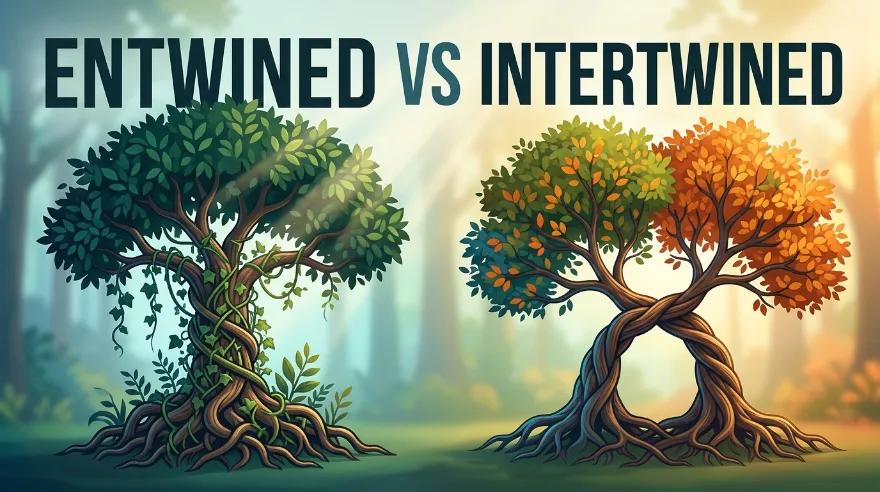
Choosing between entwined and intertwined can be confusing because both words describe things that are twisted, connected, or closely linked. Although they are often used interchangeably, each word can carry a slightly different emphasis depending on the context.
Understanding the difference between entwined vs. intertwined will help you choose the right word for your sentence. In this guide, you will learn their meanings, explore simple examples, and discover how to use both words naturally in everyday and professional writing.
Entwined vs Intertwined: The Basic Rule and Key Difference
At their core, both entwined and intertwined describe things that become connected by twisting around each other.
The biggest difference is emphasis.
- Entwined usually highlights the act of wrapping around something or becoming closely connected.
- Intertwined emphasizes that multiple things wrap around one another, creating a mutual relationship.
Think of it this way.
If one vine wraps around a fence, it is often entwined.
If two vines wrap around each other, they are intertwined.
In modern English, many dictionaries recognize overlapping meanings, but this subtle distinction still appears in careful writing.
When to Use Entwined
Use entwined when focusing on one object wrapping around another or when emphasizing a close connection without stressing equal interaction.
Examples include:
- The ivy became entwined around the stone wall.
- Their memories remained entwined with the old neighborhood.
- A ribbon was entwined around the bouquet.
The emphasis stays on the wrapping or close association.
When to Use Intertwined
Use intertwined when several elements twist together and influence one another equally.
Examples include:
- Their fingers became intertwined.
- The branches were intertwined overhead.
- Culture and history are intertwined throughout the region.
The relationship feels more balanced and mutual.
Side-by-Side Comparison Table
| Situation | Entwined | Intertwined | Better Choice |
| One vine wraps around a pole | ✔ | Possible | Entwined |
| Two ropes twist together | Possible | ✔ | Intertwined |
| Two lives deeply connected | ✔ | ✔ | Usually Intertwined |
| Ribbon around flowers | ✔ | Less common | Entwined |
| Two tree roots growing together | Possible | ✔ | Intertwined |
| Business relationships | Possible | ✔ | Intertwined |
| One bracelet around a wrist | ✔ | Rare | Entwined |
| Shared histories | Possible | ✔ | Intertwined |
Deep Dive into Entwined
When Should You Use Entwined?
Entwined often focuses on a single action.
Something wraps around another object.
It can also describe emotional attachment, symbolic relationships, or poetic connections.
Examples include:
- The vines were entwined around the ancient gate.
- Her dreams became entwined with reality.
- Gold thread was entwined throughout the fabric.
- The necklace became entwined in her hair.
- Tradition remained entwined with daily life.
Notice something.
The emphasis is not always on equal participation.
Instead, one thing often surrounds or becomes attached to another.
Examples Across Different Contexts
Nature
- Moss entwined the old tree trunk.
- Ivy entwined every brick.
Literature
- Fate became entwined with destiny.
- Their hopes remained entwined for decades.
Business
- The company’s reputation became entwined with customer trust.
Relationships
- His childhood was forever entwined with the village.
Quick Test
Choose entwined if you can answer “yes” to most of these.
- Is one object wrapping around another?
- Is mutual interaction less important?
- Are you emphasizing attachment?
- Does one thing seem to surround another?
If yes, entwined probably fits best.
Deep Dive into Intertwined
When Should You Use Intertwined?
Intertwined places more attention on mutual interaction.
Every part connects with every other part.
Nothing stands alone.
Examples include:
- Their arms became intertwined.
- Politics and economics are intertwined.
- Multiple cables were intertwined beneath the desk.
- Their careers became intertwined over time.
- Art and culture are deeply intertwined.
The relationship feels balanced.
Both sides affect each other.
Common Patterns
Physical Objects
- intertwined roots
- intertwined branches
- intertwined wires
- intertwined threads
Ideas
- intertwined themes
- intertwined histories
- intertwined identities
- intertwined economies
People
- intertwined families
- intertwined friendships
- intertwined careers
- intertwined futures
Quick Pattern Recognition
Whenever several things twist together equally, intertwining usually sounds more natural.
How Entwined and Intertwined Differ in Meaning
Although dictionaries often list these words as synonyms, careful writers notice a slight difference.
Entwined often feels:
- More poetic
- More descriptive
- More focused on wrapping
- Slightly softer
Intertwined often feels:
- More analytical
- More formal
- More balanced
- Better for systems and relationships
Consider these examples.
“The vines were entwined around the fence.”
The image centers on the vine.
Now compare:
“The vines were intertwined.”
Now multiple vines twist around one another.
That tiny shift changes the picture readers imagine.
Why the Confusion Persists
Several reasons explain why writers mix these words.
First, dictionaries frequently define them using each other.
Second, modern writers increasingly treat them as synonyms.
Third, both words share the same root idea of twisting.
Another reason is that readers rarely notice the distinction unless precision matters.
Creative writers often choose whichever sounds smoother.
Journalists usually prefer intertwined when discussing economics, politics, technology, or society.
Novelists may favor entwined because it creates softer imagery.
As language evolves, overlap continues to grow.
Still, understanding the original emphasis improves word choice.
Formal vs Casual Contexts
Different settings often favor different vocabulary.
Academic Writing
Intertwined appears more frequently.
Examples:
- Social structures are intertwined.
- Environmental and economic factors remain intertwined.
Business Writing
Again, intertwined dominates.
Examples:
- Customer experience and profitability are intertwined.
- Supply chains are intertwined globally.
Creative Writing
Both words work well.
Entwining often creates stronger visual imagery.
Example:
- Moonlit vines entwined the forgotten bridge.
Everyday Conversation
Most speakers use either word naturally.
Few listeners notice the distinction.
Case Studies / Pop Culture Examples
Many novels describe lovers with intertwined fingers.
This phrase emphasizes that each person’s fingers weave together equally.
Fantasy literature frequently describes ivy entwined around castles.
The focus stays on the ivy surrounding the structure.
Historical documentaries often describe intertwined cultures, showing that each culture influences the other over centuries.
Business magazines frequently discuss intertwined global markets, highlighting mutual dependence.
Environmental research commonly explains that ecosystems are intertwined, where plants, animals, water, and climate all influence one another.
These examples reveal an interesting pattern.
Concrete wrapping often favors entwined.
Mutual systems often favor intertwined.
Advanced Scenarios & Flowchart
Use this simple decision guide.
Start here
→ Are two or more things twisting together equally?
→ Yes
Choose intertwined
→ No
Continue
→ Is one object wrapping around another?
→ Yes
Choose entwined
→ No
Continue
→ Are you discussing connected ideas or systems?
→ Yes
Usually choose intertwined
→ No
Either word may work depending on emphasis.
Quick Reference Table
| If You Mean… | Best Choice |
| One thing wrapped around another | Entwined |
| Equal twisting together | Intertwined |
| Connected economies | Intertwined |
| Ivy around a wall | Entwined |
| Shared histories | Intertwined |
| Ribbon around flowers | Entwined |
| Multiple branches crossing | Intertwined |
| Poetic visual imagery | Usually Entwined |
Common Mistakes That Lower Quality
Even experienced writers make these mistakes.
Using intertwined for single-direction wrapping
Incorrect:
- The ribbon was intertwined around the gift.
Better:
- The ribbon was entwined around the gift.
Using entwined for mutual systems
Less precise:
- Technology and education are entwined.
Better:
- Technology and education are intertwined.
Ignoring emphasis
Sometimes both words are technically acceptable.
Choosing the better emphasis creates stronger writing.
Forgetting context
Creative writing often allows flexibility.
Academic writing usually benefits from greater precision.
Overthinking the distinction
Many professional editors accept either word when the meaning remains clear. Do not force a replacement if both versions communicate the intended idea naturally.
Memory Hacks That Actually Work
Remember this simple trick.
Entwined = Enclose.
The letters “En” can remind you of enclosing or wrapping around something.
Now try another.
Intertwined = Interaction.
The prefix inter- often means between or among.
That fits perfectly because multiple things interact equally.
Another visual memory works well.
Imagine a ribbon.
It wraps around a present.
Think entwined.
Now imagine two ropes braided together.
Think intertwined.
One more shortcut.
Single direction?
Choose entwined.
Mutual direction?
Choose intertwined.
Why Precision Matters (SEO/Authority)
Precise vocabulary improves more than grammar.
It strengthens authority.
Readers notice careful word choices even if they cannot explain why one sentence feels smoother than another. Subtle accuracy builds trust, especially in educational, legal, technical, and professional writing.
Search engines also reward content that demonstrates topical depth and semantic relevance. Using entwined and intertwined appropriately helps create richer language that matches user intent more accurately.
Editors appreciate precise wording because it reduces ambiguity. Clear language speeds comprehension and minimizes misunderstandings for readers.
Professional writers, marketers, and educators also benefit. Small improvements in vocabulary create stronger articles, more persuasive copy, and better educational materials.
In competitive publishing, tiny details separate average content from authoritative content.
Choosing the right word is one of those details.
A Quick Quiz
Fill in the blanks with entwined or intertwined.
- The ivy became __________ around the old brick chimney.
- The two rivers appeared __________ before reaching the lake.
- Their fingers remained __________ throughout the ceremony.
- The ribbon was carefully __________ around the package.
- Science and technology have become increasingly __________.
- Her memories were forever __________ with the small coastal town.
- Several tree roots were __________ beneath the forest floor.
Answer Key
- entwined
- intertwined
- intertwined
- entwined
- intertwined
- entwined
- intertwined
Conclusion
Choosing between entwined and intertwined depends on the meaning you want to convey. Entwined often describes things wrapped around each other or closely connected, while intertwined commonly emphasizes how people, ideas, or events are linked and influence one another. Although the two words are often interchangeable, understanding their subtle differences can help you choose the most suitable word for your sentence.
When writing stories, articles, academic papers, or professional content, focus on the context rather than memorizing strict rules. Use the word that expresses your intended meaning most clearly. With practice, you will find it easier to use entwined vs. intertwined naturally and make your writing more precise and effective.
Frequently Asked Questions
Is entwined grammatically correct?
Yes, entwined is a completely correct English word and has been used for centuries in both literal and figurative writing. It commonly describes something wrapped around another object or closely connected with it. Although it sometimes overlaps with intertwined, it often carries a slightly more poetic or descriptive tone, especially when discussing vines, ribbons, memories, emotions, or symbolic relationships.
Can entwined and intertwined be used interchangeably?
In many everyday situations, they can be used interchangeably without changing the overall meaning. However, careful writers often distinguish between them based on emphasis. Entwined usually focuses on wrapping or attachment, while intertwined emphasizes multiple elements twisting together or influencing each other equally. Choosing the more precise option can make your writing clearer and more expressive.
Which word is more common in academic writing?
Intertwined appears more frequently in academic, scientific, and professional writing because it effectively describes interconnected systems, ideas, cultures, economies, and relationships. Researchers often discuss concepts that mutually affect one another, making intertwined the more natural choice. Entwined still appears in scholarly work but is generally less common outside literary or descriptive contexts.
Should I use entwined or intertwined for relationships?
Both words can describe relationships, but the intended meaning matters. If you’re emphasizing two people whose lives, emotions, or futures influence one another equally, intertwined is usually the stronger choice. If you’re highlighting attachment, closeness, or poetic imagery rather than mutual interaction, entwining may create a more vivid and emotional effect.
Why do dictionaries define these words so similarly?
Dictionaries often define entwined and intertwined using similar language because their meanings overlap significantly. Both involve twisting, connecting, or joining together. However, dictionaries also reflect actual language use, and modern speakers frequently use the terms as synonyms. Style guides and experienced writers often preserve the subtle distinction to achieve greater precision and improve clarity.
Which word sounds more formal?
Generally, intertwined sounds slightly more formal because it frequently appears in academic articles, business reports, journalism, and technical writing. It conveys interconnected systems and mutual influence with precision. Entwined often feels more literary or poetic, making it especially effective in storytelling, descriptive writing, and creative nonfiction where imagery plays an important role.
Can I describe physical objects as intertwined?
Absolutely. Intertwined is commonly used for physical objects that twist around one another, such as branches, roots, ropes, wires, fingers, or strands of hair. The key idea is that multiple objects are woven together rather than one simply wrapping around another. This mutual interaction is what distinguishes intertwined from many uses of entwined.
Which word is better for SEO writing?
The best choice depends on context rather than search rankings. SEO content performs better when it uses vocabulary naturally and accurately. If you’re describing mutual relationships, systems, or connected ideas, intertwined is often the better fit. If you’re describing wrapping, attachment, or poetic imagery, entwined may communicate the idea more effectively while improving readability and user experience.
How can I quickly remember the difference?
A simple memory trick is to focus on the prefix inter-, which means “between” or “among.” That makes intertwined easy to associate with mutual interaction between multiple things. Think of entwined as one object enclosing or wrapping around another. This quick mental shortcut helps you choose the correct word without overthinking the distinction.

Elliot Mason is a passionate English writer dedicated to making language learning clear, practical, and enjoyable. As an author at Grammar Alpha, he creates helpful content covering grammar, vocabulary, word meanings, sentence structure, common mistakes, and everyday English usage. His straightforward articles are designed for students, professionals, and English learners who want to communicate with greater confidence. Elliot believes that better English begins with understanding the basics, and his goal is to turn challenging language concepts into simple, useful lessons readers can apply every day.