
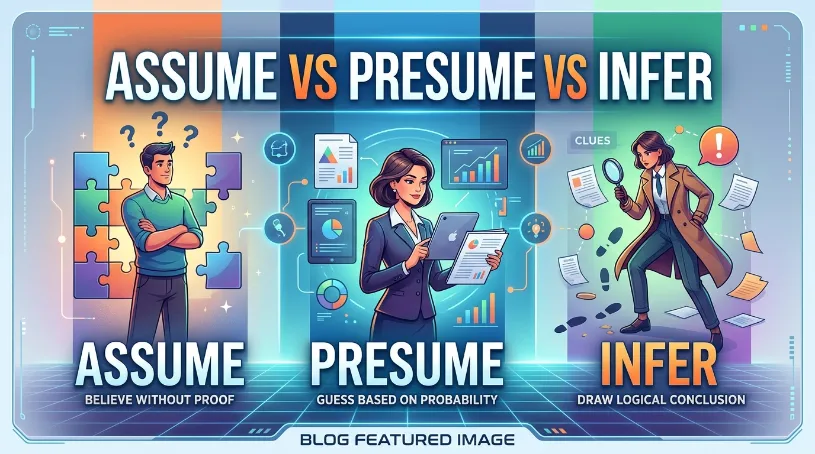
Assume vs presume vs infer is one of the most misunderstood grammar topics in English. Although these three verbs all involve reaching a conclusion, they describe different ways of thinking. Using the wrong one can make your writing unclear, weaken your argument, or even change the meaning of your sentence.
The good news is that the distinction is easier than it seems. Once you understand where the conclusion comes from, choosing the right word becomes almost automatic. Assume is based on little or no evidence. Presume is based on reasonable probability or accepted facts. Infer is based on evidence and logical reasoning.
Here’s the key idea.
The person making a guess is not always doing the same thing. Sometimes they’re assuming. Sometimes they’re presuming. Other times they’re inferring from clues. Understanding that difference will immediately improve your speaking and writing.
Assume vs Presume vs Infer: The Core Rule Explained Simply
Think about how you reached your conclusion.
- Assume = Accept something as true without enough proof.
- Presume = Accept something as true because there’s reasonable evidence or a common expectation.
- Infer = Draw a conclusion from evidence or clues.
The biggest difference is the quality of the evidence.
If there is almost none, you assume.
There is some logical basis, you presume.
You carefully analyze evidence before reaching a conclusion, you infer.
Assume: A Guess Without Strong Evidence
An assumption often fills in missing information.
Examples:
- I assumed the meeting started at 9:00.
- Don’t assume everyone agrees.
- She assumed he knew the address.
In each example, the speaker accepts something without confirming it.
Presume: A Reasonable Expectation
A presumption usually has some support.
Examples:
- We presume the package arrived because tracking says it was delivered.
- The court presumes a defendant innocent until proven guilty.
- I presumed you had already finished because your office was empty.
Notice that each conclusion has some logical reason behind it.
Infer: A Logical Conclusion
To infer means to examine evidence first.
Examples:
- I inferred from her smile that she liked the proposal.
- Scientists infer climate patterns from collected data.
- Readers infer a character’s emotions through dialogue.
Unlike assuming, inferring depends on observable evidence.
Assume vs Presume vs Infer: Side-by-Side Comparison Table
| Situation | Assume | Presume | Infer |
| Evidence available | Little or none | Some evidence | Strong evidence |
| Confidence level | Low | Moderate | High |
| Thinking process | Guessing | Expecting logically | Reasoning from facts |
| Example | I assumed you were home. | I presumed you were home because your car was outside. | I inferred you were home after seeing lights, hearing music, and noticing your car. |
| Academic writing | Less preferred | Sometimes appropriate | Very common |
| Legal contexts | Rare | Extremely common | Common |
| Based on clues | Usually no | Sometimes | Always |
| Main idea | Accept without proof | Accept with reasonable expectation | Conclude from evidence |
Deep Dive into Assume
When to Use Assume
Use assume whenever information is missing and you’re making an unverified conclusion.
Typical situations include:
- First impressions
- Everyday guesses
- Missing details
- Unconfirmed beliefs
Examples:
- I assumed the restaurant was open.
- We assumed the exam would be easy.
- She assumed he understood the instructions.
Notice that none of these statements mention actual evidence.
Examples of Assume
Incorrect thinking:
You see dark clouds and immediately assume it will rain.
Better thinking:
Dark clouds alone don’t guarantee rain.
You simply made an assumption.
Another example:
Someone doesn’t answer your message.
You assume they’re ignoring you.
In reality, they may simply be busy.
Quick Test for Assume
Use assume if these statements are true:
- I don’t really know.
- I haven’t checked.
- I’m filling in missing information.
- My conclusion could easily be wrong.
If yes, assume is probably correct.
Deep Dive into Presume
When to Use Presume
Use presume when probability supports your conclusion.
There is evidence, but not complete certainty.
Common situations include:
- Professional communication
- Legal language
- Polite conversation
- Reasonable expectations
Examples:
- I presumed the office was closed because the lights were off.
- We presume good faith during negotiations.
- Parents often presume their children are safe at school.
Patterns of Presume
Notice these common sentence structures:
- Presume that…
- Presume someone is…
- Presume something happened…
Examples:
- I presume that everyone received the email.
- We presumed she understood the policy.
- They presumed the train would arrive on schedule.
Quick Test for Presume
Ask yourself:
- Do I have some reason to believe this?
- Is this the normal expectation?
- Would most people reach the same conclusion?
If yes, choose presume.
Deep Dive into Infer
When to Use Infer
Use infer when you’re actively analyzing evidence.
You observe facts first.
Then you reach a conclusion.
Examples:
- Detectives infer motives from evidence.
- Teachers infer understanding from student answers.
- Historians infer events from historical documents.
- Doctors infer medical conditions from symptoms.
Patterns of Infer
Common structures include:
- Infer that…
- Infer from…
- Infer something about…
Examples:
- I inferred that she was nervous.
- Scientists inferred the age from carbon dating.
- Readers infer meaning from context.
Quick Test for Infer
Ask yourself:
- Am I examining evidence?
- Can I explain how I reached this conclusion?
- Would someone else reach the same conclusion using these facts?
If yes, use infer.
The Meaning Shift
These three words may describe similar situations, but the degree of evidence changes everything.
Consider this example.
Assume
“I assumed Alex was home.”
No explanation.
Just a guess.
Presume
“I presumed Alex was home because his bicycle was outside.”
Now there’s a reason.
Infer
“I inferred Alex was home after seeing his bicycle, hearing music upstairs, and watching lights turn on.”
Now the conclusion comes from multiple clues.
That progression, guess, reasonable expectation, evidence-based conclusion, perfectly captures the relationship among these verbs.
Why the Confusion Persists
Several reasons explain why people mix these words.
First, all three involve reaching conclusions.
Second, many dictionaries describe them using similar language.
Third, everyday conversation rarely distinguishes between different kinds of reasoning.
Education also contributes to the confusion.
Many grammar lessons simply define all three as “making a conclusion.”
That oversimplification ignores the quality of evidence, which is the real difference.
Modern media also blends these words freely.
News articles, blogs, and casual conversations often use assume, presume, and infer interchangeably, even though careful writers avoid doing so.
Assume vs Presume vs Infer in Formal and Casual Contexts
Context influences which word sounds most natural.
Casual Conversation
People often default to assume.
Examples:
- I assumed you were busy.
- Don’t assume the worst.
- We assumed everything was fine.
This sounds natural in everyday speech.
Professional Writing
Professional writers prefer greater precision.
Examples:
- Researchers inferred a relationship between the variables.
- Attorneys presume innocence.
- Analysts inferred market trends from sales reports.
Formal writing rewards accurate word choice.
Academic Context
Academic writing overwhelmingly favors infer whenever conclusions come from data.
Examples:
- Students inferred the author’s purpose.
- Scientists inferred migration patterns.
- Researchers inferred statistical significance.
Using assume in these situations often weakens the credibility of the statement because it suggests insufficient evidence.
Case Studies / Pop Culture Examples
Detective Stories
Detectives rarely assume.
They infer.
Sherlock Holmes examines footprints, clothing, handwriting, and behavior before drawing conclusions.
Every conclusion comes from evidence.
Courtrooms
Courts usually presume innocence.
That presumption exists until evidence proves guilt.
This illustrates why presume often appears in legal English.
Scientific Research
Scientists avoid assumptions whenever possible.
Instead, they collect observations.
From those observations, they infer patterns, causes, or relationships.
Everyday Workplace
Imagine your coworker hasn’t arrived.
You assume they’re late without knowing the reason.
If highways are closed, you might presume they’re stuck in traffic.
After seeing an email from HR, a calendar cancellation, and an automatic out-of-office reply, you can infer they called in sick.
Each version reflects a different level of evidence.
Advanced Scenarios & Flowchart
Choosing between these words becomes easier when you follow a simple decision process.
Start here:
Is there evidence?
No.
Use assume.
Yes.
Is the evidence only enough to create a reasonable expectation?
Yes.
Use presume.
No.
Did you analyze facts or clues before reaching the conclusion?
Yes.
Use infer.
No.
Use presume.
This decision tree works in almost every writing situation.
Assume vs Presume vs Infer: Quick Reference Table
| Word | Best Used When |
| Assume | You have little or no evidence. |
| Presume | You have reasonable grounds for believing something. |
| Infer | You analyze evidence before concluding. |
| Assumption | A guess without confirmation. |
| Presumption | A reasonable expectation. |
| Inference | A conclusion supported by evidence. |
| Best academic choice | Infer |
| Best legal choice | Presume |
Conclusion
Choosing between assume, presume, and infer is ultimately about understanding how a conclusion is reached. When you accept something as true without checking the facts, you assume. A reasonable expectation or common circumstance may lead you to presume something. Careful examination of facts, clues, or evidence allows you to infer a conclusion. While these words are closely related, they are not interchangeable in precise writing. Mastering this distinction improves clarity, reduces ambiguity, and helps readers understand exactly how confident you are in your statement. Whether you’re writing an email, an academic paper, a business report, or a blog post, selecting the correct verb strengthens your message and demonstrates a better command of English grammar.
The easiest way to remember the difference is to focus on the amount of evidence involved. Assume begins with little or no proof, presume relies on reasonable probability, and infer depends on logical analysis of available evidence. Once you build the habit of asking yourself, “What evidence supports this conclusion?” the correct word usually becomes obvious. Over time, this simple mental check will make your writing more accurate, persuasive, and professional. Readers notice precise language, even if they cannot explain why it sounds better. By consistently using these three verbs correctly, you’ll communicate ideas with greater confidence and earn more credibility in both formal and everyday situations.
Frequently Asked Questions
Is assume always a negative word?
No. Assume is not inherently negative. It simply means accepting something as true without sufficient proof. While assumptions can lead to mistakes, they are also a natural part of everyday decision-making. The important point is recognizing that an assumption lacks confirmation, making it less reliable than a presumption or an inference based on evidence.
What is the main difference between presume and assume?
The biggest difference is the amount of supporting evidence. When you assume, you have little or no proof. When you presume, you have some logical reason or accepted expectation that supports your belief. A presumption is generally more justified than an assumption, although it still falls short of complete certainty.
Can infer and imply be used interchangeably?
No. They describe opposite sides of communication. A speaker or writer implies something by suggesting it indirectly. A listener or reader infers that meaning by interpreting clues or evidence. Remember this relationship: the sender implies, while the receiver infers. Mixing them up is one of the most common grammar mistakes.
Why is infer preferred in academic writing?
Academic writing values evidence-based conclusions. Researchers collect data, analyze results, and then infer patterns, relationships, or explanations from that evidence. Using assume in place of infer can suggest unsupported reasoning, which weakens the credibility of an academic argument or research paper.
Why does legal English often use presume?
Legal systems rely on established principles rather than unsupported guesses. For example, courts presume innocence until guilt is proven with evidence. This means innocence is accepted as the default position unless facts demonstrate otherwise. The word reflects a reasonable legal standard instead of an arbitrary assumption.
Can you infer something without direct proof?
Yes. An inference does not require direct proof, but it does require evidence. You might infer that someone is tired because they are yawning, rubbing their eyes, and speaking slowly. Although none of these clues proves the conclusion by itself, together they provide a logical basis for your inference.
Which word should I use in professional emails?
It depends on the situation. If you’re making an unsupported guess, use assume carefully. If you’re referring to a reasonable expectation, presume may fit better. When discussing observations or conclusions drawn from data, infer is often the strongest and most precise choice. Matching the word to the evidence makes professional communication more credible.
How can I quickly decide between assume, presume, and infer?
Ask yourself one simple question: How much evidence do I have? With almost no evidence, choose assume. When you have reasonable grounds but not definitive proof, choose presume. After analyzing facts or clues before reaching your conclusion, choose infer. This quick test works in nearly every writing situation.
Do native English speakers confuse these words?
Yes. Even native speakers sometimes use these verbs interchangeably in casual conversation. However, skilled writers, editors, lawyers, researchers, and educators usually maintain the distinctions because each word communicates a different level of certainty and reasoning. Using them accurately makes your writing sound more polished and authoritative.

Alexander Brooks is an experienced English writer and language educator focused on helping readers build grammar, vocabulary, writing, and communication skills. At Grammar Alpha, he creates accurate, well-researched, and practical content designed for students, professionals, and English learners. His work explains grammar rules, word usage, sentence structure, and common mistakes in clear, accessible language. Alexander values accuracy, clarity, and trustworthy information, with a goal of making English learning easier while helping readers communicate confidently and effectively in professional and daily situations.